

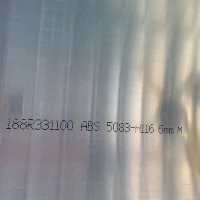




As an experienced aluminum plate supplier working directly with shipyards and marine engineers worldwide, GNEE frequently encounter procurement managers asking the following: "Which temper of EN 5083 aluminum should I specify for my hull design?"
Marine-grade aluminum alloys are the backbone of modern shipbuilding. While steel is traditional, the marine industry relies heavily on medium-hard aluminum alloys to reduce hull weight, increase speed, and maintain fuel efficiency under the same power conditions.
However, specifying just "EN 5083 aluminum" on a purchase order is a critical mistake. The alloy temper dictates whether your material will survive decades in harsh seawater or fail prematurely due to exfoliation corrosion.
In this guide, we cover technical properties and practical procurement standards of marine aluminum. At GNEE, we manufacture and supply classification society-certified aluminum materials, ensuring your maritime projects meet strict international safety codes.
1. The Core Material of EN 5083 Marine Grade Aluminum Plate
EN 5083 aluminum belongs to the 5000 series aluminum-magnesium (Al-Mg) alloy family. Magnesium (Mg) is the primary strengthening element, typically ranging from 4.0% to 4.9%. This specific magnesium content provides an optimal balance: it offers solid solution strengthening for high yield strength without requiring heat treatment, while simultaneously creating an incredibly tough oxide layer that resists seawater corrosion.
For commercial shipbuilding, yachts, and offshore platforms, the EN 5083 marine grade aluminum plate is the standard choice for hull plating, bulkheads, and flooring. Unlike 6000 series alloys, which lose significant strength after welding, 5083 retains excellent post-weld mechanical properties, allowing shipbuilders to construct entire vessels utilizing efficient continuous welding processes.
EN 5083 Aluminum Plate Chemical Composition Limit (Weight %):
| Alloy | Mg (%) | Mn (%) | Cr (%) | Fe (%) | Si (%) | Zn (%) | Ti (%) | Cu (%) | Al (%) |
|---|---|---|---|---|---|---|---|---|---|
| 5083 | 4.0 – 4.9 | 0.4 – 1.0 | 0.05 – 0.25 | ≤ 0.40 | ≤ 0.40 | ≤ 0.25 | ≤ 0.15 | ≤ 0.10 | Remainder |
EN 5083 Aluminum Plate Mechanical Properties
(Typical for H116 / H321, Thickness: 3 mm – 50 mm)
| Temper | Tensile Strength (Rm, MPa) | Yield Strength (Rp0.2, MPa) | Elongation (A50, %) | Exfoliation Corrosion Test |
|---|---|---|---|---|
| H116 / H321 | ≥ 305 | ≥ 215 | ≥ 10 | Pass (ASTM B928) |

2. Tempers of 5083 H111 and 5083 H112 Aluminum Sheets
When we supply materials to marine fabricators, the first tempers usually discussed are H111 and H112.
- 5083 H111 Aluminum Sheet: This temper means the material has undergone some strain hardening during the forming processes (like stretching or leveling) but less than the amount required for an H11 temper. H111 offers excellent ductility and bendability. It is frequently used for structural components inside the ship, bulkheads, and interior consoles where severe forming is required but direct exposure to continuous seawater splash is limited.
- 5083 H112 Aluminum Sheet: This indicates an alloy that is strain-hardened from working at an elevated temperature or has limited cold working.
While 5083 H111 and H112 aluminum sheets have excellent general corrosion resistance, in my operational experience, I do not recommend them for the exterior hull plating below the waterline for large commercial vessels. For sub-waterline applications, you need stabilized tempers to prevent long-term intergranular corrosion.
3.5083 H116 and 5083 H321 aluminum plate for Shipbuilding Aluminum
For hulls, decks, and any components directly exposed to seawater and salt spray, ship designers universally specify stabilized tempers.
- 5083 H116 Shipbuilding Aluminum: This temper is specifically engineered for high magnesium alloys (Mg > 3.0%). It undergoes special strain hardening and stabilization processes to guarantee resistance to exfoliation corrosion (flaking of the metal surface).
- 5083 H321 Shipbuilding Aluminum: Similar to H116, the H321 temper involves strain hardening followed by low-temperature stabilization.
What is the real difference? To the naked eye, none. Functionally, both are designed to pass the strict ASTM G66 (ASSET test for exfoliation corrosion) and ASTM G67 (NAMLT test for intergranular corrosion mass loss).
If you are buying materials for a yacht hull, a patrol boat, or a fishing vessel bottom, 5083 H116 and 5083 H321 marine aluminum plates are your mandatory choices. At GNEE, we rigorously test these specific tempers to ensure they will not suffer from structural degradation even after decades of continuous saltwater immersion.

4.5052, 5454, and 5086 Aluminum Alloy Plates
Although EN 5083 is the most commonly used aluminum alloy for marine applications, other 5000 series alloys should be selected for non-critical parts to optimize material cost and weight distribution.
- EN 5086 Aluminum Plates: Slightly lower Mg content than 5083. It is incredibly tough and often used for upper hull shells and patrol boat armor plating.
- 5052 and 5454 Aluminum Sheets: With lower magnesium levels (around 2.5% for 5052), these alloys have higher formability. Shipyards routinely utilize 5052 and 5454 to fabricate ship decks, upper outfitting panels, radar masts, and interior staircases. Using 5052 for superstructures reduces procurement costs while maintaining adequate marine atmospheric corrosion resistance.
5. EN 5083 Aluminum Alloy for LNG Storage
Beyond standard marine transport, the global shift towards clean energy has created massive demand for ocean transportation of Liquefied Natural Gas (LNG). LNG is stored at a cryogenic temperature of -162°C.
Traditional carbon steels become dangerously brittle at these extremely low temperatures. However, the EN 5083 aluminum alloy exhibits an outstanding metallurgical anomaly: its yield strength, tensile strength, and elongation actually increase at low temperatures without any loss in impact toughness. This makes 5083 aluminum plates the primary structural material for offshore low-temperature storage tanks, combustible ice containment vessels, and LNG carrier spheres.

6.The GNEE Advantage
Procuring marine aluminum is not like buying standard commercial metal. A single defective plate can cause a vessel to fail class inspections, delaying millions of dollars in project deliverables.
When you purchase EN 5083 marine grade aluminum from GNEE, you are ensuring:
- Classification Society Certifications: We supply materials certified by major global societies including DNV, ABS, LR, CCS, BV, and RINA.
- Strict Flatness Tolerances: Boat builders know that warped plates cause welding nightmares. We guarantee stringent flatness tolerances exceeding standard EN 485 specifications.
- Ready for Welding: Our 5083 plates pair perfectly with standard ER5183 or ER5356 welding wires using MIG/TIG processes, ensuring high-strength watertight seams.
Ready to secure high-quality marine aluminum for your next shipyard project?
Avoid the risk of substandard materials. Contact our technical sales team at GNEE today with your thickness, dimension, and temper requirements. We provide rapid quoting, transparent lead times, and global shipping logistics.


Click Here to Request a Quote for EN 5083 Aluminum Plates from GNEE


