When purchasing 1100 aluminum tread plate (also known as checker plate or diamond plate), buyers often face a choice between two common tempers: 1100 H14 and 1100 H24. Because they share the same 1100 pure aluminum base, they look completely identical. However, their internal structures dictate how they will perform on your factory floor or product assembly line.
Here is the direct answer you need:
- 1100 H14 offers easier forming and bending. It is suitable for light-duty use, wall protection, and decorative panels.
- 1100 H24 offers higher strength and structural stability. It is the absolute best choice for flooring, load-bearing platforms, and walkways.
Use 1100 H14 for processing and shaping; use 1100 H24 for durability and foot traffic.
Both 1100 H14 and 1100 H24 aluminum tread plates feature the exact same raised diamond or 5-bar patterns. These raised patterns provide traction to prevent slipping. Both have a bright, silver mill finish.
The difference lies entirely in how they react to physical pressure. If you place a sheet of H14 on a walkway, heavy foot traffic or rolling carts may eventually cause the sheet to warp slightly, and the raised pattern may wear down faster. If you use 1100 H24, the sheet remains flat, and the anti-slip pattern holds its shape firmly under pressure.
Core Differences Between 1100 H14 vs H24 Aluminum Tread Plate
| Property | 1100 H14 Aluminum Tread Plate | 1100 H24 Aluminum Tread Plate |
| Temper Meaning | Half Hard (Strain hardened) | Half Hard (Strain hardened & stabilized) |
| Mechanical Strength | Medium | Higher |
| Material Hardness | Medium | Higher |
| Formability | Good (Easy to bend) | Moderate (Stiffer to bend) |
| Anti-Deformation | Medium | Strong (Resists warping under loads) |
| Best End Use | Bending, forming, wall panels | Flooring, structural walkways, ramps |
Key Conclusion: 1100 H24 is much more durable, making it the superior choice for actual tread plate applications where people or equipment will stand on it.

Mechanical Properties of 1100 H14 vs H24 Aluminum
| Mechanical Property | 1100 H14 Value | 1100 H24 Value |
| Tensile Strength (Rm) | 90 – 120 MPa | 100 – 130 MPa |
| Yield Strength (Rp0.2) | ≥ 35 MPa | ≥ 45 MPa |
| Elongation (%) | ≥ 5% | ≥ 6% |
The Technical Explanation:
1100 H14 (Strain Hardened): The aluminum is rolled through cold mills to reach a "half-hard" state. It increases strength but leaves internal stress inside the metal. Over time, or under pressure, this internal stress can cause the plate to warp or bend.
1100 H24 (Stabilized): The aluminum is cold-rolled just like H14, but then it is put through a low-temperature thermal treatment. This "stabilizes" the metal, removing the internal stress without losing the hardness. As a result, an H24 tread plate stays perfectly flat when cut and resists long-term deformation.

Why is 1100 H24 Highly Recommended for Aluminum Flooring?
For standard flat aluminum sheets, the difference between 1100 H14 and 1100 H24 might not be very noticeable. However, for aluminum tread plate, the difference is critical.
Aluminum tread plates are almost exclusively used for environments requiring traction-which means things will be walking, rolling, or dropping on them constantly.
- Wear Resistance of the Pattern: The raised diamonds or bars on an 1100 H14 aluminum plate are slightly softer. Under the continuous friction of heavy work boots or industrial trolley wheels, the pattern will flatten over time, losing its anti-slip capability. The stabilized 1100 H24 temper keeps the pattern crisp and aggressive for a much longer lifespan.
- Load-Bearing Stability: Flooring plates span across joists or frames. 1100 H14 may slowly bow or sag in the middle over time due to repeated weight. 1100 H24 maintains its structural rigidity, ensuring a safe, flat walking surface.
Conclusion: If you are building flooring, a truck bed, or an industrial platform, always prioritize the 1100 H24 aluminum tread plate.
Application Comparison of 1100 H14 vs 1100 H24 Aluminum Diamond Plate
Applications for 1100 H14 Aluminum Tread Plate
Use this material when you need the anti-slip or industrial look, but the metal won't bear heavy loads, and you need to bend it into shapes.
- Decorative Wall Panels: Used in garages, gyms, or retail stores for a rugged industrial appearance.
- Light Forming Parts: Toolboxes, corner guards, and custom protective trim that require folding the metal 90 degrees.
- Non-Load Applications: Kick plates on doors or interior linings of lightweight trailers.
Applications for 1100 H24 Aluminum Tread Plate
Use this material when safety, traction, and durability are your top priorities.
- Flooring and Walkways: Factory floors, catwalks, and pedestrian bridges.
- Truck Beds & Trailers: The floor of delivery trucks and utility trailers where cargo is constantly dragged across the surface.
- Stairs and Ramps: Wheelchair ramps, industrial stair treads, and loading dock boards.
- Industrial Platforms: Offshore rigs, chemical plants, and heavy machinery operator decks.

Quick Selection Guide for Purchasing Managers
To prevent ordering the wrong material, use this simple guide to match your project with the correct temper.
| Your Application | Recommended Temper | Why? |
| Decorative Walls / Trim | 1100 H14 | Easy to cut, bend, and install. |
| Light Duty / Toolboxes | 1100 H14 | Forms easily into box shapes without cracking. |
| Pedestrian Flooring | 1100 H24 | Resists wear, stays flat, and maintains traction. |
| Heavy-Duty / Truck Beds | 1100 H24 | High yield strength to handle cargo and rolling carts. |
Ready to buy aluminum tread plate?
Send your application details to us. We will calculate your required dimensions and provide a competitive custom aluminum tread plate price based on today's market.
Recommended Thickness for Aluminum Tread Plate
Choosing the right temper is only step one. Choosing the correct thickness ensures safety. If your tread plate is too thin, it will buckle, regardless of the temper. Here is GNEE's standard thickness recommendation guide based on base thickness (excluding the pattern height):
| Application Category | Recommended Thickness | Recommended Temper |
| Decorative / Wall Protection | 1.0 mm – 2.0 mm | 1100 H14 |
| Light Pedestrian Flooring | 2.0 mm – 3.0 mm | 1100 H24 |
| Heavy-Duty Flooring (Carts/Cargo) | 3.0 mm – 6.0 mm | 1100 H24 |
Safe Export Packaging
Aluminum tread plate is heavy, and its edges can be easily damaged during ocean freight. GNEE utilizes a strict seaworthy packaging protocol to ensure your goods arrive without damage.
Our Standard Export Packaging Process:
- Moisture Protection: The plates are wrapped in waterproof kraft paper and sealed in plastic film to prevent white rust caused by sea humidity.
- Palletizing: Placed on strong, fumigation-free wooden pallets designed to support heavy metal weight.
- Securing: Bound tightly with heavy-duty steel strapping.
- Edge Protection: Galvanized steel corner protectors are added under the straps so the steel does not cut into the aluminum edges.
Strict Quality Inspection Process
As a leading aluminum flooring supplier, GNEE does not compromise on safety. Every batch of 1100 aluminum tread plate undergoes rigorous quality control before shipment.
- Chemical Composition Test: Spectrometers ensure the aluminum purity meets the 1100 grade standards (≥99.0% Al).
- Mechanical Properties Test: We verify the tensile and yield strength to guarantee you receive true H14 or H24 temper.
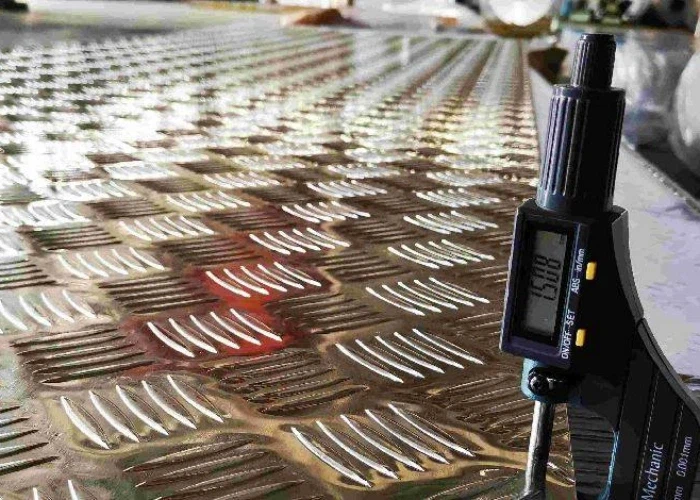
- Thickness & Flatness Inspection: Micrometers and lasers check that the base thickness and overall flatness meet ASTM tolerances.
- Surface Quality Check: Visual inspections ensure no oil stains, oxidation, or deep scratches.
- Pattern Depth Inspection (Crucial): We strictly measure the height of the raised diamonds or bars. If the pattern is too shallow, it will not provide enough traction. We guarantee deep, crisp, and aggressive patterns for maximum safety.
The GNEE Production Process
Our production flows from Ingot Melting → Hot/Cold Rolling → Annealing/Stabilizing → Embossing (Pattern Stamping) → Tension Leveling → Cutting → Final Inspection.
Because we use advanced embossing rollers, our tread patterns are sharp, uniform, and highly resistant to wear.
International Certifications & Backing
You need a supplier you can trust. GNEE manufactures strictly according to international standards, ensuring your material passes all local building and safety codes.
Standards Compliant: ASTM B209, EN 485, GB/T 3880.
Third-Party Inspections: We fully support inspections by SGS, BV, or TUV before shipment.
Mill Test Certificate (MTC): Provided with every single order, showing the exact chemical and mechanical testing results for your batch.

Why Choose GNEE Aluminum?
Finding a reliable aluminum tread plate factory saves you time and secures your profit margins.
- 18+ Years of Experience: We specialize in aluminum manufacturing and deep processing.
- Full Range Supply: From 1000 series to 5000 series (like the marine-grade 5052 tread plate).
- Fast Delivery: Massive production capacity ensures typical lead times of 15 to 25 days.
- Global Export: A reliable supplier providing global aluminum solutions to over 100+ countries with zero shipping damage complaints.

Secure Your Aluminum Tread Plate Supply Today
Whether you need easy-to-form H14 panels for toolboxes or rugged H24 plates for industrial flooring, GNEE has the material and the manufacturing capacity to deliver.