


Looking for the best ceiling panel material? 3003-H24 aluminum is the industry standard. It balances strength, cost, and formability perfectly. Here is why 3003-H24 outperforms other alloys and how to source the right specifications for your commercial interior projects.
Why Choose 3003-H24 Aluminum Plate
When contractors look for interior decorative panels, they often start by comparing the 1000 series and the 3000 series. 1100 aluminum sheet is commercially pure aluminum. It is highly ductile and very cheap. However, it lacks structural strength.
If you use 1100 aluminum for ceiling panels, especially large spans like 600x1200mm tiles, the material will sag under its own weight over time.
The 3003-H24 aluminum plate belongs to the Al-Mn (Aluminum-Manganese) alloy family. The addition of manganese increases its strength by about 20% compared to the 1100 series. This means a 3003 aluminum panel can maintain absolute flatness across a large ceiling grid without requiring you to increase the material thickness, saving you overall project costs.
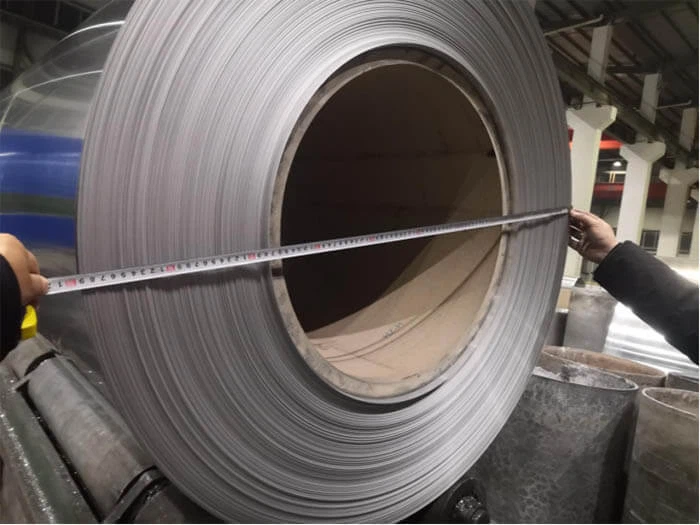
Specs of 3003 Aluminum Coil
To ensure seamless production of interior panels, your raw material needs to meet strict dimensional standards. Below is the standard specification data for our interior application coils.
| Item | Specification Parameter |
| Alloy Grade | 3003 Aluminum |
| Temper | H24 (Strain-hardened and partially annealed) |
| Thickness Range | 0.4 mm – 1.0 mm |
| Max Width | Up to 2650 mm |
| Core ID | 405 mm / 505 mm / 20 inches |
| Density | ~2.73 g/cm³ |
| Surface Finish | PE Coating, PVDF Coating, Embossed, Laminated |
Why 3003-H24 Aluminum Panel Beats H14 Temper
In the aluminum industry, temper is just as important as the alloy grade. You will often see suppliers quoting 3003-H14 or 3003-H24.
H14 means the aluminum is strain-hardened to a half-hard condition. H24 means it is strain-hardened and then partially annealed. While both have similar tensile strength, their internal stress levels are completely different.
Interior ceiling panels require a lot of processing. You need to punch holes for ventilation or acoustics, bend the edges for clip-in systems, and shear the sheets. When you punch a 3003-H14 sheet, the release of high residual internal stress often causes the panel to warp or bow.
3003-H24 aluminum panel, because of the partial annealing process, has much lower residual stress. When you punch thousands of acoustic microholes into an H24 sheet, it stays perfectly flat. It also bends 90 degrees at the edges without developing micro-cracks, reducing your factory's scrap rate.
Processing 3003-H24 Aluminum Plate
1. Stamping and Deep Drawing
Many modern ceiling tiles feature 3D geometric patterns or recessed edges. 3003-H24 has excellent elongation properties. It flows smoothly into stamping dies without tearing or wrinkling. This allows for the creation of intricate custom architectural panels with very low yield loss.
2. Roll Forming
For manufacturing linear baffle ceilings (the long, U-shaped vertical slats you see in shopping mall corridors), roll forming is the standard method. The 3003-H24 aluminum coil offers highly predictable springback. Once your engineers calibrate the roll forming line, the 3003-H24 material will hold its profile consistently from the first meter of the coil to the last.
3. Tool Wear and CNC Machining
Because 3003 is relatively soft compared to high-magnesium aerospace alloys, it is extremely gentle on your factory tooling. Your punch pins, shear blades, and routing bits will last significantly longer when cutting 3003-H24 aluminum sheet, drastically reducing your machine downtime and maintenance costs.
Are your current aluminum panels warping after CNC punching or cracking during 90-degree edge bending? The root cause is likely uncontrolled internal stress.

Click here to request a free sample of our tension-leveled 3003-H24 aluminum sheet. Run it through your own press brake and punch press to see the difference in flatness and formability.
Surface Coatings on Color Coated 3003 Aluminum Coil
1. PE (Polyester) Spray and Roller Coating
For 90% of indoor ceiling environments, PE coating is the standard choice. It provides a highly uniform, smooth finish with excellent color saturation. Because interior ceilings are not exposed to harsh UV sunlight, acid rain, or extreme weather, PE coating offers more than enough durability while keeping the PE coated 3003 aluminum sheet price highly competitive. It is available in matte, high-gloss, or metallic finishes.
2. Wood Grain and Stone PET/PVC Lamination
Modern commercial interiors frequently feature ceilings that look like timber wood or solid marble. However, real wood is heavy, prone to rotting, and fails commercial fire safety codes. To solve this, factories apply decorative PVC or PET films directly onto the 3003-H24 aluminum sheet. The rigid yet flat nature of the H24 temper ensures that the lamination process is perfectly smooth, with no trapped air bubbles or surface ripples.
3. PVDF Coating for Semi-Outdoor Areas
If your decorative panels are being installed in semi-open transition zones-like a subway entrance, an airport terminal with massive glass skylights, or a building canopy-PVDF coating is recommended. It offers extreme resistance to UV fading, ensuring your 3003 aluminum panels maintain their exact color tone for over 20 years.
Uses of 3003-H24 Aluminum Sheet in Daily Life
- Grid Ceiling Systems: Walk into any modern hospital, bank, or corporate office, and look up. You will see white, square aluminum tiles. These are usually 3003-H24 aluminum panels. Their lightweight nature (weighing only about 2.73 g/cm³) means the overhead suspension grid does not need heavy structural reinforcement, making installation incredibly fast and safe for contractors.
- Perforated Acoustic Wall and Ceiling Panels: Inside university lecture halls, public libraries, and concert venues, echo cancellation is critical. Factories punch thousands of precise micro-holes into 3003-H24 aluminum sheets and attach a sound-absorbing acoustic fleece to the back. Even with 30% of the metal removed by punching, the H24 panel maintains its structural integrity and stays flat against the wall framing.
- Aluminum Honeycomb Composite Ceilings: For massive hotel lobbies where designers want continuous, ultra-large ceiling panels without any visible grid lines, 3003-H24 is used as the top and bottom skin. It is sandwiched around an aluminum honeycomb core. This creates a panel that is thick and impossibly rigid, yet light enough to be handled by two workers.
read more:3003-punched-aluminium-sheet.html


