

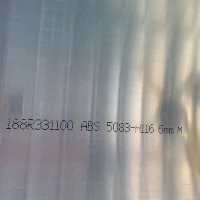



If you specify aluminum for a hull, an offshore module or a road tanker, the grade that comes back is almost always 5083. This guide explains why that happens, what the two common marine tempers - H116 and H321 - actually mean, how 5083 welds, and the few lines on the material certificate that decide whether a plate is fit for seawater service.
Why 5083 Is The Standard Marine Aluminum Plate
5083 is an aluminium-magnesium (Al-Mg) alloy in the 5xxx family. Its corrosion behaviour in seawater comes down to one element: magnesium. With 4.0–4.9 % Mg it sits in the range where pitting and crevice corrosion in marine atmosphere, salt spray and the tidal zone are minimal, and it is widely regarded as a seawater-grade plate. Two other points keep it on the shortlist:
Strength without heat treatment. 5083 is not heat-treatable; its strength comes from magnesium in solid solution plus work hardening. The minimum tensile strength is 275 MPa per ASTM B209, with typical values in the 275–350 MPa band depending on thickness and temper - enough for hull plating and stiffeners that see fatigue and alternating loads.
Weldability that survives the weld. 5083 welds cleanly with Al-Mg fillers and the joint keeps most of the parent strength, with no post-weld heat treatment needed. That single property is what lets shipyards build large welded structures from it.
By contrast, 5052 has only 2.2–2.8 % Mg, so its seawater corrosion margin is thinner and its strength is lower; 6061 contains copper and welds poorly for marine structures (see the welding section). For boats, offshore and tankers, 5083 is the practical default.

Chemical Composition of 5083 Aluminum Sheet and Plate
The chemical envelope follows GB/T 3190, which lines up with EN 573-3 and ASTM composition limits. Weight percent, aluminium remainder:
| Element | Si | Fe | Cu | Mn | Mg | Cr | Zn | Ti |
|---|---|---|---|---|---|---|---|---|
| Limit | 0.40 max | 0.40 max | 0.10 max | 0.40–1.00 | 4.0–4.9 | 0.05–0.25 | 0.25 max | 0.15 max |
The 4.0–4.9 % magnesium window is deliberate. Below about 3.5 % the alloy loses seawater-corrosion margin; above roughly 5 % it becomes prone to sensitization (β-phase precipitation at grain boundaries) and hot-shortness during fabrication. When you buy marine 5083, the line that matters most on the certificate is the measured magnesium value - confirm it actually lands in 4.0–4.9 %, not just that the grade is printed on the label. Density is 2.66 g/cm³.
5083 H116 vs 5083 H321
Both are strain-hardened tempers of 5083 with the same 275 MPa minimum tensile strength, but they reach that strength by different routes and behave differently in service:
| Temper | Route | Typical yield (MPa) | Where it is used |
|---|---|---|---|
| H116 | Strain-hardened and stabilized for corrosion resistance | ≈ 195 | Hull bottom, side shell, primary welded structure |
| H321 | Strain-hardened then partially annealed | ≈ 215 | Bulwark, superstructure, parts bent or rolled before welding |
In plain terms: H116 is the corrosion-resistant temper. It is specified where the weld is the weak point and exfoliation or intergranular corrosion after welding must be avoided - typically the main hull. H321 trades a little corrosion margin for better formability and a slightly higher yield (about 10–20 MPa above H116), which makes it the choice for panels that are folded, rolled or pressed into shape before they are welded.
How To Choose Between 5083 H116 And H321
The decision is mostly about loading versus forming:
Choose H116 for load-bearing members that are welded in place and where post-weld corrosion resistance is critical - hull bottom plating, longitudinal framing, stiffeners.
Choose H321 for components that need bending or roll-forming first and are then welded - bulwark, wheelhouse and superstructure panels, curved transoms.
Either way, marine 5083 should meet a classification-society material specification (DNV, ABS, BV, LR, CCS and others), and the certificate should state the temper and any required non-destructive testing. Agree the thickness-tolerance class before you order.

Welding 5083 - And Why 6061 Struggles In Welded Hulls
5083 is one of the easier structural aluminium alloys to weld. MIG/TIG with Al-Mg fillers 5356, 5183 or 5556 gives sound joints, and the heat-affected zone retains good properties without any post-weld heat treatment. That is the reason it dominates welded marine and offshore work, and also why it is chosen for tankers and low-temperature vessels where corrosion resistance and low-temperature toughness both matter.
6061 tells a different story. As a heat-treatable alloy, 6061-T6 relies on precipitation hardening; the weld heat-affected zone loses that hardening, and joint yield efficiency typically drops to roughly 40–50 % of the T6 value unless the entire assembly is re-solution-heat-treated and aged - a step that is not practical on a finished hull. So where welding volume is high, marine specifiers lock in weldable 5083 rather than 6061.
GNEE Manufacturing Specifications of 5083 H321 Aluminum Plate
As a leading custom 5083 marine aluminum plate manufacturer, GNEE offers extensive inventory and custom processing capabilities to meet your exact project requirements.
| Name | 5083 Aluminum Plate/Sheet |
| Hot sale status | O, H112, H116, H321 |
| Thickness(mm) | 0.5-500mm |
| Width(mm) | 20-2650mm |
| length(mm) | 500-16000mm |
| Surface treatment | Anodizing, powder coating, fluorocarbon coating (PVDF coating), electroplating (such as nickel/zinc plating), etc. |
| Typical products | Ship plates, LNG storage tanks, gas cylinders, GIS shells, vehicle body skins, flange materials, etc. |
What To Check When Buying Marine 5083 Plate
A short acceptance checklist for procurement:
Alloy: 5083 (verify on the mill certificate, not just the bundle tag).
Temper: H116 or H321, stated explicitly.
Magnesium: measured value in 4.0–4.9 %.
Standard: acceptance against GB/T 3880 (or EN 485 / ASTM B209 equivalent); agree the high-precision thickness-tolerance class. For dimensional tolerances, ANSI H35.2(M) is the international reference many buyers quote.
Approvals: for load-bearing marine plate, classification-society approval and any required ultrasonic or other NDT.
Common sizes can ship from stock; special tempers or thicknesses are produced to order, so confirm the production window when you place the order.


FAQ
Why is 5083 preferred over 5052 for marine plate?
5083 carries 4.0–4.9 % magnesium against 5052's 2.2–2.8 %. That extra magnesium pushes pitting and crevice corrosion resistance well above 5052 in seawater, and the minimum tensile strength (275 MPa per ASTM B209) is also higher. For hulls and saltwater exposure, 5083 is the standard choice and 5052 is usually reserved for lighter, less corrosive duty.
What is the difference between 5083-H116 and H321?
Both are strain-hardened marine tempers with a minimum tensile strength of 275 MPa. H116 is stabilized for resistance to exfoliation and intergranular corrosion after welding, so it is used for primary welded structure such as hull bottom and side shell. H321 is strain-hardened then partially annealed, giving slightly higher yield (about 215 MPa vs 195 MPa) and better formability for parts that are bent or rolled before welding, such as bulwark and superstructure panels.
Can 6061 be used for welded marine structures?
6061 is a strong, heat-treatable alloy, but 6061-T6 loses its precipitation hardening in the weld heat-affected zone; joint yield efficiency typically falls to roughly 40–50 % of the T6 value unless the whole assembly is re-solution-heat-treated and aged, which is impractical on a finished hull. For welded marine and offshore work, weldable 5083 is normally specified instead. 6061 remains useful where welding is minimal and stiffness-to-weight matters.
What magnesium content should marine 5083 plate have?
Per GB/T 3190 (consistent with EN 573-3 and ASTM composition limits), magnesium should be 4.0–4.9 %. Below about 3.5 % the seawater corrosion margin thins; above roughly 5 % the alloy risks sensitization and hot-shortness during fabrication. Always check the measured magnesium value on the material certificate, not just the grade label.
What documents should I check when buying marine 5083 plate?
At minimum verify the alloy (5083), the temper (H116 or H321), the measured magnesium content (4.0–4.9 %), and acceptance against GB/T 3880 or an equivalent standard. For load-bearing marine plate also confirm classification-society approval (DNV, ABS, BV, LR, CCS, etc.) and any required non-destructive testing, and agree the thickness tolerance class before ordering.


