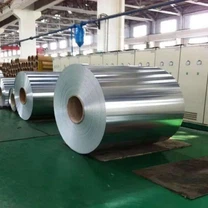
Aluminum foil is generally classified according to thickness, status and use.
By thickness: Aluminum foils greater than 0.012mm are called single foils, and aluminum foils less than or equal to 0.012mm are called double foils; those with a 0 after the decimal point are also called single-zero foils, and those with two 0s after the decimal point are called It is double zero foil, such as 0.005mm foil, which can be called double zero 5 foil.
According to the state: it can be divided into full hard foil, soft state foil, semi-hard foil, 3/4 hard foil, and 1/4 hard foil. Fully hard foil refers to foil that has not been annealed after rolling (completely annealed coil and >75% cold rolling), such as container foil, decorative foil, medicine foil, etc.; soft foil refers to fully annealed after cold rolling Foils, such as composite packaging materials such as food and cigarettes, and electrical appliance foils; any aluminum foil whose tensile strength is between full hard foil and soft foil is called semi-hard foil, such as air conditioning foil, bottle cap foil, etc.; any aluminum foil whose tensile strength is between The strength of aluminum foil is between full hard foil and semi-hard foil, which is called 3/4 hard foil, such as air-conditioning foil, aluminum-plastic pipe foil, etc.; the tensile strength of aluminum foil is between soft foil and semi-hard foil, which is called 1 /4hard foil.
According to surface condition: it can be divided into single-sided light foil and double-sided light foil. Aluminum foil rolling is divided into single-sheet rolling and double-sheet rolling. During single-sheet rolling, both sides of the foil are in contact with the roller surface, and both sides have a bright metallic luster, which is called double-sided light foil. During double rolling, only one side of each foil is in contact with the roller. The side in contact with the roller is bright, and the two sides in contact with each other are dark. This kind of foil is called single-sided light foil. The minimum thickness of double-sided aluminum foil mainly depends on the diameter of the work roll, which is usually not less than 0.01mm. The thickness of single-sided aluminum foil is usually not greater than 0.03mm, and the current minimum thickness can reach 0.004mm.

Aluminum foil uses
Aluminum foil can be divided into packaging foil, pharmaceutical foil, daily necessities foil, battery foil, electrical and electronic foil, construction foil, etc. according to its use. The uses of aluminum foil are shown in Table 2.
Battery foil and electrical foil:
Battery foil is aluminum foil used to make various workpieces for batteries, while electrical foil is aluminum foil used to make various workpieces for other electrical appliances. They can also be collectively referred to as electronic foil. Battery foil is a high-tech product with a compound annual growth rate of more than 15% in the next few years. The mechanical properties of cable foil and battery foil are shown in Table 3 and Table 4. 2019-2022 is a period of great development for Chinese battery foil companies. There are about 200 companies that have been put into production or under construction, with a total production capacity of about 1.5 million tons.
Electrolytic capacitor aluminum foil is actually a deep-processed product. It is a corrosive material that works under polar conditions and has high requirements on the structure of the foil. There are three types of aluminum foil used: cathode foil with a thickness of 0.015-0.06mm, high-voltage anode foil with a thickness of 0.065-0.1mm, and aluminum foil with a thickness of 0.065-0.1mm. 0.06-0.1mm low voltage anode foil. The anode foil is made of industrial high-purity aluminum, and the mass fraction should be greater than or equal to 99.93%, while the purity of the aluminum used in high-voltage anodes should be greater than or equal to 4N. The main impurities of industrial high-purity aluminum are Fe, Si, and Cu, and trace elements Mg, Zn, Mn, Ni, and Ti should also be treated as impurities. Chinese standards only stipulate the contents of Fe, Si, and Cu, but do not clearly stipulate the contents of other elements. The impurity content of foreign battery aluminum foil is significantly lower than that of domestic ones.

According to GB/T8005.1, aluminum foil with a thickness of not less than 0.001mm and less than 0.01mm is called double-zero foil. Commonly used alloys are 1145, 1235, 1350, etc. The most commonly used alloy is 1235, and its Fe/Si ratio is 2.5 -4.0. Aluminum foil with a thickness of not less than 0.01mm and less than 0.10mm is called single-zero foil. Capacitors mostly use 1235-H18 (0.020-0.050mm thick); mobile phone batteries use 1145-H18 and 8011-H18, which are 0.013-0.018mm thick; The cable foil used is 1235-O, with a thickness of 0.010-0.070mm. Foil with a thickness of 0.10-0.20mm is called zero-free foil. The main varieties are decorative foil, air-conditioning foil, cable foil, wine bottle cap foil, and shutter foil.