


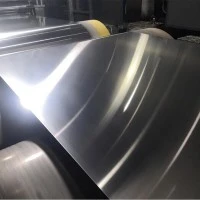



Special features of aluminum foil rolling
In the production of double foils, the rolling of aluminum foil is divided into three processes: rough rolling, intermediate rolling and finishing rolling. From a technological point of view, it can be roughly divided according to the thickness of the rolling exit. The general classification method is that the exit thickness is greater than Or equal to 0.05mm is rough rolling, the exit thickness between 0.013 and 0.05 is medium rolling, and the single finished product and double rolled finished product with exit thickness less than 0.013mm are finish rolling. The rolling characteristics of rough rolling and aluminum plate and strip are similar. The thickness control mainly depends on the rolling force and post-tension. The thickness of rough rolling is very small. Its rolling characteristics are completely different from the rolling of aluminum plate and strip. It has the characteristics of aluminum foil rolling. Its particularity mainly includes the following aspects:

(1) Aluminum plate and strip rolling. To make the aluminum strip thinner mainly depends on the rolling force, so the automatic control method of plate thickness is based on the constant roll gap as the main control method of AGC. Even if the rolling force changes, the thickness can be obtained by adjusting the roll gap at any time to keep the roll gap at a certain value. Consistent sheet and strip material. When aluminum foil is rolled to medium-finish rolling, because the thickness of the aluminum foil is extremely thin, the rolling force is increased during rolling, making it easier for the roller to produce elastic deformation than for the rolled material to produce plastic deformation. The elastic flattening of the roller cannot Neglected, the elastic rolling and flattening of the roller determines that in aluminum foil rolling, the rolling force no longer plays the same role as rolling plates. Aluminum foil rolling is generally roll gap-free rolling under constant pressure conditions, and the thickness of the aluminum foil is adjusted. Mainly depends on adjusting the tension and rolling speed.
(2) Overlapping rolling. For extremely thin aluminum foil with a thickness less than 0.012mm (the thickness is related to the diameter of the work roll), due to the elasticity of the roll, it is very difficult to roll it with a single sheet. Therefore, the double rolling method is used, that is, the The method of adding lubricating oil between two aluminum foils and then rolling them together (also called stack rolling). Laminated rolling can not only roll out extremely thin aluminum foil that cannot be produced by single rolling, but also reduce the number of strip breaks and improve labor productivity. This process can be used to mass produce single-sided aluminum foil of 0.006mm to 0.03mm.
(3) Speed effect. During the rolling process of aluminum foil, the phenomenon that the thickness of the foil becomes thinner with the increase of the rolling degree is called the speed effect. The explanation of the speed effect mechanism still needs in-depth research. The reasons for the speed effect are generally believed to have the following

three aspects:
1) The friction state between the work roll and the rolling material changes. As the rolling speed increases, the amount of lubricating oil brought in increases, thus causing the lubrication state between the roll and the rolling material to change. The friction coefficient decreases, the oil film becomes thicker, and the thickness of the aluminum foil becomes thinner.
2) Changes in the rolling mill itself. In a rolling mill using cylindrical bearings, as the rolling speed increases, the roll neck will float in the bearing, so that the two interacting loaded rolls will move closer to each other.
3) Processing softening when the material is deformed by rolling. The rolling speed of the high-speed aluminum foil rolling mill is very high. As the rolling speed increases, the temperature of the rolling deformation zone increases. According to calculations, the metal temperature in the deformation zone can rise to 200°C, which is equivalent to an intermediate recovery annealing, thus causing Process softening phenomenon of rolled materials.
Developing principles for aluminum foil rolling processes
① Determination of the total processing rate The total processing rate refers to the total deformation degree of the foil after recrystallization annealing until the finished product is rolled. Generally speaking, the total processing rate of 1 series can reach more than 99%, and some 8 series products can also reach this value. However, the total processing rate of aluminum alloy foil is generally less than 90%.
② Determination of pass processing rate Determination of pass processing rate is the core of the rolling process. For pure aluminum series products, the pass processing rate can reach 65%. It is not advisable to use excessively large steel for the first pass after annealing the billet. The processing rate is generally around 50%.
Rolling thickness
The thickness measurement methods during aluminum foil rolling mainly include eddy current thickness measurement, isotope ray thickness measurement and X-ray thickness measurement. X-ray thickness measurement is the most commonly used thickness measurement method in aluminum foil production, especially in high-speed aluminum foil rolling mills. Thickness control methods during aluminum foil rolling: rolling force control, tension control, rolling speed control, tension/speed, speed/tension control.


