The 3xxx series is an Al-Mn (aluminum-manganese) alloy. Adding about 1.2% manganese makes 3003 roughly 20% stronger than pure 1100 aluminum. But why choose the H24 temper specifically? Because it solves the most common fabrication problem: cracking during 90-degree edge bending.
Here is the straightforward technical data and practical sourcing advice you need before placing an order.
What Does the 3003 H24 Temper Mean?
- 3003 H14 (Strain Hardened): Rolled to a half-hard state. It is strong but holds internal stress. If you bend it sharply, micro-cracks can appear on the outer radius.
- 3003 H24 (Strain Hardened & Partially Annealed): The metal is rolled to a harder state, then put into an annealing furnace at a controlled temperature to partially soften it back to the "half-hard" level. This thermal relaxation relieves internal stress.
3003 H24 has better elongation and bendability than H14 while maintaining almost the same ultimate tensile strength. If your project involves flanging, deep stamping, or complex HVAC duct folding, H24 is your safest bet to avoid material failure.
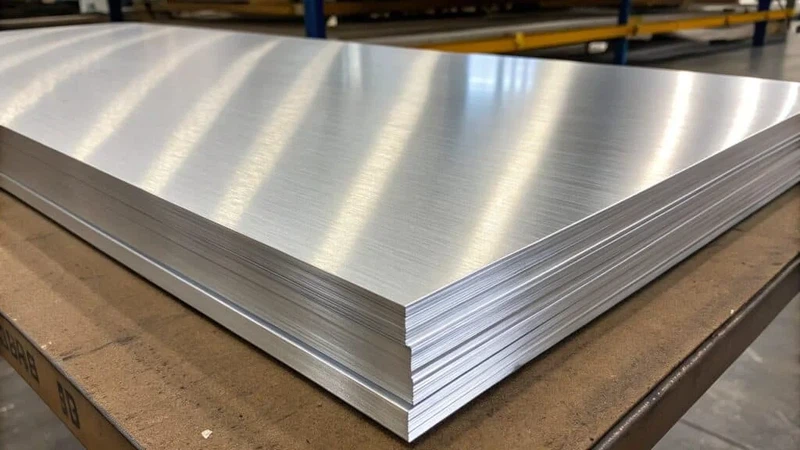
Chemical & Physical Properties of 3003 H24 Aluminum
At GNEE, our 3003 H24 sheets strictly follow AMS QQ-A-250/2 and ASTM B209 standards.
Table 1: Chemical Composition (% (Weight)
| Element | Min (%) | Max (%) |
| Silicon (Si) | 0.00 | 0.60 |
| Iron (Fe) | 0.00 | 0.70 |
| Copper (Cu) | 0.05 | 0.20 |
| Manganese (Mn) | 1.00 | 1.50 |
| Zinc (Zn) | 0.00 | 0.10 |
| Aluminum (Al) | Balance | Balance |
Table 2: Physical Properties
| Property | Value |
| Density | 2.73 g/cm³ |
| Melting Point | 643 - 654 °C |
| Modulus of Elasticity | 69 GPa |
| Thermal Conductivity | 190 W/m·K |
| Electrical Resistivity | 41% IACS |
Mechanical Properties of 3003 H24 Aluminum
We test our coils and sheets before dispatch. Here are the realistic mechanical baseline numbers for standard 3003 H24 sheets (thickness 1.0mm - 3.0mm).
Table 3: Mechanical Specifications
| Property | Standard Value Range |
| Ultimate Tensile Strength (UTS) | 145 - 195 MPa |
| Yield Strength (Rp0.2) | ≥ 115 MPa |
| Elongation ( A50 mm) | 6% - 10% (Depends on thickness) |
| Hardness | ~ 40-45 HB |
| Bending Radius (90°) | 0.5t to 1.5t (t = thickness) |
Note: The yield strength guarantees the material won't permanently deform under a 115 MPa load. The 6-10% elongation is exactly why it handles CNC bending so well without fracturing.
Machinability, Welding, and Coating of 3003 H24 Aluminum
1. Machinability
3003 H24 is not a free-machining alloy (like 2011 or 6061-T6). It is somewhat "gummy." If you try to mill or drill it at high speeds without proper coolant, it will build up on the tool edge. It is primarily designed for sheet metal forming (shearing, punching, bending), not heavy CNC milling.
2. Welding
Weldability is where 3003 shines. It is highly weldable using TIG (GTAW) or MIG (GMAW) processes.
Pro Tip: When welding 3003 H24, always use ER4043 or ER1100 filler wire. The heat-affected zone (HAZ) near the weld will lose its H24 temper and revert to an 'O' (fully annealed) state, so expect a drop in strength exactly at the weld seam.
3. Surface Coating
Unlike the 5000 series, which can sometimes be tricky with certain paints, 3003 accepts PE (polyester) and PVDF (fluorocarbon) color coatings flawlessly. It is also suitable for standard architectural anodizing, though the manganese content might give the anodized layer a very slight grayish/brownish tint compared to pure 1100 aluminum.
How We Calculate Pricing at GNEE
As an international buyer, you need price transparency. The pricing for 3003 H24 aluminum sheets is not static; it fluctuates daily.
Our formula is simple:
Total Price = SMM Daily A00 Aluminum Ingot Price + Processing Fee.
- The Ingot Price: We use the real-time SMM (Shanghai Metals Market) base rate.
- The Processing Fee: This covers rolling the slab, slitting, the annealing furnace cost for the H24 temper, and packaging. Note that producing H24 costs slightly more than H14 because it requires an additional thermal step in the annealing furnace.
If you order standard sizes (e.g., 4x8 ft or 1000x2000 mm) from our existing stock, the lead time is fast.