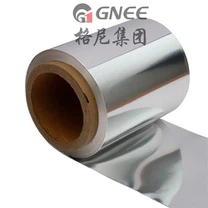
What Air Conditioning Foil Actually Is
Air conditioning foil, often called ACR fin stock, is a thin rolled aluminium product used to build the fin pack of a condenser or evaporator. It is supplied as coils of 0.08 mm to 0.20 mm thickness and 300 mm to 1250 mm width, in the O, H22, H24 or H26 temper, and delivered to ASTM B479 for foil or to GB/T 3198 and GB/T 3880 for foil and strip. Alloy choice is driven by formability, thermal conductivity and corrosion behaviour rather than by strength.
Alloy and Temper Selection
| Alloy | Typical fin thickness (mm) | Temper | Selection logic |
|---|---|---|---|
| 8011 | 0.09 to 0.15 | H22 / H24 | General purpose fin stock, good formability and coating response |
| 3102 | 0.10 to 0.15 | H24 / H26 | Better sag resistance in wide fin packs |
| 1100 | 0.10 to 0.20 | O / H22 | Highest conductivity, lowest strength, easy forming |
| 1235 | 0.09 to 0.14 | H22 / H24 | Low-cost high-purity base for coated fins |
Thermal conductivity of fin stock sits at roughly 200 W/(m.K) for 8011 and rises towards 237 W/(m.K) for 99.5 percent pure aluminium, so alloy choice has a smaller effect on heat transfer than fin pitch, fin height and the quality of the tube-to-fin bond. Chrome-free pretreatment plus a hydrophilic top coat is now the normal build for indoor units, while outdoor condenser fins usually receive an anti-corrosion coat, sometimes with a hydrophobic top layer to shed water and reduce pressure drop.
Coating Systems and Coating Weight
A typical coated fin carries 0.5 to 2.0 g/m2 of coating per side, applied by roll coating and cured at 200 to 250 C, with a total dry film thickness of 1 to 3 micrometres. The coating is verified by weight loss on dissolution, by cross-cut adhesion testing after forming, and by contact angle or water run-down testing for the hydrophilic grade. Over-cured coating becomes brittle and cracks at the fin collar; under-cured coating blocks the fin die and reduces drainage.
Corrosion Performance and Testing
Fin pack corrosion is acidic condensate attack plus galvanic coupling through the copper or aluminium tube. Screening is done by neutral salt spray to ASTM B117 for short runs and by the SWAAT cyclic acidified salt spray test of ASTM G85 Annex A3 for serious qualification, with a 500 to 1000 hour pass being the usual customer target. Fin stock that will contact copper tubes must be tested as an assembled couple, because the aluminium becomes the anode and the measured pit depth is far greater than for an isolated coupon.
Forming, Handling and Purchasing Notes
Fins are louvred and collared in a progressive die, so thickness tolerance, flatness and camber all matter as much as the mechanical properties. Tighter thickness control allows higher fin density and lowers coil weight per fin pack. Copper and iron contamination on the coil surface seeds galvanic pitting, so protective wrapping and clean slitting are part of the specification. Where the heat exchanger must meet an efficiency target, the buyer should quote fin thickness, fin pitch, louvre angle, coating type and coating weight together, since the coil alone does not define performance.
Frequently Asked Questions
Q: Which aluminium alloy is best for air conditioner fins?
A: 8011 in H22 or H24 is the most common general purpose fin stock. 3102 is chosen where better sag resistance is needed, and 1100 where maximum conductivity and lowest cost matter more than strength.
Q: What is the standard thickness of air conditioning aluminium foil?
A: Most fin stock runs between 0.09 mm and 0.15 mm, with 0.10 mm and 0.105 mm the most common commercial thicknesses. Fin packs below 0.09 mm demand tighter die control and are used mainly in high efficiency designs.
Q: Why is a hydrophilic coating used on evaporator fins?
A: Untreated aluminium holds condensate as droplets, which bridge fin gaps and raise air-side pressure drop. A hydrophilic coating spreads water into a film that drains, keeping the coil clean and reducing fan power.
Q: Which corrosion test applies to coated fin stock?
A: ASTM B117 neutral salt spray is used for routine process control, while the cyclic acidified test in ASTM G85 Annex A3, known as SWAAT, is used for qualification of coated fins in coastal and marine duty.
Q: What standards cover the aluminium foil itself?
A: ASTM B479 covers general purpose aluminium foil, GB/T 3198 covers aluminium and aluminium alloy foils, and GB/T 3880 covers wrought plate, sheet and strip. Tensile testing is normally performed to ASTM E8 or ISO 6892-1.
Q: Does coating both sides increase cost without benefit?
A: For condensers the wetted side usually needs the anti-corrosion layer, and coating both faces is a common way to protect against condensate carry-over and to keep the coil visually uniform, so it is normally worth the cost on outdoor units.