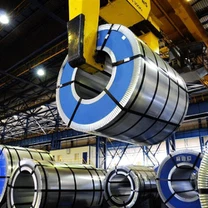
What an Aluminum Coil Actually Is
Aluminum coil is a continuous strip wound on a mandrel, produced by hot rolling a cast slab and then cold rolling it to the required gauge. Coil is the starting form for most downstream products: it is slit, cut to length, blanked, roll formed, stamped, anodized or coated. Because it is supplied in a continuous length, coil allows high-speed automated processing with few joints, which is why construction, transport and appliance manufacturers specify it in preference to plate.
Two alloys dominate general engineering use: 6061, which is heat treatable and can be strengthened to a T6 or T651 temper, and 5052, which is strengthened only by cold work. They overlap in cost and availability but behave quite differently in service, so the choice should follow the forming method, the welding requirement and the corrosion environment.
6061 Aluminum Coil: Composition and Performance
6061 is an Al-Mg-Si alloy with magnesium and silicon as the main additions, plus small amounts of copper and chromium. Magnesium and silicon combine to form Mg2Si, which dissolves in the aluminum matrix and makes the alloy responsive to artificial age hardening. Copper raises strength slightly without seriously harming corrosion resistance, and chromium offsets the adverse effect of iron on toughness.
In the T6 condition the alloy typically reaches a tensile strength of about 310 MPa (45 ksi), a yield strength of about 275 MPa (40 ksi) and a hardness of about 95 HB, with roughly 12% elongation. Density is 2.70 g/cm3 and thermal conductivity is about 167 W/m.K. Because it can be heat treated, 6061 coil can be supplied soft for severe forming and then aged to its full strength, or delivered already in T6 or T651 for parts that are machined or formed lightly.
Good machinability and chip formation
Excellent welding response with 4043 or 5356 filler
Excellent atmospheric and marine corrosion resistance
Reliable anodizing and coloring response
Moderate strength, well below the 2XXX and 7XXX families
Typical uses include aerospace fittings and fixtures, marine hardware, truck and trailer components, structural framing, jigs, mold plates, electrical enclosures, and precision instrument parts.
5052 Aluminum Coil: Composition and Performance
5052 is an Al-Mg alloy with magnesium as the principal addition and a small amount of chromium. There is no silicon addition and no copper, so the alloy cannot be strengthened by precipitation hardening. Its strength comes entirely from work hardening introduced during cold rolling, which is why it is normally supplied in tempers such as H32, H34 and H36 rather than in T tempers.
Representative properties of 5052-H32 are a tensile strength of about 228 MPa (33 ksi), a yield strength of about 193 MPa (28 ksi) and elongation of roughly 12%, with a hardness of about 60 HB. The alloy has excellent formability, high fatigue resistance in the as-rolled condition and the best corrosion performance of the two alloys in salt-laden atmospheres.
Outstanding formability for bending, deep drawing and spinning
Excellent corrosion resistance, particularly in marine service
Highest weldability of the common non-heat-treatable alloys
Cannot be strengthened by heat treatment
Lower machinability and lower strength than 6061-T6
Typical uses include fuel tanks, marine panels, pressure vessels, sheet metal enclosures, road signs, appliance housings and architectural cladding.
6061 and 5052 Coil Compared
| Property | 6061 (T6/T651) | 5052 (H32) |
|---|---|---|
| Family | 6000 series, Al-Mg-Si | 5000 series, Al-Mg |
| Main additions | Mg, Si, Cu, Cr | Mg, Cr |
| Tensile strength | approx. 310 MPa (45 ksi) | approx. 228 MPa (33 ksi) |
| Yield strength | approx. 275 MPa (40 ksi) | approx. 193 MPa (28 ksi) |
| Elongation | approx. 12% | approx. 12% |
| Hardness | approx. 95 HB | approx. 60 HB |
| Heat treatment | Yes, to T4, T6 or T651 | No; work hardened only |
| Formability | Limited in T6, good when annealed | Excellent |
| Weldability | Very good | Excellent |
| Machinability | Good | Fair |
| Corrosion resistance | Excellent | Excellent, best in marine air |
| Anodizing response | Good, uniform color | Good |
The practical summary: 6061 wins on strength, machinability and heat treatability, while 5052 wins on formability, welding and marine corrosion resistance. Neither alloy is a substitute for the other in a well-designed part.
How to Choose the Right Coil Alloy
Strength-critical, machined or lightly formed parts: specify 6061-T6 or T651 coil. It gives roughly 35% more tensile strength than 5052-H32 and machines cleanly.
Deep drawn, bent or roll formed parts: specify 5052 in an H temper. Its elongation and strain hardening behavior allow tight radii without cracking.
Welded assemblies: both alloys weld well, but 5052 is the safer choice because welding does not destroy a heat treatment that was never there.
Marine or salt-spray environment: 5052 is preferred; if higher strength is required, use 6061 with anodizing or a protective coating.
Anodized decorative parts: both respond well, though 6061 holds color more consistently after aging.
Recyclability and cost: both alloys are fully recyclable; 5052 is generally the lower-cost option for equal thickness, while 6061 costs more because of its alloying content and heat treatment.
When ordering coil, state the alloy, temper, thickness, width, coil inner diameter, coil weight, edge condition and the governing standard. Coil for these alloys is normally produced to GB/T 3880, EN 485, ASTM B209 or JIS H 4000, and the tolerance class on the order determines what the mill will guarantee for thickness, width and camber.
Frequently Asked Questions
Q: Can 6061 and 5052 coil be welded to each other?
Yes. The two alloys are metallurgically compatible and can be joined with 4043 or 5356 filler. The joint strength will be closer to that of 5052, and the heat-affected zone in 6061 will lose part of its T6 strength.
Q: Why is 5052 not available in a T6 temper?
5052 has no silicon or copper addition, so it forms no precipitates that can be redissolved and re-aged. Its strength comes only from cold work, which is why coil is supplied in H tempers.
Q: Which alloy bends better without cracking?
5052 in an H32 or annealed condition. 6061-T6 has limited formability and should be bent with generous radii or formed in the O/T4 condition and aged afterwards.
Q: Does 6061 coil need heat treatment after forming?
Only if it is formed in the annealed condition. If it is supplied in T6 or T651, no further aging is needed and any subsequent forming should be light.
Q: How should the coil surface be protected in transit?
Interleaved paper, white film, blue film or black-white film can be applied. Film choice should match the forming and anodizing route, because some adhesives leave residue after long storage.
Q: What thickness range is typical for coil?
Coil is normally rolled from about 0.2 mm up to a few millimetres; heavier gauges are supplied as cut-to-length sheet or plate up to 350 mm thick.