


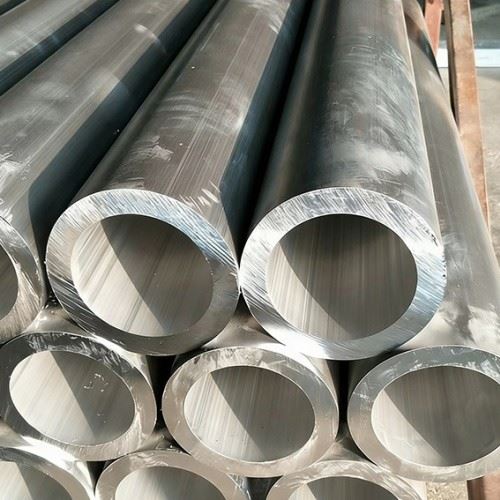

That combination is exactly what busbar, heat-exchanger, and decorative-conduit buyers need: a pipe that carries current or heat efficiently, forms without cracking, and resists corrosion without secondary coating.
But a 1060 pipe ordered for a busbar that arrives in the wrong temper - or a 3003 pipe shipped where 1060 was specified - looks identical on the rack and fails only when the line overheats. We confirm grade and temper on every lot before it leaves. Contact now with your OD, wall, length, and temper, and we will quote with mill test certificate and current lead time.
What is 1060 Aluminum Pipe
1060 is a commercially pure aluminum grade in the 1000 series. By specification it contains a minimum of 99.60% aluminum, with iron and silicon as the only meaningful impurities; copper, manganese, and magnesium are capped at 0.05% or below. That chemistry is deliberate: every alloying addition lowers electrical and thermal conductivity, so the purer the metal, the better it conducts.
An "aluminum pipe" in this grade is a hollow, round, long product made by either seamless extrusion (ASTM B241) or cold drawing from a hollow (ASTM B210). It is not a structural alloy. Where 6061 or 6082 are chosen for yield strength, 1060 is chosen for three things it does better than any heat-treatable grade:
Conductivity: about 61–63% IACS (typical 62%), versus 43% for 6061 and 29% for 5083 - the lowest-resistance option for current-carrying pipe.
Formability: in the O temper it bends, spins, and deep-draws without cracking, ideal for fabricated conduits and fittings.
Corrosion behavior: pure aluminum forms a uniform, self-healing oxide that needs no paint in most atmospheres.
The trade-off is strength: 1060 in the O temper has a yield near 28 MPa, roughly one-tenth of 6061-T6. It is specified where conduction and forming matter more than load - not for frames or pressure structure.

Chemical Composition
| Element | Min % | Max % | Role / Function |
|---|---|---|---|
| Aluminum (Al) | 99.60 | - | Base metal; provides conductivity, formability, and corrosion resistance. |
| Silicon (Si) | - | 0.25 | Impurity; kept low to protect conductivity. |
| Iron (Fe) | - | 0.35 | Principal impurity from smelting; limited to maintain ductility and surface quality. |
| Copper (Cu) | - | 0.05 | Kept near zero - Cu sharply reduces conductivity and promotes SCC risk. |
| Manganese (Mn) | - | 0.03 | Trace only; higher Mn would reclassify toward 3003 and drop conductivity. |
| Magnesium (Mg) | - | 0.03 | Trace only; Mg is absent in pure 1060. |
| Zinc (Zn) | - | 0.05 | Impurity cap; negligible effect at this level. |
| Titanium (Ti) | - | 0.03 | Trace grain refiner residue. |
Mechanical Properties
1060 is strain-hardened, not heat-treated, so strength comes from cold work. Values below are typical room-temperature properties for common tempers (ASTM B210/B241 / Aluminum Standards & Data). Use them for design screening; always confirm against the lot MTC.
| Temper | UTS MPa | Yield MPa | Elong % | Hardness HB |
|---|---|---|---|---|
| O (annealed) | 69 | 28 | 43 | 19 |
| H12 | 83 | 69 | 25 | 23 |
| H14 | 97 | 90 | 12–20 | 26 |
| H16 | 110 | 103 | 14 | 30 |
| H18 | 124 | 117 | 6–15 | 35 |
Shear strength is roughly 55–70 MPa in the O temper and rises with cold work. Fatigue strength (rotating beam, 5×10⁸ cycles) is about 34 MPa for O temper. Design pressure rating depends on wall thickness, OD, and end use and is [To be confirmed] per project; 1060 is normally selected for low-pressure or non-pressure service.
Physical & Thermal Properties
| Property | Value |
|---|---|
| Density | 2.71 g/cm³ (0.0978 lb/in³) |
| Melting range | 646–657 °C (1195–1215 °F) |
| Modulus of elasticity | 68.9 GPa (10.0×10⁶ psi) |
| Thermal conductivity (25 °C) | about 234 W/m·K |
| Electrical conductivity | about 61–63% IACS (typical 62%) |
| Coefficient of thermal expansion | 23.6 µm/m·°C (13.1 µin/in·°F) |
| Specific heat | about 900 J/kg·K |
The 234 W/m·K thermal conductivity and 62% IACS electrical conductivity are the two numbers that drive most 1060 pipe enquiries - heat-exchanger tube and busbar/conductor pipe respectively.
1060 Aluminum Pipe Specifications Table
| Parameter | Typical range / value |
|---|---|
| Product form | Seamless aluminum pipe (B241) / drawn seamless tube (B210) |
| Alloy & temper | 1060; O, H12, H14, H16, H18, H112, F |
| Outer diameter (OD) | 6–300 mm (standard seamless); larger sizes |
| Wall thickness | 0.5–30 mm (standard); thin-wall drawn to ±10% per B210 |
| Length | Up to 6000 mm standard; cut-to-length per drawing |
| Standards | ASTM B210, ASTM B241, ASTM B221, EN 755 |
| Dimensional tolerance | Per ASTM B210 / B241 (OD ±0.1–1.0 mm, wall ±10–15% depending on size) |
| Surface | Mill finish, anodized, powder coated, PVDF, polished, brushed |

Heat Treatment & Temper Guide
1060 is not heat-treatable. There is no solution heat treatment or artificial aging (the 530±5 °C / 175±5 °C × 8 h route used for 6061/6082 does not apply to this grade). Its tempers are produced by cold working from the annealed condition:
O (annealed): full anneal around 343–413 °C followed by slow cooling - maximum softness and formability, lowest strength.
H12 / H14 / H16 / H18: strain-hardened by 1/4, 1/2, 3/4, and full hard cold work respectively - strength climbs as ductility falls.
H112 / F: as-fabricated tempers for extruded product where no specific mechanical property is guaranteed.
If your application needs higher strength than H18 provides, move to a heat-treatable grade such as 6061 or 6082 - 1060 cannot be made stronger by heat.
Equivalent Designations
| AA | UNS | EN | DIN | JIS | GB | ISO |
|---|---|---|---|---|---|---|
| 1060 | A91060 | EN AW-1060 (Al 99.6) | Al99.6 (3.0205) | A1060 (JIS H4000) | 1060 (GB/T 3190); older L2 | Al99.6 |
GB/T 3190 adopts the 1060 designation directly; the legacy Chinese grade L2 is the historical equivalent and is occasionally still quoted - confirm which your drawing references.
Corrosion Resistance
Atmospheric: Excellent. Pure aluminum forms a thin, adherent Al₂O₃ film that protects in rural, urban, and most industrial air.
Marine: Good. 1060 resists general seawater corrosion well; pitting can occur in stagnant, oxygen-poor seawater, so design for drainage and avoid crevices.
Galvanic: Active (anodic). 1060 will sacrifice itself when bolted directly to steel, copper, or stainless. Use dielectric isolation washers or sleeves - never land a 1060 conductor straight onto a copper bus without a barrier.
Stress-corrosion cracking (SCC): Not susceptible. Pure, non-heat-treatable, copper-free aluminum has no SCC mechanism in this grade.
Finishes: Anodizing builds a clear, dense oxide; note 1060 anodizes to a softer, milkier tone than architectural 6063 - specify if you need a bright finish. PVDF and powder coat give durable color for exterior use.
Fabrication
Welding. 1060 welds readily by GTAW and GMAW. Use filler ER1100 (matching pure aluminum - best conductivity and color match) or ER4043 (more fluid, the common general-purpose choice). Do not use ER5356 on 1060: that wire is formulated for 5xxx/6xxx magnesium alloys, and 1060 contains no Mg to react with it. Because 1060 is non-heat-treatable, there is no post-weld heat treatment; a welded H-temper joint relaxes to roughly the O strength in the heat-affected zone, so design welded assemblies for O-temper properties.
Machining. Poor-to-fair. Pure aluminum is gummy and builds up on the tool edge. Use sharp HSS or carbide, a high positive rake angle, generous flood coolant, and moderate speeds; it is not a free-machining grade like 2011 or 6262.
Formability. Excellent in the O temper - the grade's main fabrication advantage. It bends, spins, and deep-draws cleanly. As cold work increases (H14 → H18), formability drops and minimum bend radii must be opened up.
Quality Control
1060 and 3003 pipe look identical on the rack - but 3003 carries only about 40% IACS against 1060's 62%. A 3003 pipe shipped where 1060 was specified for a busbar raises line resistance by roughly 50% and overheats at the joint. Equally, an H18 pipe delivered as O temper is too soft to hold busbar clamp torque and loosens in service.
Action: We run 100% XRF/PMI per lot to confirm Al ≥99.6% and rule out manganese (the 3003 tell-tale), verify temper by hardness plus tensile, and measure OD and wall against ASTM B210/B241. Surface is visually inspected and, where specified, checked by eddy current. A written EN 10204 3.1 MTC travels with the order.
Standards applied: ASTM B210 / B241 (dimensions, tensile), ASTM E572 / E1251 (XRF), ASTM B557 (tensile), ASTM E10 (hardness), EN 10204 3.1 (inspection document).
Result: Every pipe leaves with verified grade, temper, dimensions, and certificate - no grade or temper ambiguity in your busbar or heat-exchanger line.

Surface Finishes
| Finish | Process | When to specify |
|---|---|---|
| Mill finish | As-extruded / as-drawn, no treatment | Economic; internal or non-visible runs |
| Anodized (clear / colored) | Electrolytic oxide 5–25 µm | Decorative columns, reflective or protected surfaces |
| Powder coated | Electrostatic RAL color, baked | Architectural, color-matched handrail |
| PVDF | Fluoropolymer coil/Spray coating | Exterior with 20+ year weather demand |
| Polished / Bright | Mechanical mirror polish | Lighting housings, reflectors |
| Brushed | Satin directional grain | Interior decorative trim |
Applications
Electrical busbar & conductor pipe: 62% IACS conductivity at one-third the weight of copper - the primary 1060 pipe use.
Heat-exchanger / condenser / radiator tubes: 234 W/m·K thermal conductivity moves heat efficiently in HVAC and process cooling.
Lighting poles & lamp housings: formability plus reflectivity; anodized or polished for optical surfaces.
Chemical & food-process piping: pure, non-toxic, corrosion-resistant metal for low-pressure, purity-sensitive lines.
Architectural handrail & decorative columns: anodized or powder-coated; the decorative angle competitors lead with.
Cryogenic transfer lines: pure aluminum retains ductility at low temperature where some alloys embrittle.
Refrigerant & capillary tubing: clean, formable, easy to bend and braze in field fabrication.
RF waveguide & EMI shielding: high conductivity makes 1060 pipe effective as a low-loss conductive enclosure.

1060 vs Other Aluminum Alloy Pipe
| Alloy | Typical temper | UTS MPa | Yield MPa | Elong % | Conductivity %IACS | Density g/cm³ | Key pipe use |
|---|---|---|---|---|---|---|---|
| 1060 | O / H14 | 69–97 | 28–90 | 12–43 | 62 | 2.71 | Conductivity & forming |
| 3003 | O / H14 | 110–150 | 41–125 | 8–30 | ~40 | 2.73 | General + corrosion |
| 5052 | H34 | 210–260 | 160–215 | 8–14 | ~35 | 2.68 | Marine |
| 6061 | T6 | 310 | 276 | 12 | 43 | 2.70 | Structural |
| 6063 | T5 / T6 | 186–241 | 145–214 | 8–12 | 53 | 2.70 | Architectural |
| 5083 | O / H111 | 275–350 | 110–145 | 16–22 | 29 | 2.66 | Marine high-strength |
1060 wins on conductivity and formability and loses on strength - pick it when the pipe carries current or heat, not load. For a stronger but still conductive pipe, 6063 (53% IACS) is the next step up.
About Us
Traceable since 2008, 100+ countries: every 1060 pipe ships with an EN 10204 3.1 mill test certificate documenting grade, temper, and dimensions - no grade or temper guesswork on your line.
Dimensional control: OD, wall, and length are measured and recorded against ASTM B210/B241; thin-wall drawn tolerances are held so the pipe seats in insulators and transitions without rework.
Custom tempers and sizes: O through H18, plus cut lengths and non-standard OD/wall to your drawing - we supply the temper your design actually needs, not just stock H14.
Lead time and MOQ: standard 15–30 day production with flexible minimum order quantities for both trial and volume buys.
Export packaging: end caps, bundle strapping, moisture-barrier wrap, and seaworthy wooden crates protect the soft 1060 surface through long ocean transit.

Delivery & Order Process
After you send the drawing or specification, we issue a quote listing alloy, temper, exact OD/wall/length and tolerances, standard, surface, packaging, and the 15–30 day lead time. Before production we confirm the sign-off node: you approve the written specification and, where required, a sample, so there is no ambiguity about grade (1060 vs 3003), temper, and dimensions. For every lot we run XRF grade verification, tensile/temper check, and dimensional inspection - the same checks described in the QC block above. If any pipe fails incoming inspection - wrong grade or temper, out-of-tolerance, or surface defect - we quarantine that lot and ship a replacement from a verified batch; we do not mix suspect material into your order. This is how a 1060 pipe arrives grade-true, on-size, and ready to weld or bus.

FAQ
1. Is 1060 aluminum pipe heat-treatable?
No. 1060 is commercially pure aluminum and is strengthened only by cold work (strain hardening). There is no solution treatment or aging. Available tempers are O, H12, H14, H16, H18, H112, and F. If you need heat-treated strength, move to 6061 or 6082.
2. What filler wire should I use to weld 1060 pipe?
Use ER1100 (matching pure aluminum - best conductivity and color match) or ER4043. Do not use ER5356; that wire is for magnesium-bearing 5xxx/6xxx alloys and 1060 contains no magnesium. Welded zones relax toward the O-temper strength, so design for O properties across the joint.
3. What is the largest size you can supply?
Standard seamless drawn (B210) and extruded (B241) 1060 pipe covers OD 6–300 mm, wall 0.5–30 mm, length to 6000 mm. Larger welded or special sizes are [To be confirmed] - send your requirement and we will confirm route and tolerance.
4. 1060 or 3003 pipe - which should I choose?
If the pipe carries electric current or must form deeply, choose 1060 (62% IACS, best ductility). If you need a little more strength and slightly better general corrosion at low cost for non-current service, 3003 is the better fit. Confirm grade by XRF on arrival either way.
5. Can 1060 pipe be anodized?
Yes - clear or colored anodizing works well for decoration and added surface protection. Note that 1060 anodizes to a softer, milkier tone than architectural 6063; if you need a bright, uniform architectural finish, tell us so we can advise temper and pre-treatment.
Hot Tags: 1060 Aluminum Pipe, China 1060 Aluminum Pipe manufacturers, suppliers, factory


