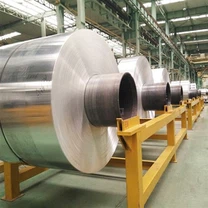
The performance requirements of battery aluminum foil are very strict. It is not difficult to meet the requirements of several indicators, but it is difficult to meet all the requirements:
1. Melt quality. During the metal smelting process, there will be certain gas, metal and scrap metal inclusions in the melt, which will cause excessive pinholes and holes in the finished product. This is also an important reason that affects the quality of the final aluminum foil. In order to ensure the quality of aluminum foil, melt purification is crucial. The key is to carry out process steps such as degassing, slag removal and filtration. Generally, the hydrogen content index is controlled to ≤0.1ml/100gAL.
2. Shape control. Plate shape, also known as tension, is an important indicator of the straightness of aluminum foil. In the aluminum processing industry, an online shape meter is used for control. The principle is to use the shape meter to feel the force per unit area in the transverse direction of the aluminum foil and feedback the tightness of the aluminum foil. Battery manufacturers usually use offline shape detectors to detect the quality of the plate shape. The principle is to use corresponding tension to flatten the aluminum foil and detect the difference between the horizontal position and the sagging amount of the edge of the product, which is called the edge sag amount.

3. Thickness control. Generally, the thickness of aluminum foil for batteries is required to be within ±4%, and the aluminum foil rolling mill is mainly controlled through an online thickness control system. Although some downstream battery manufacturers hope to control the thickness tolerance of battery aluminum foil within ±2%, however, most equipment currently on the market cannot achieve such control accuracy. Factors affecting thickness tolerance include alloy composition, hydraulic system, roll roundness and bearing accuracy. These factors combine to limit the possibilities of current technology in achieving tighter thickness control.
4. Surface quality. Battery aluminum foil has extremely high requirements for the surface quality of the aluminum foil, which requires uniform color, no serious streaks and color differences, no concave and convex points and drum lines, no residual oil and foreign matter intrusion, no scratches and scratches and other defects. To ensure products meet this stringent quality standard, finished battery foils are inspected for pinholes and surface defects.

5. Mechanical properties. The tensile strength and elongation of aluminum foil for batteries are mechanical performance indicators that need attention. The higher the tensile strength, the better. The elongation is within 5%, and the higher the better.
6. Surface wetting tension. This indicator is described by the mechanical unit "dyne value" (i.e. dyn). Generally, users require the surface wetting tension to be 30-32 dyn, and some sensitive materials require higher dyne values.
7. End surface quality. That is, the cutting quality of the edge of the aluminum foil, there should be no defects such as V-shaped notches, burrs, aluminum wires, etc. on the edge.