


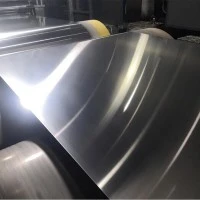



Aluminum foil is a hot stamping material that is directly rolled into thin sheets with metallic aluminum. Its hot stamping effect is similar to that of pure silver foil, so it is also called fake silver foil. Since aluminum is soft, malleable and has a silvery white luster, it can also be printed if rolled sheets, water glass and other materials are mounted on offset paper to make aluminum foil. However, aluminum foil itself is easily oxidized and becomes darker in color, and will fade when rubbed or touched, so it is not suitable for hot stamping book covers that have been stored for a long time. Aluminum foil is a packaging material with excellent performance. In daily life, the most common aluminum foil processed products are aluminum foil and aluminum foil paper for food packaging. Of course, aluminum foil can be used for much more than that. Therefore, as a packaging manufacturer, it is very important to choose aluminum foil with excellent performance and quality. So how to choose high-quality aluminum foil? This article will discuss this issue in detail and give you some help.

Production Process
The aluminum foil processing process is the aluminum product with the most processing steps, the smallest thickness, and the most difficulty in the aluminum processing industry. At present, there are two commonly used processing technology routes in the industry: (1) Ingot hot rolling method; (2) Double-roller casting and rolling method.
Ingot hot rolling method
First, the aluminum melt is cast into a flat ingot, and then after homogenization, hot rolling, cold rolling, intermediate annealing and other processes, it is continued to be cold rolled into a plate with a thickness of about 0.4~1.0 mm as a foil blank (casting → hot rolling) Billet→cold rolling→foil rolling).
In the ingot hot rolling method, the hot-rolled billet is first milled to remove defects such as the oxide layer and impurities on the surface of the ingot, and then the microstructure of the ingot is made more uniform through homogenization, and then hot rolling, cold rolling and intermediate After multiple processes such as annealing and recrystallization, the internal structural uniformity and grain size of the billet have been significantly improved. Therefore, hot-rolled billets are usually of better quality and are suitable for high-quality double-zero aluminum foil and deep processing. Aluminum foil products. However, hot-rolled blanks have problems such as high ear yield, easy cracking, and uneven deformation areas during the deep drawing process, which restricts the improvement of the yield of high-quality aluminum foil.

Two-roll casting method
Compared with the ingot hot-rolling method, the process flow of producing aluminum foil blanks by the cast-rolling method is relatively simple; there is no need to go through complex process steps such as ingot melting, milling, homogenization and hot rolling, but the aluminum melt is poured directly. Enter two rotating casting rollers (crystallizer), and complete the solidification and hot rolling processes simultaneously in the casting and rolling area within 2 to 3 seconds to obtain a plate with a thickness of 4 to 7 mm. Similar to hot-rolled aluminum foil billets, cast-rolled plates also need to go through a series of cold rolling and intermediate annealing processes, and are finally rolled into 0.3~0.7mm thick plates as aluminum foil billets.
