



Aluminum Market Price Drivers
In October 2026, the SMM A00 aluminum spot average traded in a band of RMB 23,650–23,810 per tonne, with a month-to-date average near RMB 23,723/t (about USD 3.32/kg at an indicative RMB/USD 7.15). As of 2026-10-13, the spot stood at RMB 23,710/t (about USD 3.32/kg), -2.3% versus the prior month. Over the most recent five sessions the price eased about 1.6%, so the near-term read is range-bound-to-soft rather than trending hard in either direction. For international buyers, the ex-works price of Aluminum Coil depends on more than the base metal.
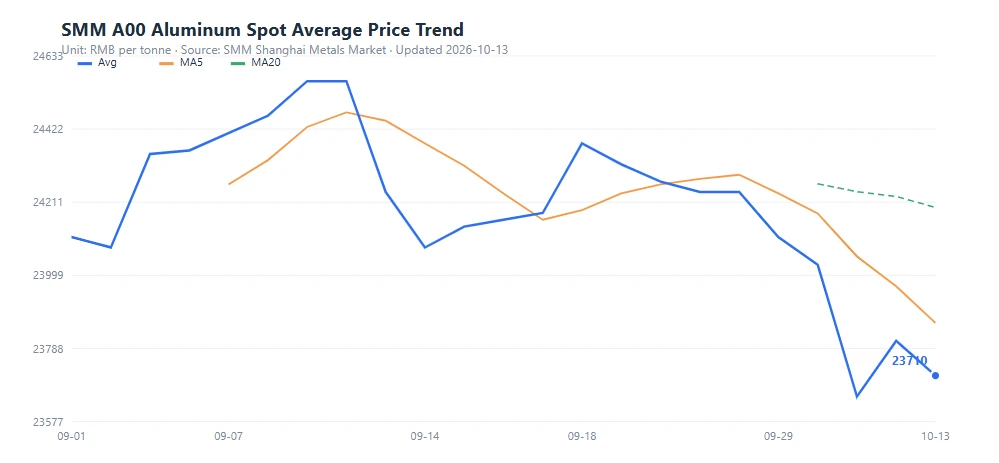
SMM aluminum base (raw metal). The dominant component. Every RMB 100/t move in SMM A00 shifts the underlying metal cost by roughly USD 0.014/kg, so the base sets the floor.
Conversion / processing fee. Conversion (rolling, extrusion, or forming) in China is broadly stable month-on-month - typically RMB 1,500–3,500/t (about USD 0.2–0.5/kg) ex-works, rising with product complexity.
Alloying elements and temper. 5052-H32 is formulated for higher strength and corrosion resistance than 3003-H14, which lifts melt and process cost marginally. Alternative tempers and alloys change the economics again.
Size premium. Small or thin sections, wide formats, and asymmetric shapes raise per-kg conversion cost. Large standard sizes carry a modest premium over small ones, while fully custom tooling adds amortization.
Surface treatment. Anodizing, powder coating, or bright finishes add roughly USD 0.3–0.6/kg and longer process time.
Aluminum Price by Size & Grade
All figures below are indicative, market-dependent, ex-works China, and exclude freight, packing, and import duties. They are derived from the SMM A00 anchor plus typical conversion and grade premiums, and must be confirmed against a formal GNEE quotation. Trend (▲ / ▼ / -) reflects the aluminum base direction versus the start of October 2026.
| Product | Size (mm) | Grade | Surface | Price (USD/kg) | Price (USD/t) | Trend | Remark |
|---|---|---|---|---|---|---|---|
| Coil | 0.5–3 mm | 3003-H14 | Mill | 3.5–4.2 | 3,500–4,200 | ▲ | indicative, ex-works |
| Coil | 0.5–3 mm | 5052-H32 | Mill | 3.7–4.5 | 3,700–4,500 | ▲ | +4–7% vs 3003 |
| Coil | 3–6 mm | 3003-H14 | Mill | 3.6–4.3 | 3,600–4,300 | ▲ | heavier gauge |
| Coil | 3–6 mm | 5052-H32 | Mill | 3.8–4.6 | 3,800–4,600 | ▲ | +4–7% vs 3003 |
| Coil (rigid) | 0.5–3 mm | 3004-H34 | Mill | 3.7–4.4 | 3,700–4,400 | ▲ | can-body grade |
| Coil | 0.5–3 mm | 5052-H32 | Mill | 3.9–4.7 | 3,900–4,700 | ▲ | wider width +0.1–0.3 |
Update month: October 2026 (data as of 2026-10-13, SMM A00). Coil prices reflect cold-rolling conversion; indicative, ex-works, revised monthly with the SMM A00 anchor.
Why 5052-H32 Aluminum Costs More Than 3003-H14
5052-H32 carries a +4–7% cost premium over 3003-H14 in like-for-like supply, and the gap is metallurgical rather than cosmetic.
| Metric | 3003-H14 | 5052-H32 | Difference (B vs A) |
|---|---|---|---|
| Tensile strength (MPa) | 140–180 | 215–265 | +50% |
| Yield strength, 0.2% offset (MPa) | ≥115 | 160–200 | +57% |
| Elongation (%) | ≥5 | 10–14 | +7 pp |
| Hardness (HB) | 40 HB | ~60 HB | +50% |
| Density (g/cm3) | 2.73 | 2.68 | -2% |
| Thermal conductivity (W/m·K) | 190 | 138 | -27% |
| Electrical conductivity (% IACS) | 40% IACS | 35% IACS | -5 pp |
| Relative cost, ex-works | baseline | typically +4–7% | +4–7% |
Strength per kilogram. 5052-H32 measures 215–265 tensile and 160–200 yield against 140–180 and ≥115 for 3003-H14 - a +50% difference in tensile strength. That MPa gap is what a load-bearing section is buying.
Why the conversion costs more. The additional Mg and Mn that produce those numbers raise rolling load and cut the reduction achievable per pass, so 5052-H32 needs more passes and tighter thermal control through the mill than 3003-H14. The alloy premium is a rolling and annealing cost, not a marketing cost.
What you give up. The same chemistry moves thermal conductivity from 190 to 138 and electrical conductivity from 40% IACS to 35% IACS. On heat sinks, heat-exchanger fin stock, busbar stock, or anything rated on heat path or current path, that trade has to be checked against the strength requirement.
Availability and lead time. 3003-H14 is a stock item for most Chinese mills, so it books into the rolling schedule faster; 5052-H32 in the same specification can add days for separate heat-treatment scheduling.
Bottom line: 3003-H14 covers general fabrication at the lower cost per kg, and the table above shows exactly where it stops. Step up to 5052-H32 when the design load calls for its tensile and yield values - and accept the conductivity figures listed in the same row.
Aluminum Applications & Cost Trade-offs
3003-H14 - general fabrication, structural and machinery parts, automotive and marine components. Best balance of cost and performance; the default choice.
5052-H32 - heavy and structural members, bridges, cranes, trusses, marine and offshore. Used when strength and corrosion resistance dominate the spec.
3004-H34 - architectural profiles (windows, doors, curtain walls) where surface finish, not strength, drives the design.
Cost trade-off: specify 3003-H14 unless the structure genuinely demands 5052-H32; reserve 3004-H34 for finish-critical architectural work. Avoid over-specifying temper or surface treatment you do not need - a standard mill-finish 3003-H14 is the cheapest defensible option.
Typical supply specifications:
| Item | Value |
|---|---|
| Temper | H14 / H32 / H34 (per grade) |
| Standard | ASTM B209 / EN 485 / GB/T 3880 |
| Thickness | 0.5–6 mm |
| Width | 1000–2000 mm |
| Surface | Mill |
| MOQ | Flexible, small orders negotiable |
| Lead time | 15–30 days |
How to Reduce Aluminum Procurement Cost
Index the base to SMM. Price the metal component off an SMM A00 formula over the contract window so spot spikes do not blow the budget.
Standardize sizes. Common catalog sizes cost less to convert than custom or oversized sections; consolidating on a few sections cuts die and setup overhead.
Consolidate shipments. Combining several small orders into one lot saves freight and MOQ overhead.
Negotiate conversion at volume. Conversion fees fall with tonnage; GNEE's flexible MOQ helps here.
Right-size the spec. Drop unnecessary tempers, tight tolerances, or surface treatments (anodizing adds roughly USD 0.3–0.6/kg).
Quick cost check: total material cost = weight (kg) × price per kg. For example, 5,000 kg of 3003-H14 at USD 3.5/kg is about USD 17,500 ex-works, before conversion extras, freight, and duties.
Why Buyers Choose GNEE Aluminum
Established 2008, exporting to 100+ countries and regions.
Flexible MOQ - small orders are negotiable, not refused.
Standard lead time 15–30 days, with multi-temper, multi-size, and multi-surface supply from one vendor.
Transparent, SMM-indexed quotations plus export documentation and seaworthy packing support - no surprise surcharges.
Get an Aluminum Quote
Tell us your grade, size, temper, quantity, and destination, and GNEE returns an indicative ex-works or FOB price within 1–2 working days. MOQ is flexible and standard lead time is 15–30 days. Use the table above as a planning range, then request a firm quote for your specific order.


