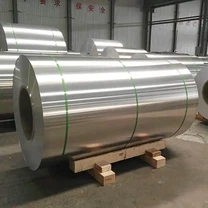
The 1050-H14 aluminum coil is a specialized material manufactured for heat exchanger fins in thermal management systems. Produced by GNEE, this aluminum features a minimum purity of 99.5 %, offering high thermal conductivity. Processed to an H14 half-hard temper, it achieves an optimal balance between rigidity and formability.
Aluminum coils are rolled to a precise thickness of 0.12 mm and supplied as 1200 mm wide master coils, subsequently slit into 98 mm strips. This specific alloy fulfills the rigorous demands of climate control units while maintaining strict dimensional tolerances for automated production.
Contact GNEE today to buy 1050-H14 aluminum coil for your commercial HVAC manufacturing line.
Send an Inquiry Now
1. Primary Uses and Applications of 1050-H14 Aluminum Coil
The 1050-H14 aluminum alloy is actively deployed across everyday thermal regulation devices, functioning as the primary conductive medium.
- Residential Split Air Conditioners: Indoor evaporators and outdoor condensers rely on 0.12 mm stamped fins to transfer heat. The 98 mm slit strips allow manufacturers to produce compact fin blocks for standard household units operating across typical 22°C room temperatures.
- Commercial Refrigeration Display Cases: Supermarket cooling cabinets utilize this aluminum fin stock to maintain consistent internal temperatures of 2 °C to 5 °C. High thermal conductivity ensures rapid frost recovery during defrost cycles, keeping grocery items chilled efficiently without overworking the compressor.
- Automobile Cabin Climate Control: Standard vehicles incorporate heating and cooling matrices constructed from these aluminum coils. The material forms densely packed fins that condition external air, managing passenger comfort levels inside the cabin throughout seasonal temperature fluctuations ranging from -20 °C to 40 °C.
- Dehumidifier Condensation Coils: Portable dehumidifiers use these metallic fins to create a cold surface where ambient moisture condenses. Drawing humid room air over the chilled strips facilitates rapid water droplet formation, extracting liters of moisture daily to prevent mold.

2. Key Benefits and Advantages of 1050-H14 Aluminum Coil for HVAC Fin Stock
- Optimized Heat Transfer Efficiency: Testing indicates an 8% improvement in heat-transfer efficiency versus previous 8011 alloy baselines. The 99.5 % purity enhances thermal conductivity, enabling faster dissipation of heat from circulating refrigerant into the surrounding air stream under standard operational conditions.
- Balanced Mechanical Strength: The H14 temper imparts a minimum yield strength of 85 MPa, providing stiffness to prevent the 0.12 mm fins from collapsing under forced airflow. This rigidity ensures uniform fin spacing, preventing detrimental airflow restriction during system operation.
- Excellent Stamping Formability: The metal's ductility allows high-speed presses to punch complex louvered patterns into 98 mm strips without micro-cracking. This structural integrity minimizes tool wear on stamping dies and reduces material scrap rates during high-volume commercial production runs.
- Inherent Corrosion Resistance: The pure aluminum composition forms a natural protective oxide layer, extending the functional lifespan of heat exchangers. This characteristic resists degradation from airborne humidity, maintaining thermal efficiency without requiring heavy secondary chemical coatings in damp environments.

International Equivalent Designations
| Designation System | Equivalent Name |
|---|---|
| Aluminum Association (AA) | 1050 |
| UNS | A91050 |
| ISO | Al 99.5 |
| EN (Europe) | EN AW-1050A |
| DIN (Germany) | Al99.5 |
| NF (France) | A5 / 1050A |
| BS (UK) | 1B |
| JIS (Japan) | A1050P |
| GB (China) | 1050A / 1A50 |
Chemical Composition (per ASTM B209 / EN 573-3)
| Element | Content (wt %) |
|---|---|
| Al | ≥ 99.50 |
| Fe | ≤ 0.40 |
| Si | ≤ 0.25 |
| Cu | ≤ 0.05 |
| Mn | ≤ 0.05 |
| Mg | ≤ 0.05 |
| Zn | ≤ 0.05 |
| Ti | ≤ 0.03 |
| V | ≤ 0.05 |
| Others (each) | ≤ 0.03 |
1050 Aluminum Coil Mechanical Properties
| Alloy-Temper | Tensile Strength (ksi) | Yield Strength (ksi) | Elongation (%) |
| 1050-H14 | 16 | 15 | 7 |
1050 Aluminum Specifications
| Product Type | Specification | Details |
|---|---|---|
| General Information | Alloy | 1050 |
| Temper | O, H12, H14, H16, H18, H24, H26, H28 | |
| Forms | Sheet, plate, strip, coil, circle & disc | |
| 1050 Aluminum Strip | Thickness | 0.08 – 3.0 mm |
| Ultra-thin: 0.08 – 0.5 mm | Standard: 0.5 – 3.0 mm | ||
| Width | 10 – 600 mm | |
| Coil Weight | 500 – 3000 kg (inner diameter: 150 / 300 / 505 mm) | |
| Slitting Precision | Width tolerance ±0.1 mm (<300 mm), ±0.2 mm (≥300 mm) | |
| 1050 Aluminum Coil | Thickness | 0.1 – 6.0 mm |
| Thin coil: 0.1 – 1.0 mm | Standard coil: 1.0 – 6.0 mm | ||
| Width | 100 – 2000 mm (slitting tolerance ±0.2 mm) | |
| Coil Diameter | OD 600 – 2000 mm (ID: 508 / 610 mm) |
Request technical specifications and secure your bulk order from a leading HVAC fin stock supplier.
3. Delivery Packaging and Inspection Standards
Stringent packing and incoming inspection protocols safeguard the physical integrity of aluminum coils during transit and verify foundational material properties.
- Raw-Material Purity Verification: Operators perform incoming inspections utilizing an OES spectrometer to confirm the chemical composition aligns with ASTM B209 mandates. This verification prevents contaminated metals from entering the casting phase, guaranteeing the required 99.5 % aluminum minimum.
- Real-Time In-Process Control: Manufacturing systems conduct continuous monitoring of casting temperatures, rolling reduction ratios, and specific annealing cycles. Adjusting variables ensures the exact H14 temper is achieved uniformly across the entire 1200 mm width of the master coil continuously.
- Secure Transit Packaging: Finished slit coils feature inner diameter core protection to prevent physical deformation of the fragile 0.12 mm gauge material. Moisture-barrier plastic wrapping and wooden palletization prevent oxidation and mechanical damage during international marine or overland transport operations.
- Comprehensive Material Certification: GNEE dispatches every verified shipment accompanied by an EN 10204 Type 3.1 mill test certificate. This documentation delivers complete traceability by providing exact chemical analysis and mechanical test results for the specific batch of aluminum delivered.

4. 1050 Aluminum Coil Quality Inspection
Final inspection procedures involve standardized laboratory testing methodologies to validate mechanical, dimensional, and microstructural characteristics of the finished aluminum strips.
- Mechanical Property Validation: Technicians execute standardized tensile testing according to ASTM E8 / E8M protocols to confirm tensile strength and elongation metrics. Hardness testing using ASTM E10 (Brinell) and ASTM E384 (micro-Vickers) methods guarantees the H14 temper meets exact engineering parameters.
- Dimensional Accuracy Verification: Measurement specialists verify coil thickness and width against EN 485-4 tolerance limits for surface appearance and dimensional accuracy. Mechanical properties are cross-referenced with EN 485-2, ensuring 98 mm slit strips feed flawlessly into automated high-speed fin press manufacturing machines.
- Metallographic Structure Analysis: Laboratory personnel conduct microstructural evaluations, utilizing ASTM E3 for specimen preparation and ASTM E112 for calculating exact grain size. Uniform grain distribution prevents surface defects when collars are drawn during the mechanical copper tube expansion process.
- Surface Condition Assessment: Quality control teams evaluate surface roughness utilizing ISO 4287 methodologies alongside visual inspections. Validating smooth surface parameters and conducting corrosion-resistance testing ensures the fins repel water droplet accumulation, preventing localized oxidation in damp operating environments effectively.

Source verified 1050-H14 aluminum directly from GNEE to optimize your thermal management manufacturing processes.
5. Future Development Prospects
The continuous evolution of domestic climate control applications directly dictates the required performance specifications for next-generation heat exchanger fin stock.
- Integration with Smart HVAC Systems: As air conditioners increasingly feature variable-speed inverter technology, fins must accommodate rapid shifts in refrigerant flow rates. The 1050-H14 material provides the necessary thermal responsiveness to support sensors constantly adjusting outputs to maintain precise room temperatures.
- Adaptation for Low-GWP Refrigerants: The transition to environmentally friendly refrigerants requires highly optimized coil designs with reduced internal volumes. Thinner, more efficient aluminum fin designs constructed from 98 mm strips allow manufacturers to shrink total heat exchanger sizes while maintaining capacity.
- Enhanced Heat Pump Deployment: Electrification trends drive widespread adoption of cold-climate heat pumps operating in sub-zero environments. Aluminum fins must efficiently manage severe frosting and rapid thermal shock during high-temperature defrost cycles without suffering mechanical fatigue or losing structural integrity.
- Acoustic Optimization in Compact Units: Consumer demand for quieter indoor air handlers forces engineers to redesign fin geometries to minimize air turbulence. The ductility of the 0.12 mm H14 alloy enables stamping intricate wavy patterns that smooth airflow, significantly reducing operational decibels.
Secure exact material specifications by contacting GNEE, a certified aluminum foil and coil supplier.
Conclusion
The 1050-H14 aluminum coil manufactured by GNEE provides a controlled raw material critical for modern heat transfer applications. By maintaining chemical limits under ASTM B209 and validating mechanical performance through EN 485-2, this product ensures seamless integration into high-speed stamping operations.
The documented 8 % improvement in heat-transfer efficiency over 8011 alternatives highlights its functional superiority. Supported by EN 10204 Type 3.1 certification and rigorous metallographic testing, these precise 0.12 mm thick, 98 mm wide strips reliably facilitate efficient thermal regulation across residential and commercial climate systems worldwide.