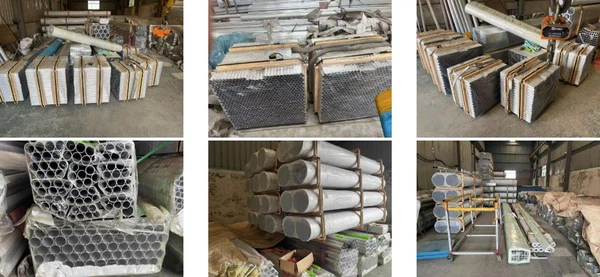
7075-T6 aluminum alloy, supplied by GNEE, is a high-strength material originally developed for aircraft and aerospace applications and is widely known as aircraft-grade aluminum. Alloyed primarily with zinc and copper, 7075 ranks among the strongest aluminum alloys available on the market.
In the T6 temper, 7075 aluminum exhibits strength levels that exceed most mild steels. It offers good machinability and good corrosion resistance, though it is generally not recommended for welding. 7075-T651 aluminum shares similar mechanical properties with T6 but undergoes an additional stress-relieving process, resulting in improved dimensional stability.
GNEE supplies Aluminum Alloy 7075 in T6 and T651 tempers, available in plate and round bar forms.

Alloy Designation and Composition
Alloy Name: 7075
Chemical Formula: Al Zn5.5 Mg Cu / Al Zn Mg Cu1.5
Temper: T6 (F48–52)
Chemical Composition (EN 573-3)
| Element | Si | Fe | Cu | Mn | Mg | Cr | Ni | Zn | Ti | Other (Each) | Other (Total) |
|---|---|---|---|---|---|---|---|---|---|---|---|
| % Max / Range | 0.4 | 0.5 | 1.2–2.0 | 0.3 | 2.1–2.9 | 0.18–0.28 | – | 5.1–6.1 | 0.2 | 0.05 | 0.15 |
Composition in weight %, balance aluminum
Material standard: EN 573-3:2013
Physical & Mechanical Properties (7075-T6)
Brinell Hardness: 150
Rockwell Hardness (A): 53.5
Rockwell Hardness (B): 87
Vickers Hardness: 175
Ultimate Tensile Strength: 572 MPa (83,000 psi)
Yield Strength: 503 MPa (73,000 psi)
Elongation at Break: 11%
Key Features of 7075 Aluminum
Strength comparable to many steel grades
Excellent fatigue resistance
Moderate machinability
Capable of achieving a highly polished surface finish
Typical Applications
Marine, automotive, and aviation industries
Hang glider airframes
Rock climbing and safety equipment
Bicycle components
Is 7075 Aluminum as Strong as Steel?
In many practical cases, 7075-T6 aluminum, supplied by GNEE, achieves tensile strengths in the range of 510–570 MPa, which is comparable to certain mild steels that typically fall between 400 and 550 MPa. However, higher-carbon and alloy steels can exceed 800 MPa, meaning 7075 aluminum is not stronger than all steel grades. Even so, its strength-to-weight ratio is significantly superior to that of steel, which is a key advantage in weight-sensitive applications.
Is 7075 Aluminum Durable?
From an engineering perspective, 7075 aluminum offers excellent durability due to its high fatigue strength (around 160 MPa), strong resistance to permanent deformation, and stable mechanical behavior under sustained loads. These characteristics make it a preferred material for aerospace and defense components that require long-term structural reliability.
Can 7075 Aluminum Be Bent?
7075 aluminum has limited bendability, particularly in the T6 or T651 tempers, where tensile strength above 500 MPa significantly reduces formability. In many applications, bending in these conditions can lead to cracking unless the material is softened to the O temper, which greatly improves ductility. While the alloy machines well, it is generally not well suited for forming operations.
Why Is 7075 Aluminum More Expensive?
7075 aluminum is typically more costly due to its high alloying content, including zinc, magnesium, and copper, as well as the complex heat-treatment processes required to achieve tempers such as T6 or T73. In addition, aerospace-grade standards, strict quality controls, and superior mechanical performance all contribute to higher production and market costs.
Is 7075 Aluminum Stronger Than Titanium?
When comparing materials, 7075-T6 aluminum provides tensile strength in the range of 510–570 MPa, while Grade 5 titanium reaches approximately 900 MPa, making titanium stronger in absolute terms. However, 7075 aluminum offers a better strength-to-weight ratio and is significantly easier to machine, which is why GNEE often recommends it for lightweight structural components where efficiency and manufacturability are critical.