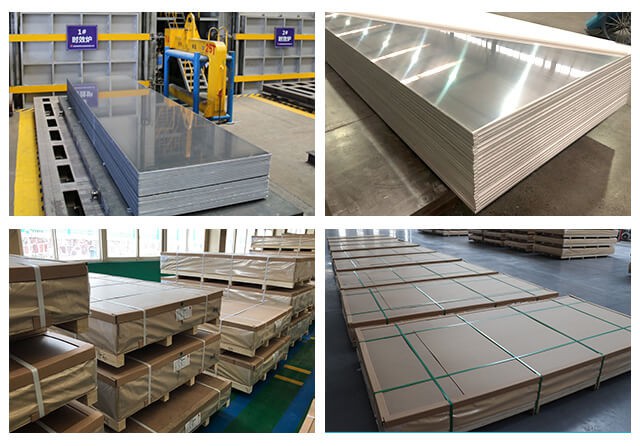
Stop fighting rust with heavy steel and expensive coatings. For environments exposed to moisture and industrial air, the 3003 anti-rust aluminum plate is the industry standard. It perfectly balances corrosion resistance, structural strength, and material cost for large-scale manufacturing.
3003 Anti-Rust Aluminum Plate vs Carbon Steel
In traditional manufacturing, carbon steel is the default choice for structural panels. However, steel has a fatal flaw: red rust. To stop steel from rusting, factories must spend money on galvanizing, heavy powder coating, or constant maintenance painting. The moment the paint chips, moisture enters, and the steel rusts from the inside out.
The 3003 anti-rust aluminum plate solves this problem fundamentally. It is an Al-Mn (Aluminum-Manganese) alloy. When exposed to air or water, the aluminum instantly forms a dense, transparent oxide layer on its surface. This layer acts as a natural shield. If scratched, the oxide layer self-heals instantly.
Furthermore, the addition of manganese makes 3003 aluminum highly resistant to industrial pollution and mild chemical exposure. You get a material that never develops red rust, eliminates the need for expensive anti-corrosion coatings, and weighs about 65% less than a carbon steel plate of the same thickness. For project managers looking to reduce long-term maintenance costs and product weight, 3003 aluminum is the ultimate upgrade.
Technical Specs of 3003 Aluminum Sheet
To ensure your production line runs without interruptions, your raw material must meet strict international standards. Below are the typical specifications for our industrial-grade 3003 anti-rust aluminum.
| Item | Specification Parameter |
| Alloy | 3003 Aluminum |
| Temper Options | O (Annealed) / H14 / H24 |
| Thickness Range | 0.5 mm – 10.0 mm |
| Max Width | Up to 2200 mm |
| Tensile Strength | 120 – 180 MPa |
| Yield Strength | ≥ 95 – 115 MPa |
| Elongation | ≥ 10% |
| Density | ~2.73 g/cm³ |
| Standard | ASTM B209 / EN 485 |
3003 Aluminum Sheet vs 1060 Aluminum Plate
When buyers need corrosion resistance, they often look at the 1000 series, like 1060 pure aluminum. While 1060 has excellent anti-rust properties and is very affordable, it lacks mechanical strength.
If you manufacture roofing sheets or equipment housings using 1060 aluminum, the final product will be too soft. A strong gust of wind or a minor impact will dent and deform the panel.
By adding manganese to the alloy, 3003 aluminum plate increases its overall strength by roughly 20% to 30% compared to the 1060 series. You retain the excellent rust-proof characteristics of pure aluminum, but you gain enough rigidity to hold a structural shape. This makes 3003 the most practical "strong and rust-proof" choice for general industrial applications.
3003-O vs 3003-H14 Aluminum Plate
The temper of the aluminum dictates how it will behave on your factory floor. 3003 is highly formable, but you must choose the right temper for your machinery.
- 3003-O Aluminum (Fully Annealed): This is the softest state. It has the highest elongation. If your factory uses deep drawing presses to make seamless containers or complex stamped housings, the O temper will flow into your dies without tearing or cracking.
- 3003-H14 Aluminum (Half-Hard): This is the most popular temper for general fabrication. It is strain-hardened to a half-hard condition. It is perfect for press brake bending, roll forming, and shearing. It bends cleanly at 90 degrees without cracking, making it ideal for folding box-shaped equipment housings or truck body panels.
- 3003-H24 Aluminum (Partially Annealed): Similar in strength to H14, but it has been partially heated to remove internal residual stress. This means it will stay flatter after you punch holes in it, which is crucial for perforated architectural panels.
3003 Aluminum vs 5052 Aluminum Plate
This is the most common debate among purchasing managers. Both 3003 and 5052 are excellent anti-rust aluminum plates. However, they serve different budgets and environments.
5052 aluminum contains magnesium. It is significantly stronger than 3003 and has superior resistance to saltwater corrosion. Because of this, 5052 is classified as "marine-grade" aluminum. However, 5052 is noticeably more expensive per ton.
If you are building a boat or offshore equipment, you must buy 5052. But if you are building an inland storage tank, a standard commercial truck trailer, or roofing for a warehouse, a 3003 anti-rust aluminum plate is more than sufficient. Choosing 3003 over 5052 in these scenarios prevents over-engineering and saves you a massive amount of project budget while still delivering decades of rust-free performance.
Applications of 3003 Anti-Rust Aluminum Plate
1. Construction and Architecture
Buildings must survive decades of rain, snow, and humidity. 3003 aluminum is widely roll-formed into corrugated roofing sheets, standing seam roofs, and exterior wall cladding. Because it never rusts, building owners save heavily on roof replacement and maintenance. Its light weight also reduces the load on the building's structural frame.
2. Transportation and Commercial Vehicles
For truck builders, every kilogram of vehicle weight equals wasted fuel and lost cargo capacity. By replacing steel truck bodies, trailer side panels, and vehicle flooring with 3003 aluminum sheets, manufacturers reduce the tare weight of the vehicle by hundreds of kilograms. This increases the legal payload capacity for the transport company. Furthermore, the truck body won't rust away from road salt or rain.
3. Storage and Industrial Equipment
In factories, 3003 is the standard for low-pressure liquid storage tanks, water towers, and ventilation ductwork. It handles the humidity of water treatment plants and the mild chemical exposure of industrial zones without degrading.

Surface Treatments for 3003 Aluminum Coil
While bare 3003 aluminum offers great natural protection, many applications require specific colors or enhanced surface properties. 3003 is a fantastic substrate for surface finishing :
- PE or PVDF Color Coating: For architectural roofing and cladding, we supply 3003 aluminum coils pre-painted with PE (for standard use) or PVDF (for 20-year UV protection). The manganese in the alloy helps the paint adhere tightly, preventing peeling over time.
- Anodizing: 3003 can be anodized to create a thicker, harder oxide layer, which is useful for decorative panels or equipment housings that need scratch resistance.
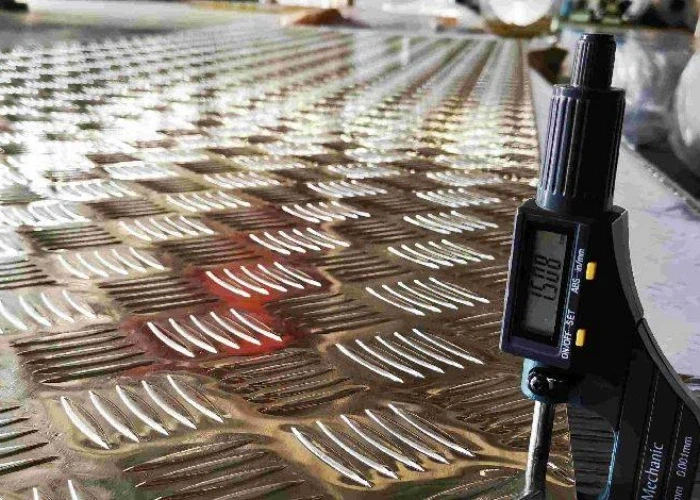
- Embossing: We often supply 3003 anti-rust plate with a stucco-embossed surface. This textured finish hides fingerprints and minor scratches and reduces light glare, making it popular for interior freezer linings and toolboxes.
Processing 3003 Aluminum on the Shop Floor
Factory managers love 3003 aluminum because it does not destroy their tooling.
- Cutting: It can be cut rapidly and cleanly with CNC laser cutters, waterjets, or standard mechanical shears without leaving heavy burrs.
- Forming: The predictable springback of the H14 temper means CNC press brake operators can program their bending angles with high accuracy, reducing scrap rates.
- Welding: It is easily welded using TIG or MIG processes. The weld seams are stable and retain good corrosion resistance.
Why Buyers Choose GNEE
- Strict Chemical Control: We rigorously monitor the manganese and impurity levels during casting. This ensures that every batch of 3003 aluminum plate delivers the exact anti-rust performance you expect.
- Flawless Surface Quality: Our rolling mills produce sheets that are clean, flat, and free from oil stains, roll marks, or oxidation-ready for direct use or immediate painting.
- Flexible Supply Chain: Whether you need 10-ton coils for continuous roll-forming or custom-cut flat sheets for laser cutting, we manufacture to your exact dimensional needs.
- Global Export Expertise: We have successfully supplied the construction, transport, and industrial sectors worldwide, ensuring stable lead times and transparent communication.
Industrial Export Packaging
Your 3003 anti-rust aluminum plates are stacked on heavy-duty, fumigated wooden pallets. We place protective paper between the sheets to prevent friction scratches. The entire stack is then sealed in waterproof plastic, wrapped in thick kraft paper, and banded with steel straps with edge protectors. This guarantees the metal arrives at your factory completely dry, flat, and ready for production.
Ready to secure a reliable supply of 3003 anti-rust aluminum for your next manufacturing run or construction project? To help us give you the most accurate and aggressive pricing, please send us an inquiry including :
- Thickness (mm) & Dimensions (Width x Length)
- Required Temper (O, H14, or H24)
- Total Quantity (in tons)
- Specific Application (e.g., roofing, tank building)
- Surface Needs (Mill finish, PE coated, embossed)
Email our expert export team right now. We will review your requirements and reply with a complete quotation and shipping schedule within 24 hours.