When sourcing medium-strength, rustproof flat-rolled aluminum, you will inevitably land on the 3003 aluminum sheet. They either overpay for 5052 marine-grade aluminum when they do not need it, or they buy the wrong temper of 3003 and face massive cracking issues during their CNC press brake operations.
The Reality of the 3xxx Series Alloy
3003 is an AL-Mn (Aluminum-Manganese) alloy. By adding approximately 1.2% manganese to commercially pure aluminum (like the 1100 series), the strength increases by about 20% without sacrificing excellent workability and corrosion resistance.
Because it lacks significant magnesium or copper, it is a non-heat-treatable alloy. You cannot make it stronger by baking it in an aging oven. Its strength is entirely determined by cold working (strain hardening) at the rolling mill. This is where choosing the right temper becomes the single most important decision for your purchase order.
Choosing the Right Temper: 3003 H14 vs 3003 H24 vs 3003 O
3003 H14 Aluminum Sheet (Half-Hard, Strain Hardened)
The "H1" means the metal was purely cold-rolled to its final thickness to achieve its half-hard strength. It receives no thermal treatment afterward.
- Best for: Flat architectural panels, roofing profiles, and parts that require moderate rigidity but minimal sharp bending.
- The Trap: Because the internal stress from cold rolling is still inside the metal, 3003 H14 has lower ductility. If you try to bend a 3mm H14 sheet to a sharp 90-degree angle with a tight die radius, the outer edge will likely micro-fracture or exhibit "orange peeling."
3003 H24 Aluminum Plate (Half-Hard, Partially Annealed)
The "H2" means the metal was cold-rolled to a harder state and then put into a controlled furnace for partial annealing. This thermal relaxation relieves the internal stresses while maintaining the same general ultimate tensile strength as H14.
- Best for: Complex sheet metal fabrication, HVAC ductwork folding, and deep-draw stamping.
- The Advantage: H24 offers noticeably better elongation and bendability than H14. If your production involves flanging, hemming, or sharp press braking, always specify the H24 temper. It significantly reduces the scrap rate in your workshop.
3003 O Aluminum Sheet (Fully Annealed)
The "O" stands for fully annealed (dead soft). The aluminum is baked until all work-hardening is removed.
- Best for: Extreme deep-drawing applications like cooking pots, pans, baking sheets, and spun aluminum reflectors. It has the lowest strength but the highest ductility. You can deform it massively without it breaking.
Verified Chemical and Mechanical Data
Below are the standard specifications we guarantee at GNEE, strictly adhering to ASTM B209 and EN 485 standards.
Table 1: 3003 Aluminum Chemical Composition Limits (%)
| Element | Minimum (%) | Maximum (%) |
| Manganese (Mn) | 1.00 | 1.50 |
| Iron (Fe) | 0.00 | 0.70 |
| Silicon (Si) | 0.00 | 0.60 |
| Copper (Cu) | 0.05 | 0.20 |
| Zinc (Zn) | 0.00 | 0.10 |
| Aluminum (Al) | Balance | Balance |
Table 2: Mechanical Properties by 3003 Temper
| Temper | Tensile Strength (MPa) | Yield Strength (MPa) | Elongation (%) | Safe 90° Bend Radius |
| 3003-O | 95 - 130 | ≥ 35 | 25 - 30% | 0t (Flat) |
| 3003-H14 | 145 - 195 | ≥ 125 | 4 - 8% | 1.0t - 2.0t |
| 3003-H24 | 145 - 195 | ≥ 115 | 6 - 10% | 0.5t - 1.5t |
(Note: "t" represents the thickness of the sheet. A smaller bend radius means it can be bent sharper without cracking.)
What is 3003 Aluminum Used for?
| Application | Description |
|---|---|
| Roofing and siding | Provides corrosion-resistant protection for residential and commercial buildings |
| Food and beverage packaging | Used in the production of cans for food and beverage products |
| Heat exchangers | Employed in air conditioning, refrigeration, and automotive cooling systems |
| Chemical equipment | Suitable for tanks, pipes, and fittings in corrosive chemical processing |
| Cooking utensils | Used for pots, pans, and baking sheets with excellent heat distribution properties |
| General sheet metal work | Ideal for fabrication and welding in automotive, construction, and signage industries |
| HVAC systems | Commonly used in ductwork, air handlers, and heat exchanger components in HVAC systems |
| Application | 3003 Aluminum Temper |
|---|---|
| Roofing, Siding, Architectural Components | 3003 H14 Aluminum Plate |
| Food and Beverage Cans | 3003 H16/H18 Aluminum Plate |
| Heat Exchanger Fins | 3003 H24 Aluminum Plate |
| Storage Tanks | 3003 H24 Aluminum Plate |
| General Sheet Metal Work | 3003 H24 Aluminum Plate |
| Cookware | 3003 H22 Aluminum Plate |
| Electrical Wiring | 3003 O Aluminum Plate |
| Reflectors | Varies |
| Chemical Equipment | Varies |
| Packaging Foils | Varies |
How We Calculate Your Cost at GNEE
Final Price = Daily SMM A00 Aluminum Ingot Price + Mill Processing Fee.
- The Ingot Base: We use the real-time SMM (Shanghai Metals Market) base rate. This ensures you are buying at the true global commodity price.
- The Processing Fee: This covers the rolling, tempering, and packaging costs. Keep in mind that thinner sheets (e.g., 0.5mm) require more passes through the rolling mill than thicker plates (e.g., 4.0mm), so the processing fee per ton is slightly higher for thinner gauges. Similarly, H24 costs slightly more to produce than H14 because it requires an extra step in the annealing furnace.
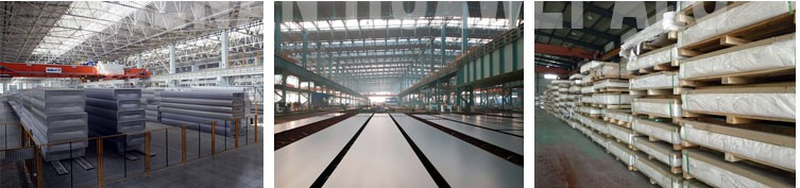
GNEE's Manufacturing Strength & Export Packaging
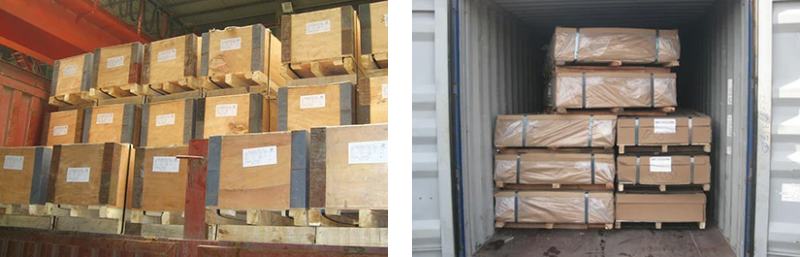
At GNEE, we don't cut corners on packaging. Every single pallet of 3003 aluminum sheet is packed using our strict 4-layer export protocol:
- Inner Layer: Tightly wrapped in moisture-proof clear PE film.
- Protection Layer: Wrapped in heavy-duty waterproof craft paper.
- Moisture Control: Industrial desiccant packets are placed inside the wrapping to absorb any trapped condensation.
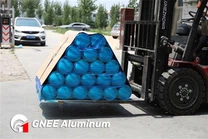
- Structural Integrity: Placed on ISPM-15 fumigated wooden pallets, secured with high-tension steel banding, and wrapped in a final layer of blue PVC canvas to ensure zero movement and zero moisture penetration inside the shipping container.