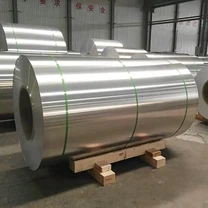
Battery aluminum foil has significantly higher requirements than traditional aluminum foil in all aspects.
First, the cleanliness is high, and no debris, dust, especially iron filings, should be mixed into the aluminum coil;
Second, the plate shape is required to be high. The uniformity of the positive electrode material coated on the surface of the aluminum foil will greatly affect the service life and endurance of the lithium-ion battery. Usually the plate shape needs to be controlled below 10I;

Third, the mechanical properties are required to be high. While the purity of the aluminum remains unchanged, it is required to have high tensile strength and high elongation, and the elongation is required to be ≥3%. It is actually difficult to achieve both;
Fourth, the thickness and pinholes require a high thickness difference of ≤±3%. However, a reduction in the thickness of the aluminum foil will inevitably lead to an increase in the number of pinholes, increase the possibility of strip breakage during the rolling process, and seriously affect its quality. This puts forward further requirements for aluminum foil. high demands;
Fifth, the surface requirements are extremely high. There must be no dark bright spots, black oil lines, pits and other surface defects on the surface. This is directly related to the uniform coating and compaction process of lithium-ion batteries, and is also critical to the cleaning of aluminum foil machines. The requirements for safety and environmental cleanliness are quite high;
Sixth, the dyne value is required to be high. In order to ensure the coating quality, the dyne on the surface of the aluminum foil should be above 31 dyne, and some customers even require it to be higher than 33 dyne.

There are two types of lithium battery positive electrode aluminum foil: flat foil and surface modified foil. Flat foil has high strength, high conductivity and high flatness; surface-modified foil greatly improves the adhesion of active materials due to surface roughening, while reducing the amount of adhesive and improving battery characteristics.
The cathode current collector aluminum foil of high-end power batteries has a high technical content. Aluminum foil for current collectors is mainly made of 1060, 1070, 1100, 1235, 3003 and other alloys. The mainstream thickness specification is 10-20μm, and some battery manufacturers use 8μm. The future direction is to continue to thin, even to 6μm. At the same time, battery factories have higher requirements for strength, so the production of battery cathode aluminum foil is not as simple as imagined.
Most of the existing lithium battery cathode aluminum foils supplied in batches can meet the needs of mid-to-low-end lithium batteries, and high-end products have a certain threshold. The tensile strength Rm of ordinary-grade battery foil is between 150 N/mm2 and 180 N/mm2. Generally, battery foil can reach ordinary grade. However, only some manufacturers can mass-produce products with high strength, high precision, high surface quality, etc. .