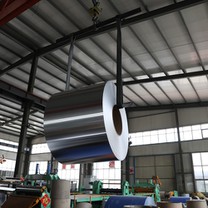
Aluminum foil for lithium-ion batteries is divided into: aluminum foil for lithium battery cathode current collectors, aluminum foil for lithium battery outer packaging aluminum plastic film, and aluminum foil for tabs. The commonly referred to battery aluminum foil refers to the aluminum foil used for the positive electrode current collector of lithium batteries. On the one hand, the battery positive electrode foil is the current collector electrode, and on the other hand, it is the carrier of the lithium battery positive electrode material, that is, the lithium battery material must be coated on it.
Battery aluminum foil is an important raw material for lithium battery production. The positive electrode consists of positive electrode tabs, high-temperature tape, positive electrode current collector aluminum foil and positive electrode material. The thickness of the positive electrode current collector aluminum foil is generally 0.010mm-0.015mm.

There are two types of lithium battery positive electrode aluminum foil: flat foil and surface modified foil. Flat foil has high strength, high conductivity and high flatness; surface-modified foil greatly improves the adhesion of active materials due to surface roughening, while reducing the amount of adhesive and improving battery characteristics.
The cathode current collector aluminum foil of high-end power batteries has a high technical content. Aluminum foil for current collectors is mainly made of 1060, 1070, 1100, 1235, 3003 and other alloys. The mainstream thickness specification is 10-20μm, and some battery manufacturers use 8μm. The future direction is to continue to thin, and may even be reduced to 6μm.

Aluminum foil is mainly divided into hot rolling and continuous casting and rolling. Double zero foil, single zero foil, battery foil, etc. used in general industry are basically pure aluminum series and are more suitable for continuous casting and rolling. Although the requirements for battery foil are significantly higher than ordinary 0.1mm aluminum foil, the production technology and process are basically the same. For example, after the demand for lithium battery aluminum foil increased significantly, Dingsheng New Materials converted the double-zero foil produced at the Hangzhou base into battery foil.
Positive current collector aluminum foil is used in ternary batteries, lithium iron phosphate batteries, sodium-ion batteries, etc. Therefore, when we measure the demand for battery aluminum foil, we should distinguish between different battery systems. According to Xinchen lithium battery data, each GWh ternary battery requires 300-450 tons of battery foil, and each GWh lithium iron phosphate battery requires 400-600 tons of battery aluminum foil; while in sodium-ion batteries, since both the positive and negative electrodes use aluminum foil, every Gwh sodium battery 700-1000 tons of aluminum foil are needed.
The imminent commercialization of sodium-ion batteries will further increase the demand for battery aluminum foil. The main advantage of sodium-ion batteries is that they are low cost and are not subject to resource constraints. As related technologies and industrial chains mature, the cost is expected to drop further. It is expected to have good application scenarios such as electric two-wheelers, low-speed electric vehicles, energy storage, start-stop, etc. Prospects. According to the latest calculations by EVTank, theoretically, with 100% penetration rate, the market space of sodium-ion batteries can reach 369.5GWh in 2026; the battery aluminum foil consumption of sodium-ion batteries is about 800 tons/GWh, corresponding to the battery aluminum foil consumption in 2025. Reaching 295,600 tons.