


When fabricating heavy-duty marine structures, pressure vessels, or specialized industrial equipment, engineers often select the 5xxx series aluminum alloys for their exceptional strength and corrosion resistance. However, a common challenge arises on the factory floor during the CNC manufacturing process.
Understanding the machining characteristics of this specific alloy is critical for production managers aiming to optimize tool life, reduce cycle times, and maintain strict dimensional tolerances.
Is 5083 aluminum easy to machine?
5083 aluminum has moderate to poor machinability compared to other aluminum alloys such as 6061. Due to its high magnesium content and strain-hardened structure, it tends to produce built-up edges on cutting tools and requires optimized machining parameters. However, with proper tooling and cutting conditions, it can still be machined effectively for marine and structural applications.
For machine shops accustomed to cutting general-purpose structural alloys, switching to this marine-grade metal requires immediate adjustments to CNC spindle speeds, feed rates, and coolant strategies.
When fabricating heavy-duty marine structures, pressure vessels, or specialized industrial equipment, engineers often select the 5xxx series aluminum alloys for their exceptional strength and corrosion resistance. However, a common challenge arises on the factory floor during the CNC manufacturing process. Understanding the machining characteristics of this specific alloy is critical for production managers aiming to optimize tool life, reduce cycle times, and maintain strict dimensional tolerances.
Is 5083 aluminum easy to machine?
5083 aluminum has moderate to poor machinability compared to other aluminum alloys such as 6061. Due to its high magnesium content and strain-hardened structure, it tends to produce built-up edges on cutting tools and requires optimized machining parameters. However, with proper tooling and cutting conditions, it can still be machined effectively for marine and structural applications.
For machine shops accustomed to cutting general-purpose structural alloys, switching to this marine-grade metal requires immediate adjustments to CNC spindle speeds, feed rates, and coolant strategies.
Struggling with material deformation during CNC machining? Contact the GNEE engineering sales team to discuss how selecting the right plate thickness and flatness tolerances can instantly improve your machining efficiency.

Machinability Comparison of Common Aluminum Alloys vs 5083 H116 Aluminum Sheet
To provide a clear baseline for CNC programmers and production planners, the following table compares how 5083 behaves under cutting tools relative to other widely used industrial aluminum grades.
| Alloy | Machinability Rating | Notes / Cutting Behavior |
| 5083 | Moderate to Poor | High Mg content, gummy behavior, prone to tool sticking |
| 5052 | Moderate | Similar gummy characteristics, but lower overall strength |
| 6061 | Excellent | Easy to machine, forms short chips, excellent finish |
| 7075 | Good | High strength, machines cleanly but causes faster tool wear |
When substituting 6061 with 5083 to meet marine classification requirements, operators must anticipate longer machining cycle times and increased tool maintenance.
Why 5083 H116 Marine Grade Aluminum Is Difficult to Machine
The relatively high magnesium content (4.0–4.9%) in 5083 aluminum increases its strength and corrosion resistance but also makes the material softer and more prone to sticking during machining. This leads to built-up edge (BUE) formation, tool wear, and reduced surface finish quality.
From a metallurgical perspective, the "gummy" nature of high-magnesium aluminum prevents it from shearing cleanly under a cutting edge. Instead of fracturing into neat, small chips, the metal tends to tear and weld itself to the cutting tool due to the heat generated by friction. This built-up edge alters the tool's geometry, pushing the material rather than cutting it, which results in a smeared surface finish and out-of-tolerance dimensions.
Furthermore, the H116 strain-hardened temper introduces internal stresses that can cause thinner plates to warp slightly when large amounts of material are milled away rapidly.

How to Improve Machining of 5083 H116 Aluminum Alloy
Despite these inherent metallurgical challenges, high-precision components can absolutely be manufactured from this alloy. CNC operators simply need to pivot away from standard aluminum cutting strategies and adopt techniques designed for gummy materials.
Recommended Practices:
- Use sharp carbide tools: High-speed steel (HSS) tools wear too quickly and generate excess friction. Use polished, uncoated solid carbide end mills with high positive rake angles to shear the material cleanly.
- Apply high cutting speeds + low feed rates: A high spindle RPM combined with a moderate-to-low feed rate helps eject the chip before it has time to weld to the cutter.
- Use coolant or lubrication: Flood coolant is highly recommended. High-pressure, water-soluble coolants lower the cutting zone temperature and provide the lubricity needed to prevent built-up edge.
- Avoid tool dwell time: Never let the tool pause or rub against the workpiece while spinning, as the friction will immediately melt the magnesium-rich aluminum onto the flute.
- Use proper chip evacuation: Utilize tools with fewer flutes (e.g., 2-flute or 3-flute end mills) to provide larger gullets, allowing the long, stringy chips characteristic of 5083 to escape the cutting zone without packing.
Proper machining strategies can significantly improve surface finish and tool life when working with 5083 aluminum.
Does Temper Affect Machinability? (5083 H116 Aluminum Metal vs H321)
While the chemical composition is the primary driver of machining difficulty, the specific temper (the mechanical processing the metal underwent at the mill) also plays a subtle role in how the metal behaves on the CNC bed.
| Temper | Machinability | Notes |
| H116 | Moderate | Strain-hardened, heavily optimized for marine environments |
| H321 | Slightly better | Strain-hardened and stabilized structure |
5083 H321 temper may offer slightly better machinability due to its stabilized structure. Because the 5083 H321 process involves a low-temperature thermal treatment to lock in mechanical properties, it relieves some internal stresses. For heavy milling operations where significant material is removed, 5083 H321 plates often exhibit slightly better dimensional stability (less warping) compared to standard 5083 H116.
Not sure whether to specify H116 or H321 for your machined components? Contact GNEE today. We supply both tempers with full marine certifications and can advise on the best option for your specific CNC setup.
Applications Where Machining of 5083 H116 Aluminum Sheet Is Required
While much of this alloy is used as flat sheet plating for ship hulls, numerous complex components must be milled, drilled, and tapped from thick plates or extrusions.
- Marine components: Custom deck fittings, watertight door hinges, and heavy-duty mounting brackets that require exact geometric tolerances to maintain seals.
- Shipbuilding structures: Propulsion mounting beds and rudder housing components milled from thick solid plates to absorb intense engine vibrations.
- Offshore equipment: Valve bodies, flange connections, and manifold blocks used on oil rigs where resistance to saltwater is non-negotiable.
- Pressure vessels: Machined end-caps, custom nozzles, and port flanges for cryogenic storage tanks (LNG transport).
- Structural parts: High-load military or railway transit components where weight reduction is prioritized without sacrificing yield strength.
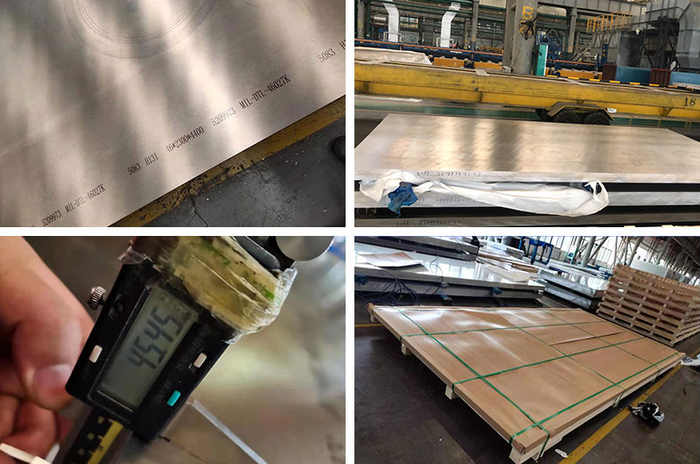
Material Supply Considerations for 5083 H116 Aluminum Extrusions Projects
When machining 5083 aluminum, material consistency, flatness, and size accuracy are critical to ensure efficiency and reduce machining costs.
If a factory purchases plates with poor flatness tolerances, CNC operators must spend hours facing the material just to create a flat datum point, wasting expensive machine time and generating heavy scrap. Furthermore, inconsistent internal stresses from low-quality mills will cause the metal to distort midway through a precision milling operation.
Flexible Supply of 5083 H116 Certified Aluminum Plates from GNEE
Procuring raw materials engineered for machining efficiency is the first step in profitable production. GNEE provides flexible supply solutions for 5083 aluminum plates and sheets tailored for machining applications:
✔ Multiple tempers available: H116, H321, H111, H112
✔ Multi-standard support: EN AW-5083, AA 5083, DIN, JIS equivalents
✔ Custom sizes: Customized thickness, width, and length processing to minimize your initial roughing passes and reduce machining waste
✔ High flatness: Premium flatness tolerances and stable internal quality for reliable vacuum-table CNC processing
✔ Mixed specifications and bulk orders supported
This helps manufacturers improve machining efficiency and reduce material costs. By starting with dimensionally accurate, stress-controlled plates, your factory can maximize spindle uptime.

Frequently Asked Questions About 5083 H116 Aluminum Material
Procurement and manufacturing teams frequently coordinate to resolve technical challenges regarding this alloy. Below are direct answers to the most common machining questions.
Ready to source high-flatness, machining-ready aluminum? GNEE supplies fully traceable 5083 marine plates with custom dimensions to reduce your CNC scrap rates.
Contact our B2B sales team to secure your project pricing and international logistics today.


