Yes, 3003 aluminum is excellent for bending. Its high ductility (the ability to be stretched without breaking) and moderate strength make it one of the most formable aluminum alloys available. You can form it into complex shapes with a very low risk of cracking, especially when using softer tempers like O (annealed) or H14.
What Is 3003 Aluminum?
Think of 3003 aluminum as the tougher cousin of pure aluminum (1100 series). It's part of the 3xxx series, which means its main alloying element is manganese (about 1.2%). This small addition of manganese gives it about 20% more strength than pure aluminum, without sacrificing its best quality: formability.
Here are the key things to remember about 3003 aluminum:
- Alloy Family: Al-Mn (Aluminum-Manganese)
- Strength: Moderate. It's not built for heavy structural loads.
- Ductility: Excellent. This is the core reason it bends so well.
- Heat Treatment: It is a non-heat-treatable alloy. Its strength comes from cold working (strain hardening), not from a heating and cooling process.
The key takeaway is that its excellent plasticity is what makes it a top choice for bending applications.
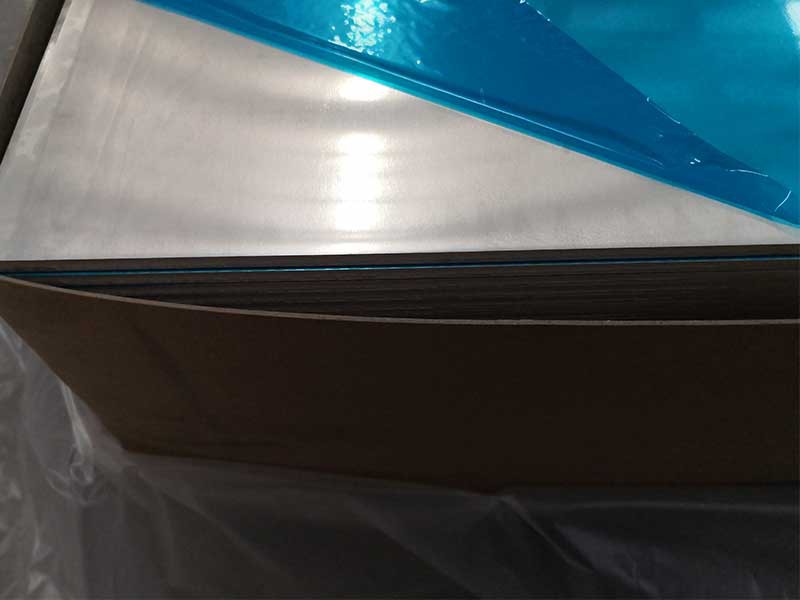
Bending Performance of 3003 Aluminum Sheet
When it comes to bending, 3003 aluminum stands out for a few simple reasons:
- Easy to Form: It requires less force to bend compared to stronger alloys like 5052 or 6061. This can make your fabrication process faster and more energy-efficient.
- Resists Cracking: The high elongation of 3003 means it can stretch significantly on the outer radius of a bend without fracturing. This is a huge advantage, reducing scrap and ensuring the integrity of your parts.
- Great for Complex Shapes: Because it's so forgiving, you can use it for deep drawing, spinning, and creating parts with multiple or tight bends.
Conclusion: For any job where formability is the number one priority, 3003 aluminum is one of the best, most reliable choices you can make.
Minimum Bend Radius for 3003 Aluminum
The "minimum bend radius" is a critical number in engineering. It tells you the tightest corner you can bend a sheet of a certain thickness without causing damage. The rule is simple: the softer the material, the smaller the bend radius can be.
For 3003 aluminum, the bend radius depends heavily on its temper, which refers to its hardness from cold working. Here's a simple table showing the relationship. The "t" stands for the thickness of the sheet.
| Temper | Minimum Bend Radius |
| O (Annealed) | 0t – 1t |
| H14 (Half-Hard) | 0t – 2t |
| H18 (Full-Hard) | 2t – 3t |
What this table tells you is that a fully soft (O temper) 3003 aluminum sheet can often be folded completely back on itself (a 0t radius). Even the commonly used 3003-H14 aluminum, which offers a good balance of strength and formability, can handle very tight bends. As the material gets harder (like H18), you need to use a larger radius to avoid cracking.
Are you fighting with your current material over tight bend radii? If cracking is causing delays, you might be using the wrong alloy or temper. Contact our technical support team for a free material consultation. We can help you select the perfect bending-friendly material for your project.
How Temper Affects Bending 3003 Aluminum
Choosing the right temper is just as important as choosing the alloy itself. For 3003 aluminum, the temper dictates its forming behavior.
| Temper | Formability | Notes |
| O (Annealed) | Excellent | This is the softest state. It's the easiest to bend and perfect for the most complex, deep-drawn parts. |
| H14 (Half-Hard) | Good | This is the most common temper for general sheet metal work.[8] It offers more strength than O temper but still has great formability. |
| H18 (Full-Hard) | Limited | This temper is significantly stronger but also much less ductile. Bending is possible but requires a larger radius and careful technique to avoid cracking. |
Conclusion: If your design requires significant bending, stick with O or H14 tempers. Don't try to force a complex bend on an H18 sheet; you are setting yourself up for failure.
Bending 3003 Aluminum vs. Other Common Alloys
| Alloy | Bending Performance | Key Characteristics |
| 1100 | Excellent | The most ductile aluminum, but also the weakest. Use it when formability is everything and strength is not a factor. |
| 3003 | Excellent | The perfect balance of great formability and moderate strength. Your go-to for most general-purpose bending. |
| 5052 | Good | Stronger and more corrosion-resistant than 3003, especially in saltwater.It bends well, but typically requires a slightly larger radius than 3003. A great choice for marine applications. |
| 6061 | Poor | A very strong, heat-treatable structural alloy. It is known for cracking during bending, especially in the common T6 temper.Avoid it for jobs that require tight bends unless you bend it in its soft state and heat-treat it afterward. |
Conclusion: For bending performance, 3003 is nearly identical to 1100 but offers a useful increase in strength, making it one of the most versatile and reliable choices for fabricated parts.
Practical Tips for Bending 3003 Aluminum
Even with a great material like 3003, proper technique ensures the best results.
- Use a Generous Radius When Possible: While 3003 can handle tight bends, using the largest radius your design allows will always reduce stress on the material.
- Bend Across the Grain: Like wood, rolled aluminum sheet has a grain direction. Bending across (perpendicular to) the grain results in a cleaner bend with less risk of cracking.
- Avoid Hard Tempers for Tight Bends: As mentioned, don't use H18 if your part needs a sharp corner.
- Use Lubrication: A small amount of lubricant can reduce friction between the die and the material, preventing galling and surface marks.
- Ensure Clean Edges: Cracks often start from a small nick or burr on the edge of the sheet. Make sure your sheet has a clean, smooth edge before bending.
Does 3003 Aluminum Crack When Bending?
Under normal circumstances, no. Cracking is very rare with 3003 aluminum, provided you are following basic fabrication rules.
However, cracking can happen if you make one of these mistakes:
- Using a Full-Hard Temper (H18): Attempting a tight bend with H18 is asking for trouble.
- Making the Bend Radius Too Small: Even H14 has its limits. If you try to create a sharp 0t radius on a thicker H14 sheet, you may see cracking.
- Bending Parallel to the Grain: This orients the stress along the weakest direction of the material structure, which can lead to cracks.
Common Applications for Bent 3003 Aluminum
You see bent 3003 aluminum every day, even if you don't realize it. Its formability makes it perfect for a wide range of common products:
- Sheet Metal Fabrication: General-purpose enclosures, boxes, brackets, and housings.
- Roofing and Siding: Panels, gutters, and downspouts that need to be formed on-site.
- HVAC Systems: Ductwork, fan blades, and heat exchanger components.
- Automotive Parts: Non-structural body panels, fuel tanks, and trim pieces.
- Cookware and Kitchen Equipment: Pots, pans, and refrigerator panels benefit from its ability to be deep drawn and its good thermal conductivity.
When Should You NOT Use 3003 Aluminum?
Despite its excellent formability, 3003 isn't the right choice for every job. Its moderate strength means it has limitations. Avoid using 3003 for:
- High-Strength Structural Parts: For frames, load-bearing components, or anything requiring high rigidity, a 6061 or 7075 alloy is a much better choice.
- Heavy-Load Applications: If the part will be under significant, continuous stress, the lower strength of 3003 makes it unsuitable.
- Precision Machined Parts: While it can be machined, stronger alloys like 6061 provide a better surface finish and chip control during CNC milling.
A Quick Guide to Choosing the Right Bending Alloy
| If you need... | The best alloy is likely... |
| The most complex bends possible | 3003 or 1100 |
| Good bends plus higher strength | 5052 |
| Maximum strength for a structural part | 6061 (and plan for a large bend radius) |
Ready to stop guessing and start bending with confidence? We stock a full range of 3003 aluminum sheet in O and H14 tempers, perfect for your forming needs. Request a quote today and get a competitive price on the right material for your job.
Common Mistakes to Avoid
Mistake 1: "All aluminum is easy to bend." This is wrong. A heat-treated alloy like 6061-T6 is notoriously difficult to bend without cracking.
Mistake 2: "Higher strength means it will bend better." This is also wrong. The opposite is usually true. Ductility and elongation, not strength, are the properties that determine bending performance.