


The 5083 aluminum alloy is an Al-Mg (aluminum-magnesium) series, non-heat-treatable alloy containing 4.0–4.9% magnesium, giving it the highest strength among all non-heat-treatable aluminum alloys. According to Aluminum Association classification standards, 5083 belongs to the 5xxx series of corrosion-resistant aluminum alloys, specifically engineered for use in harsh corrosive environments.
This alloy is widely used in global shipbuilding and marine engineering industries due to three key advantages:
Exceptional Seawater Corrosion Resistance:
The magnesium content forms a dense protective oxide film within the aluminum matrix, effectively preventing corrosion from salt spray, seawater, and industrial atmospheres. The service life of 5083 aluminum in marine environments far exceeds that of ordinary steel, significantly lowering maintenance costs.
Excellent Weldability:
Unlike heat-treatable alloys such as 6061, 5083 aluminum does not suffer from hot cracking after welding, and the weld strength can reach 90–95% of the base metal (as per AWS D1.2 welding standards). This allows complex structures to be fabricated using conventional MIG or TIG welding methods without requiring special post-weld heat treatment.
Outstanding Cryogenic Performance:
At temperatures as low as -80°C, the toughness of 5083 aluminum does not decrease sharply like that of regular steel; instead, its strength slightly increases. This property makes it the preferred material for LNG carriers and polar research vessels.
Market Application Overview of H116 and H321 Tempers
Among the various tempers of 5083 aluminum (such as H111, H112, H116, and H321), H116 and H321 are specifically designed for corrosion-resistant applications. Both comply with the stringent intergranular corrosion sensitivity requirements specified in ASTM B928 standards. Their main application areas include:
Shipbuilding Industry: Yacht hulls, fishing boat decks, cruise ship superstructures, and cargo ship holds
Marine Engineering: Offshore platform structures, drilling equipment, and seawater desalination systems
Pressure Equipment: Chemical storage tanks, cryogenic vessels, and transport tankers
Transportation: Armored vehicles, railway cars, and aerospace components
According to industry statistics, among the global annual production of 5083 aluminum, H116 temper accounts for about 42%, while H321 makes up around 23%, with the rest distributed across other temper states. H116 has become the mainstream choice due to its excellent cost-performance ratio, while H321 is favored for applications in highly corrosive environments or long-term service conditions.
Target Audience and Content Value
If you are a naval architect, marine engineer, procurement manager, or manufacturer, this content will help you:
Understand the technical differences between H116 and H321 to avoid performance issues or unnecessary costs from incorrect material selection
Access reliable performance data based on international standards such as ASTM and ASME, providing a strong foundation for design calculations
Learn how to choose the optimal temper based on your specific operating environment (corrosion level, temperature range, and design life)
Evaluate the balance between material and maintenance costs to create a more economical procurement strategy
Understanding Aluminum Temper Designations: What Do H116 and H321 Really Mean?
Understanding temper designations is essential for selecting the right material. The "H" in aluminum designations stands for strain hardening, a process that strengthens the metal by deforming its grain structure through cold working-unlike "T" designations, which indicate heat-treatable alloys.
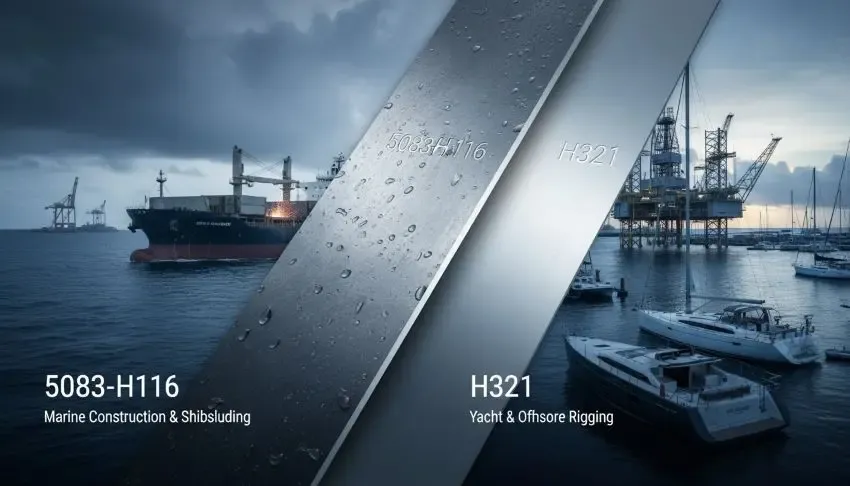
H116 Temper Definition: Strain-Hardened Treatment
H116 = H1 (Strain Hardened) + 1 (Quarter Hard) + 6 (Special Corrosion Control)
According to ASTM B928 and ASME SB209 standards, the processing of H116 includes the following steps:
Cold Rolling Treatment: The aluminum sheet undergoes multiple rolling passes, reducing thickness by approximately 12–18% and elongating the grain structure directionally.
Stress Relief Annealing: Conducted at 150–200°C for 1–2 hours to release internal stress while preserving strain-hardening effects.
Intergranular Corrosion Testing: Must pass the ASTM G67 Nitric Acid Mass Loss Test (NAMLT) to ensure excellent intergranular corrosion resistance.
This process results in a quarter-hard temper with balanced strength and ductility, ideal for hull outer plates and complex structural components requiring cold forming.
H321 Temper Definition: Strain-Hardened + Stabilized Treatment
H321 = H3 (Strain Hardened + Stabilized) + 2 (Half Hard) + 1 (Intergranular Corrosion Control)
The H321 temper includes an additional stabilization heat treatment on top of H116:
Greater Cold Working Deformation: Cold rolling deformation reaches 25–35%, increasing initial hardness.
Stabilization Annealing: Performed at 120–170°C for 3–6 hours, allowing β-phase (Mg₂Al₃) precipitates to distribute uniformly.
Grain Boundary Strengthening: Fine, evenly distributed precipitates reinforce grain boundaries, greatly improving resistance to intergranular corrosion.
Thanks to this stabilization step, H321 offers about 5% higher corrosion resistance than H116, making it especially suitable for long-term exposure in warm seawater environments exceeding 60°C.
GNEE, a leading Chinese supplier of 5083 aluminum alloy plates, provides both H116 and H321 tempers that meet ASTM B928 and ASME SB209 standards, ensuring superior corrosion resistance, weldability, and mechanical performance for marine, industrial, and cryogenic applications.


