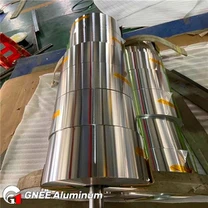
Overview of 5052 H32 Aluminum Sheet
5052 H32 aluminum sheet is a non-heat-treatable Al-Mg alloy from the 5xxx series, supplied in the H32 temper, which means the material is strain hardened to roughly quarter-hard condition and then stabilized with a low-temperature anneal. The alloy balances moderate strength with excellent resistance to seawater and industrial atmospheres, together with good formability and weldability. On that basis it has become a standard material for hull plating, fuel tanks, liquid storage systems, vehicle panels and corrosion-resistant hardware.
Because the alloy cannot be strengthened by heat treatment, its mechanical properties are developed entirely by controlled cold reduction followed by stabilization. Temper control, not chemistry alone, therefore decides the performance of a delivered sheet.
Chemical Composition
| Element | Content (%) | Function |
|---|---|---|
| Magnesium (Mg) | 2.2 - 2.8 | Solid-solution strengthening and corrosion resistance |
| Chromium (Cr) | 0.15 - 0.35 | Grain refinement, improved stress-corrosion resistance |
| Manganese (Mn) | 0.10 max | Dispersion strengthening, impurity control |
| Silicon (Si) | 0.25 max | Melt fluidity, impurity control |
| Iron (Fe) | 0.40 max | Impurity control |
| Copper (Cu) | 0.10 max | Limits hot-cracking tendency |
| Zinc (Zn) | 0.10 max | Impurity control |
| Others, each / total | 0.05 max / 0.15 max | Trace element limits |
| Aluminum (Al) | Balance | Matrix |
Mechanical Properties in the H32 Temper
| Property | Typical Value |
|---|---|
| Tensile strength, Rm | 215 - 265 MPa |
| Yield strength, Rp0.2, minimum | 193 MPa |
| Elongation, A50, minimum | 7% |
| Hardness | Approx. 60 - 70 HBW |
| Elastic modulus | 69.3 - 70.7 GPa |
| Density | 2.68 g/cm3 |
Values are typical for sheet produced and tested to ASTM B209, which is the standard specification governing aluminum and aluminum-alloy sheet and plate. Buyers should confirm the exact certified values on the mill test certificate issued for the delivered heat.
Available Sizes, Forms and Tempers
Thickness range: 0.8 mm to 12.7 mm
Width range: 1220 mm to 2500 mm, with wider formats available on request
Standard sheet formats: 1220 x 2440 mm, 1220 x 3048 mm, plus cut-to-length sizes
Classification: flat product up to 6 mm is classified as sheet, above 6 mm as plate
Supplied flat, in coils, or cut to size; protective film and seaworthy packing available
Related tempers in the same alloy family: O, H32, H34 and H112
Two tempers share the same chemistry but differ in work-hardening level: H32 is quarter-hard and easier to form, while H34 is harder and stronger with reduced ductility. Selection should follow the dominant requirement of the part, either forming severity or load carrying capacity.
Corrosion Resistance, Formability and Welding
The magnesium and chromium content gives the sheet strong resistance to salt spray, seawater and marine atmospheres, which is why it is widely used for hulls, fuel tanks, deck structures and coastal fixtures. It also resists pitting and stress-corrosion cracking far better than 1xxx or 6xxx alloys used in comparable thin-gauge applications.
Cold formability is good. The sheet bends, rolls and presses without cracking when bend radii are opened up slightly relative to fully annealed material, and the surface resists marking during forming when protective film is used. Cutting performance improves once the material is work hardened; annealed stock tends to be gummy. Joining is straightforward with gas welding, arc welding, resistance welding and TIG processes, and weld joints typically retain a large proportion of parent-metal strength when the correct 5xxx filler wire is applied.
Typical Applications and Selection Notes
Marine: hull plating, superstructures, fuel and water tanks, deck fittings
Transport: truck bodies, bus panels, trailer and tanker cladding
Industrial: heat-exchanger shells, liquid storage vessels, ductwork, sign blanks
Food and beverage equipment, since the alloy is regarded as suitable for contact applications
Architectural panels, when the semi-matte mill finish is acceptable
When specifying, state alloy and temper, thickness and tolerance, width and length, edge condition, surface finish and the required certification. Store sheets flat and dry, keep protective film in place until final fabrication, and avoid direct contact with copper, stainless steel or other dissimilar metals in wet environments to prevent galvanic attack.
Frequently Asked Questions
Q: What does the H32 temper mean?
H32 indicates strain hardening followed by stabilization: the sheet is cold rolled past its final required strength and then given a low-temperature anneal that removes residual stress without significantly lowering strength, producing a quarter-hard, dimensionally stable product.
Q: Is 5052 H32 suitable for seawater service?
Yes. The alloy is one of the standard marine-grade 5xxx materials and resists salt spray, seawater immersion and marine atmospheres well. In high-chloride environments, surface protection and isolation from dissimilar metals are still recommended.
Q: How does 5052 H32 differ from 5052 H34?
Both are strain hardened and stabilized, but H34 receives more cold reduction, so it provides higher tensile and yield strength with lower elongation. H32 is chosen where forming intensity is high, and H34 where higher load capacity matters more than ductility.
Q: Which standard covers the material?
ASTM B209 covers aluminum and aluminum-alloy sheet and plate and is commonly used for ordering 5052 in the H32 temper; European buyers often reference EN 485 for dimensional and mechanical requirements and EN 573 for composition.
Q: Can the sheet be welded?
It can. Gas welding, arc welding, TIG, MIG and resistance welding are all applied successfully, and matching 5xxx filler wires are used for structural joints. Clean the oxide layer and remove oils before welding to avoid porosity.
Q: What is the maximum thickness available?
Standard supply runs from 0.8 mm up to 12.7 mm in sheet and plate form, with wider widths and heavier sections available as custom orders subject to rolling capacity.