


In industrial settings, selecting the right material for piping, ductwork, and equipment is a critical decision driven by performance, safety, and cost.
For non-pressure applications where corrosion resistance and reliable fabrication are key, 3003-H14 aluminum sheet has long been the engineer's choice. It offers a superior balance of properties that steel and other alloys cannot match in this specific context.
Typical Specs of 3003-H14 Aluminum Sheet for Industrial Piping & Chemical Equipment
Industrial projects require materials that meet strict international standards. Below are the typical specifications for industrial-grade 3003-H14 aluminum plate.
| Item | Specification Parameter |
| Alloy | 3003 Aluminum |
| Temper | H14 (Strain-hardened, half-hard) |
| Thickness Range | 1.0 mm – 6.0 mm |
| Width | 1000 mm – 2000 mm |
| Standard | ASTM B209 / EN 485 |
Mechanical Properties of 3003-H14 Aluminum
The H14 temper provides a moderate level of strength, making it robust enough for industrial handling while retaining excellent formability.
| Property | Typical Value |
| Tensile Strength | 120 – 160 MPa |
| Yield Strength | ≥ 85 MPa |
| Elongation (%) | ≥ 10% |
| Density | ~2.73 g/cm³ |
| Corrosion Resistance | Excellent |
In simple terms, 3003-H14 is not a high-strength structural alloy. Its value lies in its durability, processability, and excellent performance in corrosive conditions.

Core Advantage of 3003-H14 Aluminum Alloy Sheet
1.Excellent Corrosion Resistance
This is the number one reason why 3003 aluminum is chosen for chemical and industrial environments. 3003 is an Al-Mn (Aluminum-Manganese) alloy. The addition of manganese significantly enhances its strength and, crucially, its resistance to corrosion compared to pure aluminum (1xxx series).
When exposed to air or moisture, 3003-H14 aluminum instantly forms a thin, dense, and highly stable layer of aluminum oxide on its surface. This passive film self-repairs if scratched and provides excellent protection against:
- Atmospheric corrosion (industrial humidity, salt spray)
- Freshwater and process water
- Many industrial chemicals, weak acids, and alkaline solutions
This makes it the perfect material for equipment in chemical plants, food processing facilities, and marine environments where steel would quickly rust and degrade.
2.Stable and Reliable Welding Performance
Industrial equipment like tanks and pipelines are fabricated by welding multiple plates together. The weldability of the material is critical to the structural integrity and safety of the final product.
3003-H14 aluminum sheet is known for its excellent weldability using common industrial methods like TIG (GTAW) and MIG (GMAW).
- Low Cracking Tendency: The alloy's composition makes it highly resistant to hot cracking during welding, resulting in strong, sound weld seams.
- Stable Weld Seam: The welds are consistent and reliable, which is crucial for ensuring leak-proof tanks and pipes.
- Good Post-Weld Properties: While the heat-affected zone (HAZ) will have its strength reduced to the annealed (O-temper) condition, the properties remain predictable and suitable for non-pressure applications.
For fabrication shops, this means higher pass rates on weld inspections, less rework, and faster project completion. It is a truly weldable aluminum sheet.
3. Good Formability for Fabrication
The H14 temper signifies a "half-hard" state. This provides enough stiffness to prevent the material from being easily damaged during transport and handling, but it remains ductile enough for easy fabrication.
3003-H14 aluminum plate can be easily:
- Rolled: Formed into large-diameter cylindrical shells for tanks and ducts.
- Bent: Using a press brake to form square or rectangular ductwork, brackets, and supports.
- Stamped: For smaller components or fittings.
This versatility allows fabricators to create a wide variety of custom shapes required for industrial equipment without the risk of cracking or requiring specialized, high-power machinery.
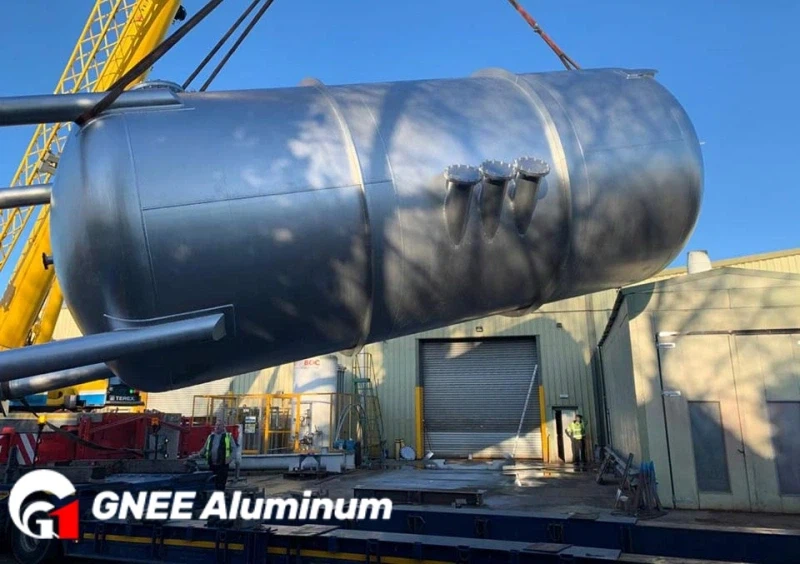
Common Industrial Applications for 3003 Aluminum Sheet
3003 aluminum is specifically suited for low-to-medium stress industrial systems that require long-term durability in corrosive environments. It is important to note that these are non-pressure applications.
Common uses include:
- Chemical Storage Tanks: For holding various industrial chemicals, process water, and weak acidic or alkaline solutions.
- Ventilation Ducts: Large-diameter ductwork in factories, wastewater treatment plants, and labs that handle humid or corrosive air.
- Heat Exchanger Shells: The outer casings for heat exchange units where good thermal conductivity and corrosion resistance are needed.
- Liquid Transfer Pipelines: Low-flow, gravity-fed, or low-pressure pipelines for transferring industrial liquids.
- Anti-Corrosion Linings: Used as a protective inner layer inside steel tanks or concrete structures to prevent corrosion.
Why 3003-H14 Aluminum Sheet Instead of Other Alloys?
Project managers often evaluate several alloys. Here is a direct comparison for non-pressure industrial use:
- 3003-H14 vs. 5052 Aluminum Sheet: 5052 aluminum offers higher strength and even better corrosion resistance, especially in saltwater environments. However, it is also significantly more expensive. For the vast majority of industrial piping and tank applications where extreme strength is not required, 3003-H14 provides more than adequate performance at a much lower cost.
- 3003-H14 vs. 6061 Aluminum Plate: 6061 is a heat-treatable, high-strength structural alloy. While very strong, its weldability is more complex. The heat-affected zone in a 6061 weld loses a significant amount of strength, which often requires post-weld heat treatment-a costly and impractical step for large structures. 3003-H14's welding process is far simpler and more forgiving.
Conclusion: For non-pressure equipment, 3003-H14 is the economic and durable choice, offering the best combination of corrosion resistance, weldability, and cost.
Key Buying Concerns for Industrial Grade Aluminum
- Corrosion Resistance: Does the material's chemical composition strictly meet standards to guarantee its anti-corrosion properties?
- Weld Stability: Is the material produced with a consistent grain structure to ensure predictable welding performance?
- Full Thickness: The plate must meet the specified thickness without a negative tolerance. Under-thickness material can compromise the integrity of the equipment.
- Flatness: The plate must be flat and free of waves or buckles to ensure it fits up correctly for welding and rolling.
- Compliance: Does the material come with a Mill Test Certificate (MTC) verifying it conforms to ASTM B209 or EN 485 standards?
GNEE Supply Advantages for Industrial Projects
As a leading Chinese supplier of industrial aluminum, GNEE is structured to meet the demanding requirements of fabricators and engineering projects.
- Strict Quality Control: We enforce tight control over the chemical composition and rolling process to ensure every batch of our 3003-H14 has consistent, reliable performance.
- Weld-Friendly Material: Our processing techniques are optimized to produce a uniform internal structure, minimizing the risk of welding defects and improving your workshop's efficiency.
- Flexible Sizing: We supply standard and custom-cut plate sizes up to 2000 mm wide, helping you minimize waste and reduce on-site cutting.
- Project Supply Experience: We have a proven track record of supplying material for chemical, environmental, and construction projects, with a commitment to stable quality and on-time delivery for long-term orders.
Important Limitations of 3003 Aluminum
To ensure safety and performance, it is critical to understand where 3003-H14 should not be used. This alloy is unsuitable for:
- High-pressure vessels or piping (e.g., pressure vessels subject to ASME code).
- High-strength structural components (e.g., load-bearing building supports).
- High-temperature environments (above 150°C), where it can lose strength.
For these applications, higher-strength alloys like 5052, 5083, or 6061 should be considered.
Export Packaging for Industrial Materials
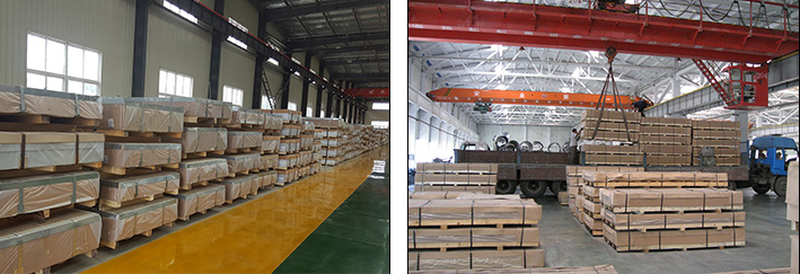
We understand that your material must arrive at the job site in perfect condition. Our 3003-H14 plates are securely packed on fumigation-free wooden pallets, separated by paper, wrapped in waterproof kraft paper and PE film, and reinforced with steel straps and corner protectors to prevent any damage during long-distance sea transport.
Need a fast, accurate quote for your industrial project? To provide the best pricing and lead time, please provide the following details in your inquiry:
- Thickness (mm) & Plate Size (Width x Length)
- Required Quantity (in Tons or Pieces)
- Your Application/Operating Environment (e.g., ventilation duct, water storage)
- Welding Requirements
Send your specifications to our sales team now. We will respond with a detailed, competitive quotation promptly.


