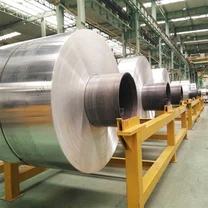
Why 3003 Aluminum for Battery Cases
3003 aluminum coil is widely used for battery case and battery shell applications because it combines good formability, moderate strength, corrosion resistance, and thermal conductivity. For deep-drawn battery components, a coil is typically supplied with controlled thickness, width, surface quality, mechanical properties, and forming characteristics matched to the customer's production process. Hot-rolled material can provide good elongation and stable mechanical properties when properly processed, but actual performance depends on the complete manufacturing route, including casting, rolling, homogenization, annealing, and final temper control. Material selection should therefore be based on the required forming performance and the battery case production process rather than the production route alone.
Typical Specification
A typical specification for battery-case coil is 3003 aluminum alloy with a temper selected according to forming requirements, a thickness range of 0.5 to 3.0 mm with customization available, and width according to customer requirements and production capability. Typical applications include cylindrical and prismatic battery housings and capacitor cases. Reference standards are GB/T 3880 and ASTM B209 where applicable. For deep-drawn battery shells, the required forming condition may differ from the final temper shown on a general-purpose sheet specification, so buyers should confirm the forming condition, final mechanical properties, and any subsequent heat-treatment or annealing requirements with the supplier.
Key Performance Factors
Deep-drawing formability is the primary requirement: 3003 offers good ductility for stamping, drawing, and other forming operations used to manufacture cylindrical, prismatic, and tray-type battery components, with the selected temper and annealing condition matched to the actual forming process. Earing control is equally important, because earing refers to the uneven, scalloped edge that can develop during deep drawing due to crystallographic texture. Controlled rolling and annealing help manage earing behavior, and for high-volume production, earing height and direction should be verified through customer-specific forming trials rather than assumed from alloy grade alone. Corrosion resistance must be verified against the specific electrolyte chemistry, temperature, exposure time, coating system, and cell design. Moderate strength provides useful rigidity for many battery housing and enclosure designs while remaining suitable for forming, and aluminum's relatively high thermal conductivity assists heat spreading within battery components, though actual thermal management depends on the complete battery-pack design. Surface quality is critical: the material must be clean and free of scratches, dents, inclusions, rolling marks, oil residues, and other surface defects.
Chemistry and Typical Properties
3003 is an aluminum-manganese alloy with manganese at 1.0 to 1.5 percent and the balance aluminum. The standard also controls elements such as iron, silicon, copper, zinc, and other residual elements. For representative H14 material, typical values are tensile strength of approximately 140 to 180 MPa, yield strength at 0.2 percent offset of approximately 115 MPa or higher depending on thickness and specification, and elongation of typically 6 percent or more depending on thickness and the applicable standard. These values are indicative and should not replace the guaranteed properties stated in the supplier's mill test certificate. For battery-case applications, customers may require additional controls including elongation, anisotropy, earing performance, surface roughness, thickness uniformity, flatness, and forming-test results.
Quality Assurance and Procurement
Battery-case aluminum coil generally requires tighter process control than standard commercial sheet because forming defects directly affect production yield and cell reliability. Quality control may include dimensional control of thickness, width, and flatness against the agreed specification; surface inspection for scratches, dents, stains, inclusions, rolling marks, and edge defects; mechanical testing of tensile strength, yield strength, and elongation; earing and forming evaluation through production-representative trials; thickness uniformity checks; and validated weldability where the case is laser welded or joined by another process. Commercial deliveries should normally be accompanied by a mill test certificate showing chemical composition and mechanical properties, and third-party inspection can be arranged when required by the purchase contract. For procurement, the buyer should provide the alloy, required temper or forming condition, thickness, width, surface requirements, earing and forming requirements, applicable standard, coil weight, and the downstream forming process so the supplier can match the coil to the actual battery manufacturing process.
FAQ
Q: Why is 3003 aluminum used for battery cases?
A: 3003 combines good deep-drawing formability, moderate strength, corrosion resistance, and thermal conductivity, which makes it suitable for stamped cylindrical, prismatic, and tray-type battery housings when supplied with controlled surface and forming characteristics.
Q: What is earing and why does it matter?
A: Earing is the uneven, scalloped edge that can develop during deep drawing because of crystallographic texture. Controlled rolling and annealing help manage it, and earing height and direction should be verified through customer-specific forming trials for high-volume production.
Q: What are typical mechanical properties of 3003 battery-case coil?
A: For representative H14 material, typical values are tensile strength of about 140 to 180 MPa, yield strength of about 115 MPa or higher, and elongation of typically 6 percent or more, with guaranteed values stated in the mill test certificate.
Q: Which standards apply to 3003 aluminum coil?
A: Reference standards include GB/T 3880 and ASTM B209 where applicable. The applicable standard should be confirmed in the purchase specification together with dimensional tolerances and surface requirements.
Q: What information should a buyer provide when ordering battery-case coil?
A: The buyer should specify alloy, required temper or forming condition, thickness, width, surface requirements, earing and forming requirements, applicable standard, coil weight, and the downstream forming process so the supplier can match the material to the actual production line.