What is 1070 Aluminum Grade?
1070 aluminum plate contains 99.7% pure aluminum, making it the highest grade of pure aluminum within the 1xxx series. Due to its high aluminum content, it retains all the excellent properties of pure aluminum, including good thermal conductivity, high corrosion resistance, and good formability. While it has low mechanical strength compared to other alloys, adding small amounts of other elements slightly enhances its mechanical properties.
1070 aluminum's production process is relatively simple because it lacks many alloying elements, making it an affordable option. It is widely used in various industries where its key properties are beneficial.
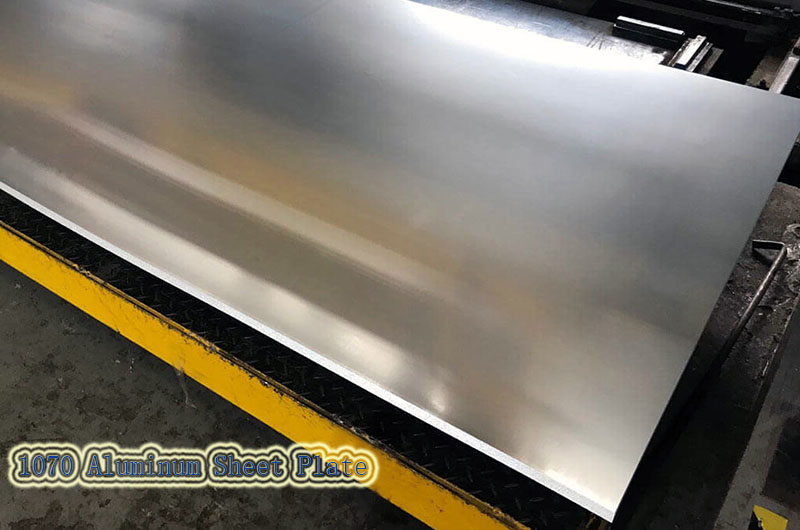
1070 Aluminum Sheet
1070 aluminum belongs to the 1000 series of alloys, which are primarily composed of pure aluminum. The four-digit system used for aluminum alloy classification assigns the following meanings to the digits:
The first digit, "1," indicates that the alloy is a pure aluminum grade with a minimum aluminum content of 99%.
The second digit "0" identifies the alloy as part of the 1000 series, known for excellent formability and high thermal and electrical conductivity.
The last two digits, "70," serve as identification within the series.
Although 1070 aluminum is not suitable for high-strength applications, it is preferred in areas requiring excellent conductivity and formability.
1070 Aluminum Plate Properties
Key characteristics of 1070 aluminum include:
High Electrical and Thermal Conductivity: This makes 1070 suitable for electrical and electronic applications, such as wiring and conductors.
Corrosion Resistance: It has strong resistance to atmospheric and water corrosion, as well as many acids and organic compounds.
Lightweight: It is lighter than metals like steel, iron, or copper, offering weight-saving benefits.
Low Strength: While it is soft and malleable, it is non-heat-treatable. The material can be strengthened through cold deformation but not through heat treatment. It is best in applications requiring formability over strength.
Weldability: The alloy is suitable for gas welding, argon arc welding, and spot welding.
Surface Quality: 1070 aluminum maintains a smooth and reflective surface that is widely used in decorative applications.
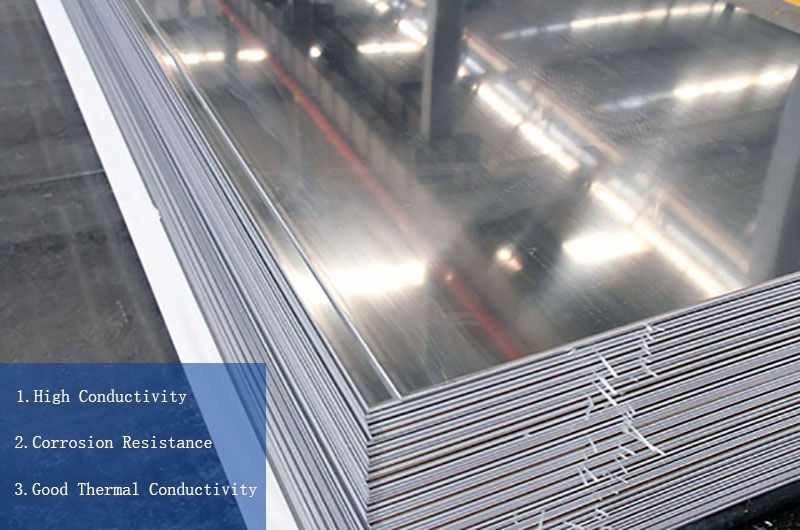
1070 Aluminum Alloy Composition
Mechanical Properties Of 1070 Aluminum Alloy at Different Temper
| Alloy and Temper | Thickness (mm) | tensile strength (MPa) | Elongation(%) | |
| National standard | Internal control | |||
| 1070 O Aluminum | >0.2-0.3 | 55-95 | 55-95 | ≥15 |
| 1070 O Aluminum | >0.3-0.5 | ≥20 | ||
| 1070 O Aluminum | >0.5-0.8 | ≥25 | ||
| 1070 O Aluminum | >0.8-1.3 | ≥30 | ||
| 1070 O Aluminum | >1.3-4.5 | ≥35 | ||
| 1070 H22 Aluminum | >0.2-0.5 | 10-100 | 100-125 | ≥12 |
| 1070 H22 Aluminum | >0.5-1.0 | ≥15 | ||
| 1070 H22 Aluminum | >1.0-4.5 | ≥18 | ||
| 1070 H24 Aluminum | >0.2-0.5 | 85-120 | 120-150 | ≥6 |
| 1070 H24 Aluminum | >0.5-1.0 | ≥8 | ||
| 1070 H24 Aluminum | >1.0-4.5 | ≥10 | ||
| 1070 H26 Aluminum | >0.2-0.5 | 110-155 | 140-170 | ≥2 |
| 1070 H26 Aluminum | >0.5-1.0 | ≥4 | ||
| 1070 H26 Aluminum | >1.0-4.5 | ≥6 | ||
| 1070 H18 Aluminum | >0.2-0.5 | ≥120 | ≥170 | ≥2 |
| 1070 H18 Aluminum | >0.5-1.0 | ≥3 | ||
| 1070 H18 Aluminum | >1.0-5.5 | ≥4 | ||
Chemical Composition of 1070 Aluminum Sheet
| Element | Content (%) |
|---|---|
| Aluminum | ≥ 99.7 |
| Iron | ≤ 0.25 |
| Silicon | ≤ 0.20 |
| Zinc | ≤ 0.040 |
| Vanadium | ≤ 0.050 |
| Copper | ≤ 0.040 |
| Titanium | ≤ 0.030 |
| Magnesium | ≤ 0.030 |
| Manganese | ≤ 0.030 |
| Other Elements | ≤ 0.030 |
1070 Aluminum Sheet Specifications
| Aluminum alloy | 1070 Aluminum sheet |
|---|---|
| Temper | O, H12, H14, H16 H18, H19, H22, H24 H26, H28, H112, etc. |
| Thickness (mm) | 0.1-500 |
| Width (mm) | 20-2650 |
| Length (mm) | 500-16000 |
| Application examples | heat sinks, battery charging stations, anti-corrosion and heat preservation materials, wire armor, etc. |
Equivalent 1070 Aluminum Alloy Name
A1070, 1070a, aa1070, 1070aa, al1070, al1070a, a 1070, aa 1070, jis a1070p, al1070 class, aw1070, en1070 grade, etc.
1070 Aluminum Alloy Performance Advantages
Low Density: 1070 is lightweight, making it suitable for transportation and structural applications.
Electrical and Thermal Conductivity: Its high conductivity makes it ideal for use in electrical components and heat sinks.
Corrosion Resistance: With minimal impurities, it forms a durable oxide film that enhances its corrosion resistance.
Weldability: It can be welded using various methods, including gas welding and spot welding.
Long Service Life: 1070 aluminum is known for its low cost, high recyclability, and long lifespan.
Thermal Conductivity of 1070 Aluminum
1070 aluminum has a high thermal conductivity of about 229 W/m·K (133 BTU/(hr·ft·°F)), which makes it suitable for applications that require efficient heat dissipation, such as heat exchangers, cooling systems, and electrical conductors.
Surface Treatment Types for 1070 Aluminum
Common surface treatments for 1070 aluminum include:
Anodizing: Forms a protective oxide layer that enhances corrosion resistance and allows for color customization.
Coating: Application of coatings like PVDF or polyester for better weather resistance, aesthetics, and UV protection.
Polishing: Polished surfaces provide high reflectivity and smoothness, which is ideal for applications requiring a reflective finish.
Product Certifications
1070 aluminum products may be certified under standards such as
ISO 9001 (Quality Management)
ROHS (Restriction of Hazardous Substances)
Industry-specific certifications depending on the intended use (e.g., electrical certifications for electrical components).
Electrical Conductivity of 1070 Aluminum
The electrical conductivity of 1070 aluminum is typically 63% of IACS (International Annealed Copper Standard), which is about 63% that of pure copper. This makes 1070 suitable for electrical wiring, busbars, and transformer windings.
Applications of 1070 Aluminum
1. Electrical Applications
1070 aluminum is widely used for electrical components such as wiring, busbars, transformer windings, and electronic devices. In this context, it is usually in the annealed (O) condition for maximum formability.
2. Heat Sinks
Due to its excellent thermal conductivity, 1070 aluminum is ideal for heat sinks used in electronic equipment, LED lighting, and power modules. Surface treatments like anodizing improve its heat dissipation capabilities.
3. Reflectors
1070 aluminum's high reflectivity makes it a popular choice for reflectors in lighting fixtures, solar panels, and decorative mirrors. The alloy is usually polished for maximum reflectivity and may be coated for added durability.
4. Cookware
1070 aluminum is commonly used in cookware due to its excellent formability and corrosion resistance. It is widely used for products like pots, pans, and kitchen utensils.
5. Chemical and Food Processing
The high corrosion resistance of 1070 aluminum makes it suitable for use in chemical tanks, food processing equipment, and storage containers.
6. Roofing and Cladding
1070 aluminum's corrosion resistance and formability make it suitable for roofing, flashings, and decorative cladding. For these applications, it is typically used in its annealed (O) form.
1070 Aluminum in Hot-Rolled Plates
Hot-rolled 1070 aluminum plates can undergo the following heat treatment processes:
Complete Annealing: Heating to 390-430°C followed by slow cooling in the furnace.
Rapid Annealing: Heating at 350-370°C, followed by air or water cooling.
Quenching and Aging: Heating to 500-510°C, then quenching and artificially aging at 95-105°C.
These processes enhance the alloy's formability and help meet specific application requirements.
Conclusion
1070 aluminum is an affordable, versatile, and highly conductive alloy. Its properties make it suitable for electrical, thermal, decorative, and food processing applications. It offers good corrosion resistance, high thermal conductivity, and excellent formability, though it is not recommended for high-strength applications.