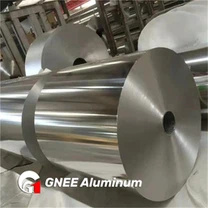
What Makes 5052 Aluminum Sheet Different
5052 is a non-heat-treatable Al-Mg alloy that combines moderate strength with the best corrosion resistance of any common sheet alloy. Magnesium is the main alloying addition and chromium controls grain structure, and together they give the sheet a combination that 1100, 3003 and even 6061 cannot match for marine and chemical service.
The alloy is supplied mainly as sheet and coil from 0.5 mm to 6 mm, with plate available in heavier gauges. It cannot be strengthened by heat treatment; strength is developed by strain hardening, which is why the temper designation H32 or H34 appears on almost every marine order.
Chemical Composition
| Element | Content, % |
|---|---|
| Magnesium | 2.2-2.8 |
| Chromium | 0.15-0.35 |
| Copper | 0.10 max |
| Manganese | 0.10 max |
| Silicon | 0.25 max |
| Iron | 0.40 max |
| Zinc | 0.10 max |
| Others, each / total | 0.05 max / 0.15 max |
| Aluminum | Balance |
Composition is controlled to ASTM B209 for sheet and plate and to the equivalent general engineering sheet standard in national systems. The narrow magnesium and chromium ranges are what keep corrosion performance and forming behaviour repeatable from coil to coil.
Mechanical and Physical Properties
| Property | 5052-O | 5052-H32 | 5052-H34 |
|---|---|---|---|
| Tensile strength | 195 MPa | 228 MPa | 262 MPa |
| Yield strength | 90 MPa | 193 MPa | 214 MPa |
| Elongation | 25% | 12% | 10% |
| Brinell hardness | 47 | 60 | 68 |
Density: 2.68 g/cm³
Modulus of elasticity: 70.3 GPa
Poisson's ratio: 0.33
Melting range: 607-649 °C
Thermal conductivity: 138 W/(m·K)
Specific heat: 880 J/(kg·K)
Electrical resistivity: 4.99 µΩ·cm
These values are typical for the tempers shown and are quoted as design guidance rather than as guaranteed minima, which are set by the applicable product standard.
Corrosion Resistance in Service
The magnesium content gives 5052 outstanding resistance to saltwater, salt spray and mildly alkaline or neutral industrial atmospheres, far better than 3003 or 1100. It is not intended for strong acids or hot caustic solutions, where the protective oxide film breaks down, and it should not be left in contact with copper-bearing fasteners in wet service without isolation.
Anodising improves both appearance and wear resistance on architectural and appliance parts, and the alloy takes a clear or dyed anodic film evenly because of its uniform grain structure.
Typical Applications
Boat hulls, decks and superstructures for smaller craft, dockside structures and marine hardware.
Fuel tanks, hydraulic lines and pressure vessels, where formability and weldability matter as much as strength.
Architectural panelling, curtain walls and roofing exposed to marine or industrial atmosphere.
Transport panels, passenger-vehicle bodywork and heat-exchanger components.
Aircraft and aerospace paneling and secondary structures that require light, formable sheet.
For heavy hull plate in large vessels, higher-magnesium alloys such as 5083 or 5086 are normally selected, while 5052 remains the practical choice for sheet work, tanks and general fabrication.
Working and Fabrication
5052 forms readily in the O temper and takes tighter bend radii than higher-strength alloys. H32 and H34 tempers are normally bent across the rolling direction with a radius of roughly one to two times the sheet thickness. It welds cleanly by TIG and MIG using 5356 or 4043 filler, and it can be riveted, bolted or adhesively bonded without special preparation beyond a clean, oxide-free surface.
Frequently Asked Questions
Q: Why is 5052 aluminum sheet used in marine work?
Its 2.2-2.8% magnesium content plus chromium gives strong resistance to saltwater and salt spray, so hulls, decks and dock hardware survive constant exposure without heavy pitting.
Q: What is the chemical composition of 5052 aluminum?
About 2.2-2.8% magnesium, 0.15-0.35% chromium, up to 0.10% copper and 0.10% manganese, up to 0.25% silicon, 0.40% iron and 0.10% zinc, with aluminium as the balance.
Q: What is the density of 5052 aluminum?
Approximately 2.68 g/cm³, about one third the density of steel, which is why the alloy is used for transport and marine structures.
Q: Is 5052 aluminum heat treatable?
No. It is a non-heat-treatable alloy. Strength is raised by strain hardening, which is why tempers such as H32 and H34 are specified for structural sheet.
Q: Can 5052 aluminum be welded?
Yes. It welds well by TIG and MIG with 5356 or 4043 filler and retains good joint strength after welding, unlike high-strength heat-treatable alloys.
Q: What thickness of 5052 sheet is available?
Sheet and coil are typically supplied from 0.5 mm to 6 mm, with plate in heavier gauges, in O, H32, H34 and H38 tempers and in widths slit to order.