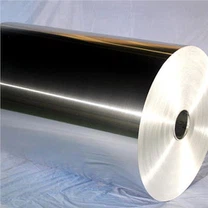
Why Retort Pouches Depend on Aluminum Foil
A retort pouch is sterilised with the product already sealed inside, typically at 121 °C for 20-40 minutes or at 135 °C for 3-10 minutes in a short-time process. The laminate must survive saturated steam, pressure and a thermal shock cycle without losing seal integrity, and it must keep oxygen and moisture away from the contents for the entire shelf life. Aluminum foil is the one layer that satisfies both requirements at the same time.
Inside a typical structure the foil sits between an outer polyester or biaxially oriented polyamide layer and an inner cast polypropylene sealing layer, bonded with a two-component polyurethane adhesive. The polymer layers provide mechanical strength, printability and the food-contact seal; the foil provides the barrier.
Pinhole Control Sets the Real Barrier Limit
The barrier performance of a 7-9 µm soft foil is governed by pinhole population, not by the intrinsic permeability of aluminum. Widely applied acceptance limits for retort-grade foil are:
| Foil thickness | Pinhole limit |
|---|---|
| 7 µm | Fewer than 200 pinholes per square metre |
| 9 µm | Fewer than 100 pinholes per square metre |
| Any thickness | Pinhole diameter not greater than 20 µm |
Every pinhole is an open channel through the barrier layer. A single defect allows gas, vapour and light to pass at a rate that can exceed the permeation of the entire polymer stack, and the resulting failure only becomes visible after the retort cycle, when the pouch has already been filled and sealed. Pinhole counting therefore belongs in incoming inspection rather than in final release.
Surface Cleanliness and Wettability
Foil for retort laminates must be free of rolling oil, dust and loose oxide before lamination. Surface tension should reach at least 72 mN/m. The check is simple: distilled water should wet the surface as a continuous film, while a greasy surface makes the droplet bead up. Oil left on the foil attacks the adhesive interface, and a pouch that delaminates after retorting fails visually long before it fails functionally.
Closely related is the storage rule. Thin foil absorbs moisture from humid air and forms a surface oxide that weakens adhesion, so reels should be kept sealed, stored dry and consumed within a defined window instead of being left open on the shop floor.
Soft Temper and Toughness
Retort-grade foil is supplied in the O temper at 7 µm and 9 µm so that it drapes over the forming die and follows the pouch geometry without cracking. A harder foil would resist forming and crack at the fold lines of the seal area. The soft temper is also easier to laminate without trapped air, which keeps the bond line continuous across the whole web.
How the Finished Pouch Is Verified
Water vapour transmission of the laminate measured by ASTM F1249.
Oxygen transmission measured by ASTM D3985.
Aluminum foil supplied to ASTM B479 for flexible barrier and food-contact applications.
Tensile properties of the foil determined by ASTM E8 where the specification demands mechanical data.
Seal strength checked before and after the retort cycle, since the heat history is what degrades the seal most.
Visual and dye-penetration checks of the seal area after sterilisation to detect channels and wrinkles.
Taken together, complete sealing, high aroma retention, oil resistance and heat resistance are not marketing claims but measurable laminate properties, and each one traces back to a controlled foil thickness, a low pinhole count and a clean, wettable surface.
Frequently Asked Questions
Q: Why is aluminum foil used in high temperature cooking bags?
Because a continuous metal layer blocks light, moisture and oxygen completely, and it survives steam sterilisation at 121 °C or 135 °C without losing barrier performance.
Q: How many pinholes are acceptable in retort foil?
A 7 µm foil should show fewer than 200 pinholes per square metre and a 9 µm foil fewer than 100, with no pinhole larger than 20 µm in diameter.
Q: What surface tension should the foil have before lamination?
At least 72 mN/m. Distilled water wets a properly prepared surface in a continuous film; beading indicates residual oil or oxide.
Q: Which foil thickness is used for retort pouches?
Soft foil of 7 µm or 9 µm is standard. The 9 µm grade is preferred where pinhole risk or mechanical abuse during filling is higher.
Q: Why must retort foil be stored dry?
Thin foil absorbs atmospheric moisture and forms a surface oxide that weakens the adhesive bond, so sealed dry storage and prompt use protect laminate quality.
Q: How is the finished pouch tested?
Water vapour transmission to ASTM F1249, oxygen transmission to ASTM D3985, plus seal strength and dye-penetration checks before and after the retort cycle.