


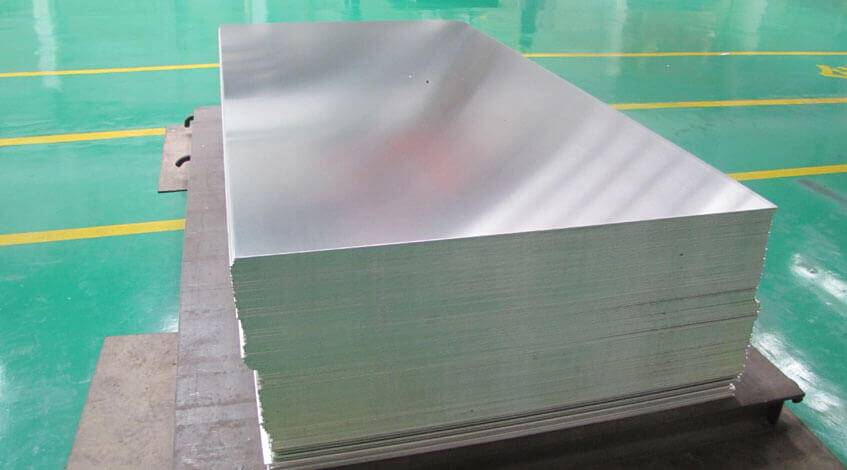
5083 H116 and 5083 H321 aluminum plates are both high-performance marine-grade aluminum alloys, widely used in shipbuilding and offshore engineering. Although they share the same chemical composition, their tempering processes, mechanical properties, and application suitability differ, leading to distinct performance characteristics for various marine and industrial environments.
Overview
Both tempers-H116 and H321-belong to the non-heat-treatable 5xxx series aluminum alloys (Al-Mg4.5Mn0.7). They are well-known for excellent corrosion resistance, weldability, and strength-to-weight ratio, making them ideal for harsh marine conditions. The main difference lies in the post-processing stabilization treatments, which result in different mechanical stability and corrosion resistance levels.
Key Differences Between 5083 H116 and H321
| Aspect | 5083 H116 Aluminum Plate | 5083 H321 Aluminum Plate |
|---|---|---|
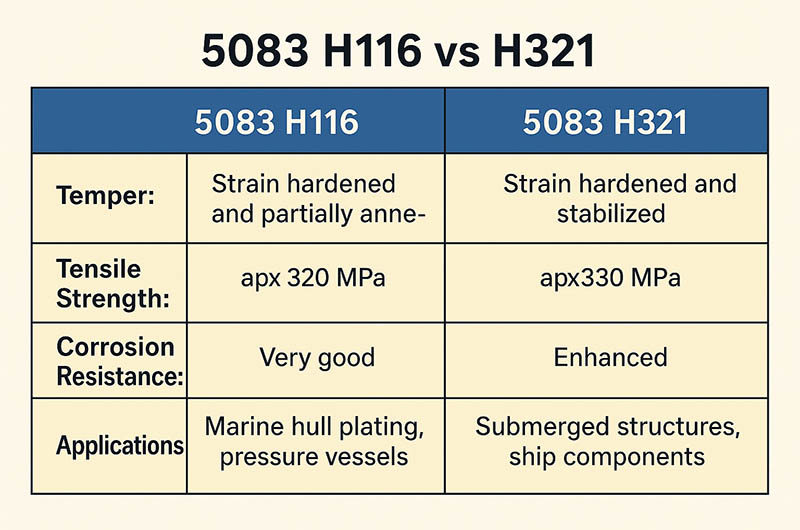
| Processing Method | Strain-hardened through controlled cold working | Strain-hardened and thermally stabilized (low-temperature heat treatment) |
| Strength | Slightly higher tensile strength | Slightly improved fatigue resistance and ductility |
| Residual Stress | Contains residual stress from cold working | Reduced residual stress and better dimensional stability |
| Corrosion Resistance | Exceptional resistance to seawater and salt spray, designed for direct marine exposure | Enhanced resistance to exfoliation and intergranular corrosion, ideal for welded and dynamic-load environments |
| Best For | Non-welded or direct load-bearing marine structures (e.g., hulls, decks) | Welded components and applications in extreme marine or chemical environments |
| Machinability | Requires careful control of forming due to higher hardness | Better formability and weldability, suitable for complex assemblies |
Mechanical Properties Comparison
| Property | 5083 H116 | 5083 H321 |
|---|---|---|
| Tensile Yield Strength (0.2% PS) | ~230 MPa (33 ksi) | ~240 MPa (35 ksi) |
| Ultimate Tensile Strength (UTS) | ~320 MPa (47 ksi) | ~330 MPa (48 ksi) |
| Elongation at Break | ~12% | ~13% |
| Brinell Hardness (HB) | 83 | 89 |
| Modulus of Elasticity | ~68 GPa | ~68 GPa |
The H321 temper offers a modest (~5%) increase in overall strength and slightly improved ductility due to its stabilization heat treatment, enhancing its reliability under cyclic stress conditions.
Temper Definitions
H116 Temper:
Obtained by controlled cold working, partially annealed to optimize strength and ductility. Plates in this condition must pass ASTM G66 (exfoliation corrosion) and ASTM G67 (intergranular corrosion) tests to ensure high seawater resistance.
H321 Temper:
Includes strain hardening and a low-temperature stabilization process that transforms β-Mg₂Al₃ precipitates into stable forms, minimizing stress corrosion cracking and improving thermal stability under welded or long-term service conditions.
Corrosion Resistance Comparison
5083 H116:
Offers excellent seawater corrosion resistance, suitable for long-term marine exposure such as hull plating and decks. However, prolonged exposure to elevated temperatures may slightly reduce its corrosion performance.
5083 H321:
Provides enhanced resistance to exfoliation and intergranular corrosion, verified through ASTM G66/G67 testing, making it ideal for submerged, chemical, or welded marine applications. Its stabilized microstructure ensures superior performance in post-weld and dynamic environments.
Processing and Alloy Control Requirements
H116 Processing:
Specially developed for high-magnesium alloys (4.0%–4.9% Mg).
Involves strict control over strain hardening and magnesium distribution during rolling.
Designed to achieve optimal corrosion resistance and strength for prolonged marine use.
H321 Processing:
Combines precise hot and cold rolling with stretch-straightening and stabilization treatment.
Ensures consistent mechanical properties and improved structural stability, particularly under welded or cyclic loading conditions.
Applications
| Application Type | Preferred Temper | Examples |
|---|---|---|
| Marine Hull Plating | H116 | Ship decks, hull plates, pontoons |
| Submerged Structures | H321 | Offshore platforms, underwater piping |
| Pressure Vessels / Cryogenic Tanks | H116 | Fuel tanks, cryogenic containers |
| Welded Marine Components | H321 | Ship cabins, structural frames, tank systems |
| Aerospace / Rail / Chemical Use | H321 | Aircraft fuel tanks, rail vehicles, chemical pipelines |
Weldability and Post-Weld Performance
Both tempers maintain excellent weldability typical of the 5xxx series aluminum alloys.
H116: Delivers strong weld joints with minimal cracking, suitable for hulls and panels directly exposed to seawater.
H321: The stabilization treatment minimizes residual stress and reduces the risk of post-weld distortion or stress corrosion cracking, making it more reliable for welded or dynamically loaded structures.
Cost and Selection Guidance
H116: Slightly higher production cost due to specialized processing, but offers exceptional durability and long service life in harsh marine conditions-ideal for direct seawater contact applications.
H321: More economical and widely used in standard shipbuilding and welded structural parts where corrosion exposure is moderate to high.
Selection Tip:
Choose H116 for high-strength, high-corrosion environments such as hulls and decks; select H321 for welded marine or industrial components requiring excellent stability and corrosion resistance.
Conclusion
While 5083 H116 and 5083 H321 aluminum plates share the same alloy composition, their different tempering processes yield distinct performance advantages.
H116 excels in direct marine exposure, offering high strength and resistance to seawater corrosion.
H321 provides enhanced stability, weldability, and resistance to exfoliation, making it ideal for welded or stress-sensitive marine structures.
As a leading Chinese supplier, GNEE offers both 5083 H116 and H321 marine-grade aluminum plates manufactured in compliance with ASTM B928/B928M standards. With advanced production control and global delivery capabilities, GNEE ensures high-quality aluminum solutions for shipbuilding, offshore platforms, and marine engineering projects worldwide.


