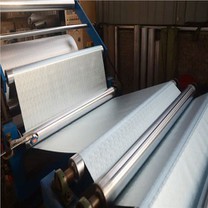
3003-H14 is aluminium-manganese sheet supplied in a strain-hardened, half-hard temper. The alloy is based on commercially pure aluminium with about 1.2 % manganese, which raises strength by roughly 20 % compared with 1100 while keeping the excellent corrosion resistance and formability of the pure metal. H14 gives a useful balance: enough strength for structural and semi-structural panels, and enough ductility for deep drawing, spinning and bending.
Reading the H14 Designation
Wrought tempers are defined in EN 515 and ANSI H35.1. The letter H means strain hardened. The first digit, 1, means strain hardened only, with no supplementary annealing or stabilising treatment. The second digit, 4, sets the degree of hardening: 2 is quarter hard, 4 is half hard, 6 is three-quarter hard and 8 is full hard. So 3003-H14 is half-hard cold rolled material. It is stronger and harder than the annealed O temper and noticeably more formable than H18, which is why it is the most widely stocked 3003 temper for general fabrication.
Composition to ASTM B209
| Element | Content, % |
|---|---|
| Manganese | 1.0 - 1.5 |
| Silicon | 0.6 max |
| Iron | 0.7 max |
| Copper | 0.05 - 0.20 |
| Zinc | 0.10 max |
| Aluminium | Remainder |
There is no magnesium and no deliberate copper addition beyond 0.20 %, so the alloy is not susceptible to the copper-driven localised attack that affects 6xxx and 7xxx alloys. The manganese is held in solid solution and as fine dispersoid particles, which is why the material also keeps its strength reasonably well after brazing or welding.
Typical Mechanical Data for the H14 Temper
| Property | Typical value |
|---|---|
| Density | 2.73 g/cm3 |
| Tensile strength | about 150 MPa |
| 0.2 % yield strength | about 145 MPa |
| Elongation, 1.6 mm sheet | about 8 % |
| Modulus of elasticity | about 69 GPa |
| Thermal conductivity | about 155 W/(m.K) |
| Melting range | about 643 - 654 degrees C |
The figures above are typical published values for the temper; the governing minimum values for a specific thickness are taken from ASTM B209 or EN 485-2, and property testing follows ASTM E8/E8M. H14 material is not heat treatable, so strength cannot be raised by a further ageing treatment, and any annealing operation returns the sheet to the soft O condition.
Product Forms and Fabrication
The alloy is supplied as sheet, coil, strip and patterned tread plate. Coil is the usual form for roofing, cladding, ducting and packaging lines, while cut sheet suits panel work and tank fabrication. H14 material shears, punches, press-brakes and rolls without difficulty, deep draws and spins well with the correct tool radius, and welds by gas tungsten arc, gas metal arc and resistance methods. Brazing is common in heat exchanger and appliance work because the alloy tolerates the brazing cycle. Where a joint must be welded and then formed, the welded area reverts to a softer condition, so heavy forming is best done before welding.
Where 3003-H14 Is Specified
Construction: roofing and wall cladding, flashing, gutters, downpipes and rainwater goods.
Consumer goods: cookware, appliance panels, decorative trim and signage blanks.
Industrial: storage and fuel tanks, chemical ducting, equipment enclosures, cabinets and ventilation ducts.
Packaging and food contact: trays, closures and containers where the alloy is used in direct contact with food.
Transport: interior panels, trim and heat shields.
Frequently Asked Questions
Q: What does H14 mean on 3003 aluminium?
A: It means strain hardened only, to the half-hard level. The sheet has been cold rolled to raise strength and hardness above the annealed O temper, and it is the standard general-purpose temper for 3003.
Q: Is 3003-H14 heat treatable?
A: No. The alloy gains strength only from cold work. Heating it above the annealing range removes that work hardening, and no ageing treatment can restore it.
Q: How strong is 3003-H14 compared with 1100 or 5052?
A: It is about 20 % stronger than 1100 aluminium and has a typical tensile strength near 150 MPa. 5052 in the H32 temper is stronger again, at about 215 MPa, and offers better marine corrosion resistance.
Q: Can 3003-H14 be welded and anodised?
A: Yes to both. It welds with conventional arc and resistance processes and takes a clear or colour anodic coating to ISO 7599, which is often used on appliance and architectural parts.
Q: Which thicknesses are available?
A: Sheet and coil are commonly supplied from 0.2 mm up to 6 mm, in coil widths from about 1000 mm and cut lengths to order.
Q: Is 3003-H14 suitable for food contact?
A: Yes. The alloy has no deliberate alloying elements of concern and is widely used for cookware, food trays and closures, subject to the applicable food contact regulations in the destination market.