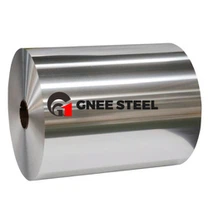
What 1100 Roofing Foil Is Made Of
Aluminium foil for roofing is made from the 1100 alloy, a commercially pure aluminium with an aluminium content of 99.0% minimum. The only significant impurities are iron and silicon, which remain at trace levels and do not disturb the metal's softness, thermal behaviour or surface appearance. Because the alloy contains no deliberate hardening additions, it cannot be strengthened by heat treatment; the foil is supplied in the annealed O temper and then finished with a reflective or protective coating depending on the duty.
The result is a thin, light, fully recyclable sheet that reflects radiant heat, blocks moisture and resists weathering. Those three functions are what make it useful in a roof build-up, where the material works as a facing on insulation or as a radiant barrier under the roof deck.
Product Specifications
| Parameter | Details |
|---|---|
| Temper | O, annealed |
| Aluminium content | 99.0% minimum |
| Thickness range | 0.014 mm to 0.03 mm |
| Width range | 20 mm to 1600 mm |
| Coating thickness | 7 µm to 10 µm per side |
| Coating options | Single side or double side lacquer |
| Roll inner diameter | 76 mm or 152 mm |
| Colours | Gold, silver, red, blue, black, grey, white, green, copper, brown or wood grain |
| Standards | EN 546, EN 573-3, ASTM C1313, GB/T 3198, RoHS compliant |
The thickness band matters more than it appears. Foil below about 0.014 mm is difficult to handle on site without creasing, while foil above 0.03 mm stops being a cost-efficient reflective facing. The 0.014–0.03 mm window is the practical compromise between mechanical robustness and weight.
Reflective and Thermal Performance
A clean, bright aluminium surface has low emissivity, typically between 0.03 and 0.05, which means it reflects roughly 95% or more of the radiant heat that reaches it. Once the foil is coated, laminated to a reinforcing scrim or backed with kraft paper, the installed performance depends on the outer surface and on how the assembly is built.
Radiant heat reflectivity of the bare foil surface is in the region of 95–97%.
Installed reflective assemblies commonly deliver radiant heat reflection above 93%.
Emissivity and reflectance of surfaces are measured under ASTM E408.
Sheet radiant barriers for buildings are specified under ASTM C1313.
One design rule overrides everything else: aluminium foil controls radiant transfer, and radiant transfer only happens across an air space. A foil pressed flat against a solid surface conducts instead of reflecting, and its performance collapses to that of the substrate.
Moisture, Vapour and Weather Behaviour
An unbroken aluminium foil is also a complete vapour barrier. In a roof build-up it prevents moisture-laden air from migrating to a cold deck and condensing there, which is the mechanism behind many roof-deck corrosion and mould problems. The foil itself does not absorb water, will not rot and contributes nothing to flame spread when it is bonded to a mineral or glass-fibre carrier.
Iron and silicon at trace level also mean the foil stays ductile at low temperature, so it does not become brittle on a winter installation, and it is unaffected by ultraviolet light at the surface. Where the foil will be exposed before the roof covering goes on, a lacquered or reinforced product holds up far better than bare foil against wind loading and handling damage.
Installation Practice in Roof Build-Ups
Under-purlin radiant barrier – foil facing the roof space, shiny side down or up according to the design, with the reflective surface left open to an air gap.
Over-deck sarking – foil laid over the decking beneath battens, with laps taped to preserve the vapour barrier.
Metal building roofs – foil laminated to glass wool, supported on the purlins so that the reflective face stays clean.
Agricultural buildings – the foil reflects ultraviolet radiation, moderating internal temperature and extending the growing season in greenhouses.
Temporary and prefabricated structures – the low weight allows fast manual installation on light frames.
In cyclone and typhoon regions, the foil is only as good as its fixing. Design practice is to keep fastener spacing within about 500 mm along supports and to add wind-pressure battens at eaves and ridges, which is what allows the assembly to survive Beaufort 12 conditions. Laps are normally 50–100 mm wide and sealed with foil tape.
Handling and Fabrication
Foil coils should be stored upright on a dry floor and cut with a sharp blade against a straight edge rather than torn, because a torn edge cannot be sealed. Creases and tight folds create pinholes that break the vapour barrier and reduce reflectivity in that area. Where the foil is laminated to insulation, the laminate should be cut oversize and folded around the insulation edges so the vapour barrier is continuous at every junction. Corrosion is not a concern in normal roofing service because the alloy has no copper addition and forms its own protective oxide film, but contact with wet alkaline cement or fresh concrete should be avoided.
Frequently Asked Questions
Q: Which side of the roof foil should face the air space?
The reflective surface must face an open air space. If the shiny side is pressed against a solid material, the foil conducts heat instead of reflecting it and the radiant barrier stops working.
Q: How reflective is 1100 aluminium foil?
A clean, uncoated surface reflects roughly 95% to 97% of incident radiant heat, with emissivity between about 0.03 and 0.05. Installed assemblies usually achieve above 93% because of dust, fasteners and laps.
Q: Does roof foil really reduce cooling load?
It reduces the radiant share of heat gain entering the roof space. Actual savings depend on climate, roof colour, attic ventilation, duct location and the amount of existing insulation, so results vary widely between buildings.
Q: Is 1100 foil a vapour barrier?
Yes. A continuous, untorn foil layer is an effective vapour barrier. The critical detail is continuity: laps, penetrations and edges must all be sealed with foil tape or the barrier is defeated at those points.
Q: Why is the foil supplied in the O temper?
The annealed O temper gives maximum ductility, which lets the thin foil be laminated, folded and wrapped around insulation without cracking. A harder temper would tear during the same handling.
Q: How long does aluminium roof foil last?
Aluminium forms a stable oxide film and does not rot, so service life is normally governed by the coating, the carrier material and the fixing, not by the foil itself. Lacquered or scrim-reinforced products hold up best.