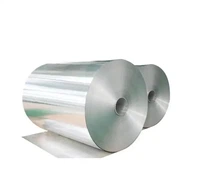
Selecting the right aluminium alloy is a critical step in the manufacturing process. Each alloy responds differently to stress, temperature and environment according to its chemical composition and mechanical properties, so the choice has to be made against the real duty of the part rather than on price alone. This article compares two cast aluminium plate alloys that are often shortlisted against each other, 5083 and 2618, covering their properties, advantages, limitations and the applications where each one wins.
What Is Cast Aluminium Plate?
Cast aluminium plate starts with molten aluminium poured into billets or slabs rather than being continuously rolled from a thin strand. Round billets can reach about 39 inches in diameter, while slabs are produced up to nearly 39 inches thick and about 94 inches wide. The slabs then undergo homogenisation in large furnaces, a controlled high-temperature soak that redistributes alloying elements which would otherwise remain trapped at the grain boundaries formed during solidification. Homogenisation is what gives the finished plate uniform mechanical and physical properties through the full thickness.
After homogenisation the slabs are saw-cut to nominal thickness and, where the application requires it, precision machined on both faces. This is particularly important for 5083 cast tooling plate up to 4 inches thick, where flatness and thickness uniformity directly affect the accuracy of the tool or fixture produced from it.
Properties of 2618 Aluminium Plate
Alloy 2618 belongs to the 2000 series and is known for high strength, high hardness and heat treatability, with copper as the primary alloying element together with magnesium, nickel and iron additions that support elevated-temperature strength. Its density is about 0.101 lb/in³, equivalent to roughly 2.80 g/cm³, and it has higher thermal conductivity than 5083.
Excellent machinability and dimensional stability in the as-cast condition.
Accepts anodising and nickel plating, and can be polished or textured for mould surfaces.
Homogenisation delivers consistent properties through large blocks.
Heat treatable, though heat treatment can reduce dimensional stability, which has to be allowed for when tight tolerances are required after treatment.
Retains useful strength at elevated temperatures, unlike 5000-series alloys.
Properties of 5083 Aluminium Plate
Alloy 5083 belongs to the 5000 series and is valued above all for weldability and corrosion resistance, particularly in marine and other aggressive environments. Magnesium is its main alloying element, with manganese and chromium additions; its density of about 0.096 lb/in³, roughly 2.66 g/cm³, is lower than that of 2618, so parts made from it are lighter for the same volume. It is not recommended for high-temperature applications.
Excellent weldability, which allows fabricated tooling and structures to be built up rather than bolted together.
Outstanding resistance to seawater and industrial atmospheres.
Lower density than 2618, giving a direct weight saving in large plates and fixtures.
Good machinability, surface treatment compatibility and uniform properties through the thickness.
Not heat treatable, so strength cannot be raised by thermal treatment after machining.
5083 versus 2618: Side-by-Side Comparison
| Property | 2618 | 5083 |
|---|---|---|
| Series and main alloying element | 2000 series, copper | 5000 series, magnesium |
| Density | About 0.101 lb/in³ (approx. 2.80 g/cm³) | About 0.096 lb/in³ (approx. 2.66 g/cm³) |
| Heat treatment | Heat treatable; high strength and hardness | Not heat treatable; strength from solid-solution and work hardening |
| Thermal conductivity | Higher than 5083 | Lower |
| Elevated-temperature service | Suitable, including high-temperature tooling | Not recommended |
| Corrosion resistance | Moderate; best when coated | Excellent, including marine exposure |
| Weldability | More limited | Excellent |
| Machinability and stability | Excellent in the as-cast state | Good, with uniform properties |
The trade-off is clear from the table: 2618 is the strength and temperature alloy, while 5083 is the corrosion and weldability alloy. Weight also separates them, since 5083 is roughly five percent lighter for the same volume.
Common Applications and How to Choose
Alloy 2618 is used where strength, hardness and high-temperature performance dominate. Typical parts include pistons, engine blocks and high-temperature tooling such as rotational moulds, blow moulds, injection moulds and composite tooling for aerospace work, as well as demanding automotive components. Its dimensional stability in the as-cast state makes it a practical choice for large moulds that must hold their form through repeated thermal cycles.
Alloy 5083 is used where corrosion resistance, weldability and flatness govern. It is common in plastic moulds that see aggressive environments, for example expanded polypropylene and polystyrene moulds for the automotive and packaging industries. Cast tooling plate up to 4 inches thick is precision machined for checking fixtures, robotic base plates and components, vacuum and router tables, and packaging and printing machinery, where dimensional stability and flatness over a large area are essential.
A practical selection sequence is to fix the service temperature first, because it immediately rules 5083 out of hot tooling; then test the environment for corrosion severity; then check whether welded fabrication is required; and only then compare strength-to-weight figures for the two candidates. Where both alloys technically pass, the deciding factors are usually the weight of the finished tool and the amount of welding in the assembly.
Frequently Asked Questions
Q: Can 5083 and 2618 be used interchangeably?
Only in a narrow band of low-duty applications. 2618 is heat treatable and gives much higher strength at temperature, while 5083 offers better corrosion resistance and weldability. Substituting one for the other changes processing and performance.
Q: Why is 5083 not recommended for high-temperature service?
The magnesium in solid solution can form embrittling phases when the alloy is held at elevated temperature for long periods, so it is specified for ambient, marine and cryogenic duty rather than hot tooling.
Q: Does heat treatment affect the flatness of 2618 plate?
Heat treatment can reduce dimensional stability, so plates that must meet close tolerances after treatment are usually machined with allowance, treated and then finish machined to final size.
Q: What is homogenisation and why does it matter?
It is a high-temperature soak applied to the cast slab that redistributes alloying elements trapped at the grain boundaries during solidification. The result is uniform mechanical properties through the full plate thickness.
Q: Which alloy gives better machined surface finish?
Both machine well and accept surface treatments and coatings. Alloy 2618 is generally described as excellent in the as-cast state, while 5083 offers good machinability with very uniform properties across large plates.