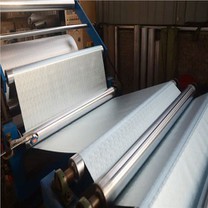
1. Melting: Use a large-capacity regenerative smelting furnace to melt the primary aluminum into molten aluminum, and enter the casting and rolling machine through the launder. During the flow of the molten aluminum, the refiner Al-Ti-B is added online to form continuous and uniform refinement. Effect: The graphite rotor degasses and removes slag online at 730-735°C, forming a continuous and uniform removal effect.
2. Rough rolling: the molten aluminum after the first step of smelting is introduced into the casting and rolling machine to be cast and rolled into billets; during this process, the cooling water inlet temperature of the inner cavity of the roller is controlled at 20-23°C, and the outlet water temperature is controlled at 28-28°C. 32°C, the static pressure of the aluminum melt between the roll gaps is controlled at 0.004-0.005Mpa, to ensure that the crystallization direction {100} area ratio of the material is >95%, the grain size is ≤5μm, and a slab of 6.5-7.5mm is rolled.
3. Intermediate rolling: The above-mentioned slab is rolled again by a cold rolling mill, and when it reaches a thickness of 4.5mm, it is sent into an annealing furnace, heated to 360°C, and kept for 2 hours, then continued to be heated to 580°C, kept warm For 18 hours, perform homogenization annealing to make the grain size uniform and the directionality consistent; then continue to cold-roll in the cold rolling mill to 0.60 mm, send it into the annealing furnace again, heat it to 460 ° C, and keep it for 5 hours. Lower the temperature to 400°C, keep it warm for 7 hours, and perform intermediate annealing; then continue rolling to a thickness of 0.3mm as aluminum foil wool.
4. Foil rolling: use a four-roller irreversible foil rolling unit to roll the above-mentioned 0.3mm aluminum foil wool into finished aluminum foil. The production process of the ultra-thin aluminum foil is short, the operating cost is low, and the production investment scale is small, and the quality of the ultra-thin aluminum foil produced can reach the most advanced international level. Compared with the production process of the hot rolling method, the investment cost in the production of blanks is reduced Two-thirds, operating costs reduced by more than half.
HENAN GNEE NEW MATERIAL CO., LTD
86-372-5055135
 Language
- English
- Srbija jezik (latinica)
- slovenščina
- Español
- Kreyòl Ayisyen
- Cymraeg
- O'zbek
- українська
- Deutsch
- Català
- Gaeilgenah Éireann
- Čeština
- 한국어
- Eesti
- hrvatski
- Bai Miaowen
- Nederlands
- Български
- Türkçe
- Italiano
- Lietuvių
- magyar
- עברית
- Indonesia
- Français
- íslenska
- Português
- Ελληνικά
- বাংলা
- 日本語
- Latviešu
- русский
- suomi
- Malti
- عربي
- Polski
- Svenska
- dansk
- bosanski
- Melayu
- فارسی
- ไทย
- اردو
- România limbi
- Norsk
- हिंदी
- slovenčina
- Việt Nam