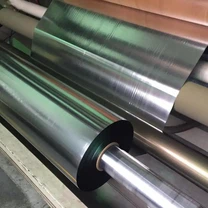
Aluminium appears in wind turbines mostly in the non-structural and secondary-structural parts of the machine: canopy and enclosure panels, frame extrusions, generator and gearbox housings, heat exchanger frames, cable trays, ladders and platform gratings, busbars and cable, and parts of the lightning protection path. The reason is mass. Every kilogram saved inside the nacelle reduces tower-head load, which reduces tower mass and foundation cost, and that saving is repeated in every load case in the design envelope.
Where Each Aluminium Alloy Is Used
| Component | Typical alloy and temper | Product form | Reason for selection |
|---|---|---|---|
| Nacelle canopy and enclosure panels | EN AW-5754 H22, or 5052 H32 | Sheet and coil | Marine-grade corrosion resistance, formability, weldability |
| Internal frame and support extrusions | EN AW-6082 T6, 6063 T6 | Extruded profile | Highest strength of the 6xxx extrusions, good extrudability, welded frames |
| Generator, converter and gearbox housings | 6xxx wrought and cast grades | Plate, extrusion, casting | Mass reduction and high thermal conductivity for heat rejection |
| Cable trays, ladders and gratings | 6063 T6, 3003 and 5052 sheet | Extrusion and sheet | Light, corrosion resistant, non-magnetic |
| Busbars and power cable | 1050A, 1350 | Bar and stranded conductor | Electrical conductivity in the region of 61 % IACS for 1350 |
| Lightning protection conductors and receptors | 1050, 6061 | Bar, sheet, extrusion | Conductivity, resistance to surge erosion |
Mechanical property requirements for extrusions are specified in EN 755-2 or ASTM B221, for sheet and plate in EN 485-2 or ASTM B209, and chemical composition in EN 573-3. Grade selection normally starts from the corrosion environment, because offshore and coastal sites demand the 5xxx sheet alloys even where a 6xxx alloy would be stronger.
How Mass and Stiffness Trade Off
Replacing steel with aluminium does not automatically save weight, because design is usually governed by stiffness rather than by strength. The modulus of aluminium is about 70 GPa against 210 GPa for steel, a ratio of one third. To match the bending stiffness of a steel panel, an aluminium panel must be about 1.44 times thicker, since stiffness rises with the cube of thickness and only linearly with modulus. At equal stiffness, aluminium then weighs roughly 0.95 of the steel panel. The real gains appear where strength, corrosion allowance or handling weight govern instead: a strength-governed bracket in 6082 T6 weighs about one third of the steel equivalent, and a coastal canopy panel in 5754 needs no protective coating at all, unlike painted or galvanised steel. For offshore machines, the elimination of coating maintenance is often worth more than the direct mass saving.
Design Rules for Aluminium in Turbine Structures
Structural design follows EN 1999-1-1, the Eurocode for aluminium structures. Fatigue is assessed to EN 1999-1-3, which assigns detail categories to welded and bolted connections, and the turbine itself is designed to the IEC 61400-1 design requirements, with lightning protection covered by IEC 61400-24. Four practical rules follow.
Deflection governs first. Choose the section for stiffness, then check stress.
Welds cost fatigue strength. A welded aluminium detail has a much lower fatigue class than the parent metal, and in 6xxx alloys the heat affected zone loses a large part of its T6 strength, so design allowables there are commonly taken at roughly half the parent value.
Keep aluminium away from copper and isolate it from steel. Aluminium is anodic in the galvanic series, so a wet joint with steel or stainless steel concentrates attack on the aluminium. Use isolating washers, coated fasteners and sealant, and avoid copper-bearing components entirely.
Do not allow pockets that hold water or salt. Drainage and ventilation details decide the service life of a canopy panel more than the alloy grade does.
Frequently Asked Questions
Q: Why is aluminium used in wind turbine nacelles?
A: To reduce tower-head mass. Lower nacelle mass means lower tower load, a lighter tower and a smaller foundation, and it also removes the need for corrosion coating on external panels.
Q: Are wind turbine towers made of aluminium?
A: No. Towers are steel or concrete, because stiffness and cost per unit of stiffness favour steel at that scale. Aluminium is used for secondary structure, enclosures and electrical components.
Q: Which aluminium alloys are used in wind turbines?
A: EN AW-5754 and 5052 sheet for panels exposed to weather, EN AW-6063 and 6082 extrusions for frames and trays, 6061 for machined parts, and 1050A or 1350 for conductors and busbars.
Q: How is corrosion controlled on offshore turbines?
A: Grade selection is the first step, since 5xxx sheet alloys resist salt water without coating. Joints are isolated to prevent galvanic attack, and where a 6xxx extrusion is used outdoors it is anodised to ISO 7599 or painted, then verified by salt spray testing to ASTM B117.
Q: How is fatigue handled in aluminium turbine components?
A: With detail categories from EN 1999-1-3 and the load spectrum from IEC 61400-1, which together define the design service life. Welded joints and the heat affected zone are the critical locations, and bolted or adhesive joints are often chosen to avoid them.
Q: Is recycled aluminium used in turbine components?
A: Yes. Secondary aluminium requires only a small fraction of the energy needed to smelt primary metal, and it is increasingly specified for non-critical enclosures and trays.