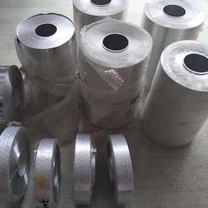
What Microwave Oven Aluminum Foil Actually Is
Microwave oven aluminum foil is a food-grade aluminium foil made from 8011, 1235 or 8079 alloy in the soft annealed O temper and supplied in rolls or pre-cut sheets for wrapping, covering and shielding food during microwave heating, reheating and defrosting. The wrap traps steam around the product, limits moisture loss, holds fat splatter inside the pack and shortens the cleaning time of the cavity after a service.
Household foil from a supermarket shelf and foil intended for microwave service are not the same product. A thin, heavily wrinkled sheet, a torn corner or a narrow cut strip can arc against the cavity wall, the turntable or a metal rack. Arcing burns pinholes through the sheet, stresses the magnetron over repeated cycles and can ignite paper or plastic parts of the packaging. Foil specified for microwave use is therefore supplied in heavier gauges with tight thickness tolerances, so that a sheet holds a flat profile and its edges stay predictable.
Alloys, Gauges and Food-Contact Compliance
Foil for food contact is produced against recognised foil specifications, so gauge, tensile strength, elongation and pinhole count are controlled lot by lot rather than judged by appearance.
| Parameter | Typical specification | Why it matters in a microwave |
|---|---|---|
| Alloy | EN AW-8011, EN AW-1235, EN AW-8079 | Iron and silicon balance sets strength and pinhole resistance |
| Temper | O, soft annealed | Dead-soft sheet forms around food without springback or tearing |
| Thickness | 15 to 30 micrometres; microwave grades normally 20 to 30 micrometres | Heavier gauges resist creasing, and creases are the main cause of arcing |
| Product standards | GB/T 3198, ASTM B479, EN 546-2 | Define gauge tolerance, tensile and elongation testing |
| Food-contact rules | GB 4806.9, EU 10/2011, FDA 21 CFR 175.300 | Set migration limits for metals transferred into food simulants |
| Thickness tolerance | Plus or minus 5 percent of nominal gauge | A uniform profile avoids thin spots that concentrate energy |
Thickness is the specification buyers quote most often, and it matters more in a microwave than in general wrapping. A 20 micrometre sheet held to a tight tolerance behaves very differently from a 12 micrometre sheet with a loose one: the lighter sheet creases under its own weight, and a crease folded back on itself creates a dense metal edge that concentrates the microwave field.
How Foil Behaves Inside a Microwave Cavity
Microwave energy is reflected by metal instead of being absorbed by it, so a smooth piece of foil does not heat the way it would in a conventional oven. Four practical effects follow from that behaviour.
Shielding. Foil laid over the thinner sections of a roast or a casserole slows heating in those areas so that the whole item finishes at the same time.
Spot heating. Energy concentrates at sharp points and irregular edges, which is why a crumpled ball, a torn corner or a strip narrower than about 25 millimetres is the classic trigger for arcing.
No true browning. Foil cannot brown a surface the way a frying pan or a grill does; it reflects energy and reflects heat back into the pack.
Contact risk. Foil touching the cavity wall, the door seal, the turntable spindle or a metal rack closes an electrical path the appliance was never designed to handle.
A workable rule used in food-service kitchens is to keep every edge of the sheet at least 25 millimetres clear of the cavity walls and to keep the covered area modest relative to the load. Where a recipe calls for full wrapping, the product is usually heated in a microwave-safe container with the foil used only as a partial cover.
Safe Usage Rules for Kitchens
Use only foil that the supplier describes as intended for microwave use, and read the gauge on the label instead of judging by feel.
Never let foil bridge two metal parts of the appliance or touch the door seal; stand the wrapped item on a glass or ceramic plate.
Keep pieces small, smooth and free from sharp folds, and discard any sheet showing pinholes, tears or crushed edges.
Avoid long contact between foil and salty, acidic or heavily spiced foods, because chloride and acid attack the metal surface and raise migration into the food.
Do not start a cycle with the cavity empty, and do not restart after arcing: switch off, unplug, inspect the sheet and remove any charred fragments.
Reposition a partial cover during heating so that reflected energy does not concentrate at a single point.
Converting and Quality Control for Suppliers
Microwave foil is slit from jumbo rolls on controlled-tension slitters and packed on cores with alloy, temper and gauge marked on every carton. Producers control the thickness profile across the web, pinhole count, wettability and residual rolling oil, because each of these properties changes how a sheet behaves in a cavity. Inline thickness gauging plus an optical pinhole detector produces a lot record that food manufacturers and retailers can audit. Foil packed in a clean, dust-free area, with interleaved paper or a light release film, also reduces the tendency of the sheet to stick to itself, which is what forces users to crush the foil in the first place.
Frequently Asked Questions
Q: Is it safe to put aluminum foil in a microwave?
Yes, provided the foil is a small, smooth piece intended for microwave use and it is kept clear of the cavity walls, the door seal and any metal accessory.
Q: Why did the foil spark?
Sparks come from sharp edges, crumpled balls, narrow strips and any foil touching the cavity wall; switch off the appliance, discard that sheet and fit a flat, wider piece.
Q: How thick should microwave-safe foil be?
Heavier grades in the 20 to 30 micrometre range are normally used, because they hold a flat shape and resist the creasing that produces arcing.
Q: Which alloys are used for food-grade foil?
EN AW-8011, EN AW-1235 and EN AW-8079 are the usual grades for food-contact work, supplied in the soft annealed O temper.
Q: Can foil be used to shield part of a dish?
Yes. Covering thin or bony sections of a joint slows heating there and helps the whole item reach serving temperature at once.
Q: Does aluminum leach into food during heating?
Migration stays very low for neutral foods, but long contact with salty or acidic products and long heating times increase it, so those combinations are best avoided.
Q: What should a buyer check on an incoming foil lot?
Check alloy and temper, gauge and thickness profile, pinhole count, food-contact documentation and surface cleanliness before releasing the lot to production.