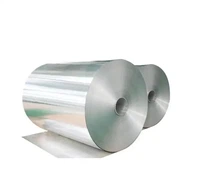
Aluminum foil is not one product but a family of products that share a common rolling route and then diverge according to thickness, temper, surface condition and the barrier or electrical duty they must perform. The four classes below cover the great majority of industrial consumption: flexible packaging foil, pharmaceutical foil, composite foil for automotive heat exchangers, and foil for electrolytic capacitors. Each class is defined less by its chemistry, which is often ordinary 1xxx or 8xxx alloy, than by the combination of gauge, temper and surface quality that the final process demands.
1. Flexible Packaging Foil
Flexible packaging is a bag or pouch formed from soft composite materials. Its arrival transformed the mechanisation and automation of the food and beverage industry and accelerated the modernisation of everyday diets. In developed markets, flexible packaging has become a leading packaging form for food and beverages, displacing cans and bottles in many applications.
Foil enters these structures as the barrier ply in a laminate. Depending on the end use, the converter may choose dry bonding, hot-melt lamination or extrusion lamination, and the foil is usually supplied in the annealed O temper at 0.006 mm to 0.04 mm so that it can be laminated without cracking or pinhole damage.
Moisture-proof and freshness-retaining barrier layer.
Printable substrate for brand graphics and product information.
Pinhole-free surface, verified by light-transmission or dye-penetration testing.
Compatible with dry, hot-melt and extrusion lamination lines.
Dead-fold flexibility where the pouch must hold a crimped or folded shape.
2. Pharmaceutical Foil
Medical packaging foil covers two large product groups: easy-open lids for liquid and injection bottles, and the push-through blister foil known as PTP foil. PTP foil is moisture-proof, easy to carry and hygienic, which is why it became the standard blister lidding material in the international pharmaceutical industry. Aluminum foil has been used for pharmaceutical packaging in China since 1985, and its share of the pharmaceutical packaging mix has climbed steadily as the sector has grown.
PTP lidding is normally 0.02-0.03 mm hard-temper foil, printed and lacquered on the outside and coated with a heat-seal lacquer on the inside so that it seals to the PVC or PVDC blister. Surface cleanliness, seal-strength consistency and print registration are the quality attributes that matter most; barrier performance is checked by moisture-vapour transmission testing.
3. Composite Foil for Automobiles
As vehicle production expanded and the aluminium content of cars rose, demand for automotive foil grew quickly. Two families dominate:
Composite foil for air-conditioning systems. The aluminium content of automotive air-conditioning systems has become essentially complete across the industry, and the annual foil demand for this segment has been reported at around 15,000 tonnes in China.
Composite foil for radiators and heat exchangers. This material is used to manufacture water-tank radiators, condensers and evaporators. Reported aluminisation of automotive water tanks reached about 40 percent, corresponding to roughly 3,000 tonnes of foil demand a year.
These products are supplied as fin and tube stock for brazed assemblies. Formability, brazability, sag resistance during the brazing cycle and long-term corrosion resistance in a coolant environment are the governing requirements.
4. Aluminum Foil for Electrolytic Capacitors
Capacitor foil is a corrosion-processed material that works under polar conditions, and it places unusually high demands on the microstructure of the metal. Three types are supplied:
| Type | Thickness | Notes |
|---|---|---|
| Cathode foil | 0.015-0.06 mm | Etched to raise effective surface area |
| High-voltage anode foil | 0.065-0.1 mm | Requires high-purity metal, typically four-nines grade |
| Low-voltage anode foil | 0.06-0.1 mm | Etched and anodised to form the dielectric oxide |
There are relatively few producers of capacitor foil, because volumes are modest and the process technology is demanding. Aluminum electrolytic capacitors nevertheless offer good performance, low cost and very wide application, so the long-term outlook for this class is favourable as electronics production expands.
Class-by-Class Comparison
| Class | Typical thickness | Temper | Governing property |
|---|---|---|---|
| Flexible packaging foil | 0.006-0.04 mm | O, H18 | Pinhole-free barrier, printability, lamination |
| Pharmaceutical foil (PTP) | 0.02-0.03 mm | H18 | Moisture barrier, seal strength to PVC or PVDC |
| Automotive composite foil | Brazed fin and tube stock | O, H14, H24 | Formability, brazability, coolant corrosion resistance |
| Electrolytic capacitor foil | 0.015-0.1 mm by type | Hard / special | Etchability and, for anodes, high-purity metal |
Foil general requirements for all four classes are commonly written around ASTM B479, GB/T 3198 and the EN 546 series, with temper designations following ANSI H35.1 and EN 515 and vapour-barrier performance checked to ISO 12572 or ASTM E96.
Frequently Asked Questions
Q: What determines which class an aluminum foil falls into?
Gauge, temper, surface quality and the downstream process. Chemistry is often similar across classes, so the specification is written around the duty the foil has to perform.
Q: Why is packaging foil so much thinner than capacitor foil?
Packaging foil must be light, flexible and printable while acting as a barrier inside a laminate, so it is rolled to a few microns. Capacitor foil must be etched to a controlled surface area and then anodised, which requires a thicker, structurally uniform base.
Q: Is PTP foil the same as flexible packaging foil?
No. PTP lidding is a hard-temper 0.02-0.03 mm foil with heat-seal lacquer that is pushed through by the tablet, whereas packaging foil is an annealed barrier ply inside a laminated pouch.
Q: What thickness of capacitor foil is used for cathodes?
Cathode foil is supplied between 0.015 mm and 0.06 mm, thinner than the 0.06-0.1 mm anode gauges because the cathode does not have to support the anodic oxide dielectric.
Q: Do automotive foils need special corrosion protection?
Yes. Heat exchanger fin and tube stock is exposed to road salt outside and to coolant chemistry inside, so alloy selection, cladding and surface treatment are all chosen to resist that combined attack.
Q: What standards should a foil specification cite?
ASTM B479, GB/T 3198 and the EN 546 series for general requirements, ANSI H35.1 and EN 515 for temper designations, and ISO 12572 or ASTM E96 where moisture-vapour transmission must be verified.