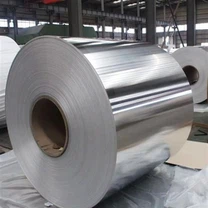
Two Product Families, Two Different Duties
Flexible packaging foil and container foil are both rolled from high-purity aluminum, but they leave the mill at very different gauges and are then converted in completely different ways. Flexible packaging foil is a thin, pliable web that is printed, laminated or coated and turned into bags, sachets and pouches. Container foil is a semi-rigid sheet that is deep drawn or folded into trays, dishes, lids and food utensils. Specifying one when the other is required is one of the most common and most expensive mistakes in packaging procurement.
Flexible packaging foil protects through a thin, compliant membrane with an extremely low moisture transmission rate.
Container foil protects through rigidity, holding a three-dimensional shape that withstands filling, stacking and oven heat.
Both are supplied in the annealed O temper as standard, because softness is essential for forming and folding.
Both rely on the same base metal, so both are fully recyclable in the same secondary metal stream.
Thickness, Alloy and Temper Ranges
Gauge is the fastest way to tell the two families apart. The table below summarises the usual commercial windows; compositions follow EN 573-3 and the four-digit designation system adopted in GB/T 3190, while thickness and tolerance requirements are commonly verified against EN 546 or GB/T 3198 depending on the destination market.
| Product family | Typical thickness | Common alloys | Temper | Conversion route |
|---|---|---|---|---|
| Flexible packaging foil | 0.0058–0.030 mm | 1235, 8079, 8011 | O | Printing, lamination, coating, bag making |
| Container foil | 0.010–0.200 mm | 8011, 3003, 3004, 1100 | O, H22, H24 | Deep drawing, folding, rim forming |
| Lidding and lid foil | 0.030–0.050 mm | 8011, 8011A | O, H24 | Lacquering, heat-seal coating, punching |
| Cigarette lining foil | 0.0063–0.0065 mm | 1235, 8079 | O | Lamination to paper, calendering |
Thickness control matters most in the thin end of the range, where pinhole density rises sharply as gauge falls, and in the thick end, where corner cracking during drawing depends on consistent mechanical properties.
Lamination and Conversion Processes
Flexible packaging rarely uses bare foil. Three lamination routes dominate, and they are selected according to the end use of the pack:
Dry lamination bonds foil to a printed film or paper with an adhesive applied and dried before the webs are nipped together.
Hot melt lamination uses a molten adhesive for fast, solvent-free bonding of foil to paper or board.
Extrusion lamination applies a molten polymer layer directly onto the foil, combining bonding and a sealable surface in one pass.
After lamination the web is printed, lacquered and finally converted into sachets, strip packs, blister lidding or pouches. Heat-seal lacquer selection determines the sealing window on the filling line, so it is normally fixed together with the foil gauge rather than afterwards.
Barrier Performance and Why It Matters
The functional value of foil in both families comes from an absolutely continuous metal layer. Moisture, oxygen, light and aroma cannot pass through a pinhole-free foil web, so the packaging designer controls shelf life mainly through pinhole density and through the quality of the seals and folds. In cigarette lining paper, for example, the foil is laminated to paper and performs two distinct jobs: it stops the aroma of the tobacco from escaping and prevents odour from the surrounding environment from reaching the product, and it blocks moisture so that cigarettes do not mould in humid conditions. Those same barrier mechanisms protect coffee, dairy powders, pharmaceuticals and ready meals.
Choosing Between Flexible and Container Foil
The decision follows the filling and preparation process rather than the price per kilogram alone.
Choose flexible packaging foil when the product is filled as a flow, needs a printed brand surface, and must stay soft during handling.
Choose container foil when the pack has to hold a three-dimensional shape, be stacked, or go directly into an oven or freezer.
Choose lidding foil when a formed container needs a hermetic, peelable or weldable closure.
Where both routes are possible, compare total packaging cost per unit sold, including line speed, waste rate and material recovery, rather than foil cost per tonne.
Frequently Asked Questions
Q: What thickness is flexible packaging foil?
The usual commercial range is 0.0058–0.030 mm. Below the lower end, pinhole density rises quickly and barrier performance becomes unpredictable, so thinner gauges are reserved for short shelf-life applications.
Q: How thick is container foil?
Container foil normally spans 0.010–0.200 mm. Shallow dishes and serving trays sit at the thin end, while deep catering pans require thicker material so that the corners can withstand drawing without cracking.
Q: Why is flexible packaging foil laminated?
Bare foil is thin, so it is combined with paper or polymer films by dry, hot melt or extrusion lamination to add mechanical strength, printability and a heat-sealable surface while keeping the barrier layer intact.
Q: What does the foil do in cigarette lining paper?
It preserves aroma by preventing the tobacco smell from escaping and outside odours from entering, and it blocks moisture so that the cigarettes do not become mouldy in humid conditions. Typical lining foil gauges are about 0.0063–0.0065 mm.
Q: Which alloys are used for these foils?
Flexible packaging and lining foils are typically 1235, 8079 or 8011 in the annealed O temper, while container and lidding foils more often use 8011, 8011A, 3003, 3004 or 1100 depending on the rigidity required.
Q: Are both foil families recyclable?
Yes. Both are aluminum, so both enter the same secondary metal stream and can be re-melted repeatedly without loss of properties. Laminated and coated structures are still recoverable, although separation steps affect the value of the recovered metal.