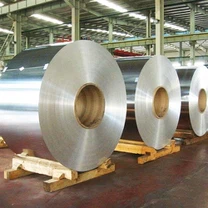
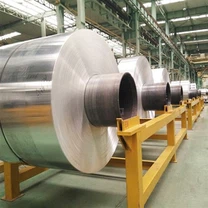
What 1100 Aluminum Sheet Actually Is
1100 is a commercially pure aluminum grade with a minimum aluminum content of 99.0%. It is designated 1100 in the international four-digit system used by EN 573-3 and adopted in GB/T 3190, and corresponds to the UNS A91100 registration. Iron and silicon are controlled to a combined maximum of about 0.95%, copper sits in the 0.05–0.20% range, and the density is approximately 2.71 g/cm³. Annealed sheet in the O temper typically shows a tensile strength near 90 MPa with elongation well above 30%, which is why the grade is chosen for deep drawn parts, spun components, nameplates, heat exchangers and food-grade utensils.
Before comparing prices it is worth separating the metal from the work. A tonne of 1100 sheet is a tonne of metal value plus the cost of turning a cast slab into a flat, dimensionally accurate product.
Factor One: Aluminum Ingot Price
For any plain, uncoated sheet the metal content dominates the delivered cost, and ingot quotations move every trading day. Suppliers therefore quote a price basis, usually the published monthly average of the Shanghai Futures Exchange for domestic business or a London Metal Exchange cash settlement for export orders, and add a conversion margin on top.
Ingot prices are published daily and change with energy costs, inventory levels and currency movement.
A fixed price is only meaningful together with the pricing date or pricing period it refers to.
Domestic and export orders may reference different exchanges, so the same sheet can carry two different bases.
Metal loss during melting, casting and rolling is charged back to the buyer as part of the conversion margin.
Factor Two: Processing and Conversion Cost
Conversion cost is the sum of hot rolling, cold rolling passes, annealing cycles, slitting or cut-to-length, edge trimming and inspection. It varies with the final specification far more than with the alloy label, because every additional rolling pass, tighter thickness tolerance and narrower width increases yield loss per tonne.
Continuous cast material is produced with fewer hot-rolling steps and is generally cheaper for common thicknesses.
Direct chill cast ingot gives better surface quality and internal soundness, at a higher conversion cost.
Thickness and width tolerance classes, flatness and edge condition are all priced separately.
Annealing to the O temper adds furnace time and energy; H14 or H24 tempers follow a different schedule.
Surface finish, protective film, interleaving paper and export packaging each add measurable cost.
Factor Three: Alloy, Temper and Quality Specification
Two suppliers quoting the same 1100 sheet can still deliver different products. Dimensional conformity is normally verified against EN 485-2 or GB/T 3880.1, and the mechanical properties and chemical composition stated on the mill certificate are what ultimately justify a price difference.
| Specification item | Standard reference | Commercial effect |
|---|---|---|
| Chemical composition | EN 573-3 / GB/T 3190 | Narrower windows cost more to hold |
| Mechanical properties | EN 485-2 / GB/T 3880.2 | Temper control affects yield and price |
| Thickness and flatness tolerance | EN 485-4 / GB/T 3880.3 | Tighter tolerance reduces yield |
| Inspection and traceability | Mill certificate and batch records | Full documentation adds cost, not risk |
Factor Four: Logistics, Quantity and Commercial Terms
Sheet is heavy and bulky, so freight is a visible line item rather than a rounding error. Distance, transport mode, coil versus cut sheet, pallet or wooden case, and container utilisation all change the landed figure, and the same order shipped to two destinations will price differently.
Larger volumes qualify for better conversion rates because mill setup and yield loss amortise over more tonnes.
Full container loads usually beat consolidated shipments on cost per tonne.
Lead time, payment terms and the loading port are genuine commercial variables, not fixed overheads.
Cut-to-length sheet costs more to pack and ship than coil of the same mass.
How the Delivered Price Is Built
Once the components are separated, the arithmetic becomes transparent. For a given specification the price per tonne equals the metal price basis multiplied by one plus the metal loss factor, plus the conversion fee for that specification, plus freight and packaging, plus applicable tax and duty adjustments. Total order value is that per-tonne figure multiplied by the ordered quantity.
Buyers who want a stable budget usually fix the conversion fee for a quarter and let the metal basis float with the published index, which keeps the commercial risk on the component that is genuinely volatile. It also makes competing offers comparable, because two suppliers can then be compared on conversion cost and specification rather than on the ingot date they happened to use.
A last practical point: the cheapest offer is often the least specified one. Ask for composition, temper, tolerance class, certificate and packaging to be stated explicitly, and compare offers on that basis.
Frequently Asked Questions
Q: What determines the price of 1100 aluminum sheet?
Four items drive it: the aluminum ingot price on the day or period of pricing, the conversion cost for the required specification, the freight and packaging to the destination, and commercial factors such as quantity, lead time and payment terms.
Q: Is the aluminum ingot price the same as the sheet price?
No. The ingot price is only the metal component. Sheet also carries rolling, annealing, slitting, inspection, packaging and metal loss, which is why the sheet price per tonne always exceeds the ingot quotation by the conversion margin.
Q: Why do two suppliers quote different prices for the same 1100 sheet?
Because the offers may differ in thickness and flatness tolerance, temper control, surface quality, packaging, documentation and delivery terms. Converting both offers into a single specification with defined tolerances usually explains the gap.
Q: What thickness and temper range is available in 1100?
1100 is rolled from thin sheet to plate thickness and is normally supplied in the O, H14, H22 and H24 tempers. The exact range depends on the mill and on whether the material is continuous cast or hot rolled from direct chill ingot.
Q: Does freight really change the sheet price that much?
It can, because aluminum sheet is a dense, bulky product. Distance, transport mode, shipment size, packaging type and container utilisation all affect the landed cost per tonne, and they are quoted separately for that reason.
Q: How can buyers keep the price stable?
Fix the conversion fee for a defined period and let the metal component track a published exchange index. This separates the volatile metal exposure from the controllable processing cost and makes supplier offers directly comparable.