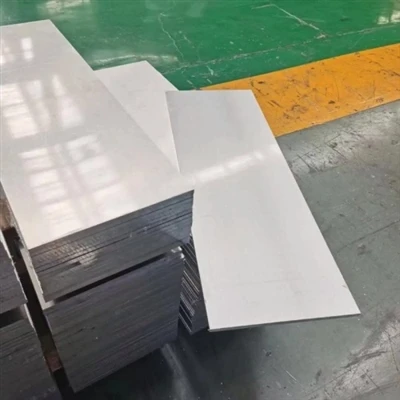
What Is the Difference Between 7075-T6 and 7075-T651?
The main difference between 7075-T6 and 7075-T651 lies in residual stress control. Both tempers undergo solution heat treatment, quenching, and artificial aging, but T651 includes an additional stretching process for stress relief.
This stretching step significantly reduces internal stress caused by quenching. As a result, 7075-T651 offers better dimensional stability during machining and service. Although the mechanical strength of both tempers is very similar, T651 is generally preferred for thick plates and precision components.
GNEE commonly supplies 7075-T651 aluminum plate for applications requiring high accuracy and long-term stability.
Why Is Stress Relief Important for 7075 Aluminum Plate?
Stress relief is critical for 7075 aluminum plate because high-strength aluminum alloys develop significant internal stress during quenching. Without stress relief, these stresses can cause distortion, warping, or cracking during machining.
By applying controlled stretching, the T651 temper reduces these residual stresses, ensuring that the plate remains flat and dimensionally stable. This is especially important for large aerospace or tooling components that require tight tolerances.
Stress-relieved 7075 aluminum also shows improved fatigue performance and more consistent mechanical behavior.
How Does Plate Thickness Affect 7075 Aluminum Properties?
Plate thickness has a noticeable effect on the mechanical properties of 7075 aluminum. As thickness increases, cooling rates during quenching decrease, which can slightly reduce tensile and yield strength.
For thin plates and sheets, 7075 aluminum achieves near-maximum strength. In thicker plates, strength may decrease modestly, but the overall performance trend remains consistent. Special rolling and heat treatment processes are often required for plates thicker than 50 mm.
GNEE offers 7075 aluminum plates in a wide range of thicknesses, with controlled processing to ensure stable performance.
What Are the Typical Mechanical Properties of 7075 Aluminum?
7075 aluminum is known for its outstanding mechanical properties. Typical tensile strength ranges from 540 to 570 MPa, while yield strength commonly exceeds 480 MPa, depending on temper and thickness.
The alloy also exhibits excellent fatigue strength and high hardness. Its elastic modulus remains consistent at approximately 71 GPa, providing predictable elastic behavior under load.
These mechanical characteristics make 7075 aluminum suitable for high-stress structural applications across multiple industries.