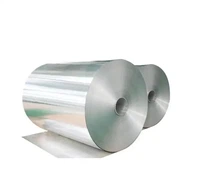
As one of the commonly used materials in flexible packaging, aluminum foil has its unique characteristics and advantages. This article will introduce the processing of aluminum foil.
Simple processing of aluminum foil
The aluminum foil blank is a cold-rolled aluminum coil with a thickness of 0.4-0.7mm and a high multiple deformation rate. The aluminum foil blank is first pre-quenched at 240-480°C, and then fed into the roller press. It is processed with high hardness and high smoothness. The steel rollers undergo rough rolling, intermediate rolling, and finish rolling to form sheets, and finally are quenched to form aluminum foil. The thickness of the aluminum foil can be controlled by adjusting the tension, the rolling force during rough rolling, and the speed during finishing rolling.

During finish rolling, the thickness of the foil becomes thinner as the rolling speed increases; the greater the tension, the smaller the thickness. The minimum thickness produced by the belt production method can reach 0.0025mm, and the width can reach 1800mm. This kind of aluminum foil that has not undergone other processing is called light foil or plain foil. Light foil has poor carrying capacity and is rarely used alone. Generally, light foil needs to be deeply processed according to different uses to make higher-grade packaging materials.

Deep processing of aluminum foil
Deep processing mainly includes:
complex
The aluminum foil and plastic film, paper, cellophane, etc. are laminated with adhesives or coated with PE, etc. to form composite films for various purposes.
Coloring
Aluminum foil can be painted in various colors on the coloring machine. It is expected that its own metallic luster will be combined to form a unique luster color and improve its decorative performance.
print
Aluminum foil can be printed directly or printed after surface coating. Generally, flexographic printing, gravure printing and screen printing are used. Because aluminum foil is not absorbent and has poor surface adsorption capacity, it needs to rely on the volatilization of the solvent in the paint for drying during printing. In addition, aluminum foil is very soft, so it is necessary to ensure that the softness of the printing ink is consistent with that of the aluminum foil after drying. Party B may experience cracks in the ink film, small pieces falling off, or even overall separation. When printing, thin aluminum foil should be supported on a pallet or mounted with a liner before printing to prevent the aluminum foil from breaking. The printed aluminum foil is used as sales packaging material. Its special luster matches the ink and has a good product decoration effect.
embossed
Aluminum foil can be embossed with various light and dark concave and convex patterns on an embossing machine and used to wrap food, which has a great decorative effect. Aluminum foil embossing can also improve its surface flatness and eliminate its slight wrinkles.