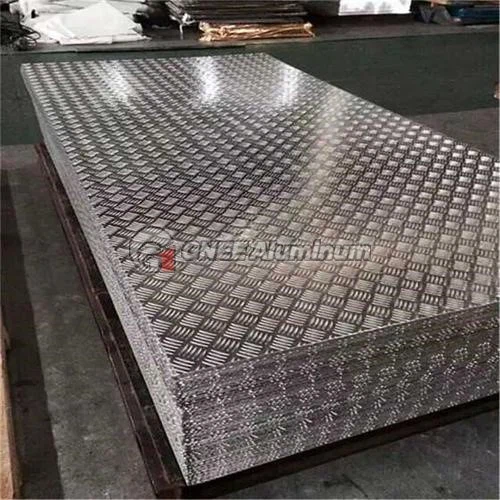
Aluminum checkered plate itself has excellent corrosion resistance, but there is still a risk of rust under certain conditions. The key influencing factors are as follows:
1. Anti-rust core mechanism
Natural oxide film protection
When aluminum comes into contact with oxygen, a dense aluminum oxide film (Al₂O₃) will be generated, which isolates moisture and corrosive media and prevents further oxidation.
The thickness of the oxide film directly affects the anti-rust ability. The oxide film of untreated aluminum plate is about 4nm, which can be increased to 10–25μm after anodizing (corrosion resistance increased by 3–5 times).
Difference in alloy composition
3003 aluminum-manganese alloy (rust-proof aluminum plate): The anti-rust performance is better than ordinary aluminum plate, but the salt spray corrosion resistance is weaker than the 5000 series, suitable for trucks, cold storage and other mildly humid environments.
5052/5083 aluminum-magnesium alloy : Contains magnesium (2.2–4.9%), and the corrosion resistance is significantly enhanced, suitable for high humidity scenes such as ship decks and coastal buildings.
2. Exceptions to possible rust
Extreme environmental erosion
Long-term exposure to strong acid (pH < 4), strong alkali (pH > 10) or high-concentration salt spray environment (such as chemical plants, seawater direct flushing areas) will cause the oxide film to fail.
Surface treatment defects
If anodizing or coating treatment is not performed, or the process is not up to standard (such as insufficient oxide film thickness, coating leakage), the aluminum plate is prone to corrosion.
If the processing areas such as welding points and bending edges are not protected for the second time, they may become the starting point of rust.
Contact of heterogeneous metals
When in direct contact with metals such as steel and copper, it may trigger an electrochemical reaction (galvanic cell effect), accelerating the corrosion of the aluminum plate.
3.Rust Prevention Optimization Plan
| Measure | Specific Operations | Effect Improvement |
|---|---|---|
| Alloy Upgrade | Select 5000 series alloys (e.g., 5083-H111) | Salt spray corrosion resistance ↑ 200% |
| Surface Treatment | Anodizing (film thickness ≥15μm) or fluorocarbon spraying (PVDF) | Salt spray test passed for ≥3000 hours |
| Isolation Protection | Use nylon gaskets to isolate aluminum from dissimilar metals | Prevents electrochemical corrosion |
| Regular Maintenance | Clean surface every 6 months to remove acidic/alkaline residues | Extends |
Summary: Aluminum patterned plates are not easy to rust under normal conditions (better than steel 710), but rust may still occur in extreme corrosive environments or process defects. Risks can be avoided to the greatest extent through reasonable material selection (preferably 5083 alloy), standardized surface treatment (anodizing/coating) and regular maintenance.