Designation and Family
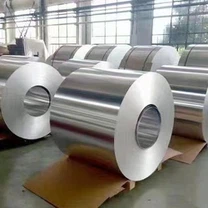
A93003 is the UNS number for aluminium alloy 3003, the most widely used member of the 3xxx Al-Mn family. The same material appears in European documentation as EN AW-3003 with the numeric designation 3.0517, and in older German practice as AlMnCu. It is a wrought alloy produced exclusively by rolling and drawing; it is not a casting alloy. Suppliers of disc circles normally work from 3003 sheet or strip and blank the discs on a press, so the finished disc inherits the metallurgical condition of the coil it was cut from.
Chemical Composition
| Element (percent, by mass) | 3003 / A93003 limits |
|---|---|
| Silicon | max 0.6 |
| Iron | max 0.7 |
| Copper | 0.05 to 0.20 |
| Manganese | 1.0 to 1.5 |
| Zinc | max 0.10 |
| Other, each | max 0.05 |
| Aluminium | remainder |
These ranges follow the registered limits for AA 3003 and EN 573-3. Manganese is the hardening addition; it forms finely dispersed intermetallic particles that inhibit recrystallisation and raise strength without a corresponding loss of ductility. Copper at 0.05 to 0.20 percent gives a modest further increase in strength.
Temper, Mechanical Properties and Drawing Behaviour
| Temper | Typical tensile strength (MPa) | Typical 0.2% proof stress (MPa) | Typical use of disc |
|---|---|---|---|
| O | 95 to 130 | about 35 minimum | Severe deep drawing, spun parts |
| H12 | 120 to 160 | about 85 | Moderate drawing, lids |
| H14 | 145 to 190 | about 125 | General cookware and holloware |
| H16 | 170 to 210 | about 150 | Shallower draws, stiffer parts |
| H18 | 185 minimum | about 165 minimum | Flat parts, light structural use |
The values above are the handbook ranges normally quoted for 3003 sheet and disc stock; the binding values for a delivery are those of ASTM B209 for the ordered thickness and temper, and tensile tests are run to ASTM E8 or ISO 6892-1. Drawing performance depends on the temper, the blank diameter to thickness ratio, the tool radius and the lubricant, so a change of temper is a change of process, not just a change of property.
Disc Dimensions and Blank Quality
Common supply ranges are 100 mm to 1200 mm diameter and 0.5 mm to 6 mm thickness, with diameter tolerance normally held to about plus or minus 0.2 mm on smaller discs and proportionally wider on large ones. Buyers should specify diameter, thickness and thickness tolerance, temper, edge condition (sheared or deburred), surface finish, flatness or bow, and the level of permissible surface defects such as scratches, roll marks and inclusions. Deep drawing grades are usually ordered with a controlled grain size and a defined earing behaviour, because excessive anisotropy produces a wavy drawn wall.
Typical Applications
3003 disc circles are used for cookware bodies and lids, pressure cooker components, non-stick pans where a separate coating line applies the release layer, lighting reflectors and housings, road sign blanks, closures, and heat exchanger end plates. The alloy is also used for general sheet metal work where the combination of moderate strength, excellent formability and atmospheric corrosion resistance is more valuable than the higher strength of the 5xxx or 6xxx families. It cannot be strengthened by heat treatment, so any hardening beyond the rolled temper has to come from cold work, which limits how far a formed part can be strengthened after drawing.
Frequently Asked Questions
Q: Is A93003 the same as 3003 aluminium?
A: Yes. A93003 is the UNS designation and 3003 is the Aluminum Association designation for the same Al-Mn alloy. EN AW-3003 with the numeric designation 3.0517 is the European equivalent.
Q: What is the difference between 3003 and 1100 disc circles?
A: 1100 is commercially pure aluminium with excellent conductivity and formability but low strength. The 1.0 to 1.5 percent manganese in 3003 raises strength by roughly 20 percent while keeping formability close, so 3003 is preferred for cookware and structural drawn parts.
Q: Can 3003 discs be hardened by heat treatment?
A: No. 3003 is not a precipitation hardening alloy. Strength comes from cold work in the temper designation, and welding or annealing returns the material to the O condition in the affected zone.
Q: Which temper should be ordered for deep drawn cookware?
A: O or H12 is usual for severe draws, moving to H14 for general cookware. H16 and H18 are used only for shallow draws because the reduced elongation causes cracking at the draw radius.
Q: Is 3003 aluminium food safe?
A: Yes, 3003 is used widely in food contact cookware and packaging. The alloying elements are within the limits accepted by food contact regulations, and the material is normally supplied with a clean, oil-free surface.
Q: What tolerance can be expected on disc diameter and thickness?
A: Diameter is typically held to about plus or minus 0.2 mm and thickness to the ASTM B209 tolerance for the ordered gauge. Tighter limits are possible but must be agreed as a special specification before blanking.