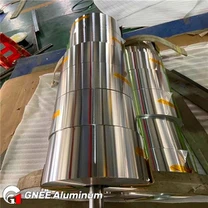
6061-T6 aluminum sheet metal is the workhorse heat-treatable product of the flat-rolled aluminium market. It combines a strength level close to mild steel at roughly one third of the density with good machinability, corrosion resistance and anodising response, and it is bought by the sheet rather than by the tonne by job shops, machine builders and transport fabricators. What follows is the specification data that determines whether a coil or cut sheet is accepted at goods-in.
Alloy Identification and Temper
6061 is a magnesium-silicon alloy of the 6XXX series; it gains strength from the precipitation of magnesium silicide during artificial ageing. The T6 temper means solution heat treated and then artificially aged, without the cold work or stress relief that distinguishes T651 plate. Sheet in T6 and T651 is supplied under ASTM B209/B209M in North American practice, while European purchase orders usually reference the EN 485 series with the equivalent designation EN AW-6061. Temper designations themselves are standardised in ANSI H35.1 and EN 515.
Registered Composition Limits
| Element | Limit (mass %) |
|---|---|
| Si | 0.40-0.80 |
| Mg | 0.80-1.20 |
| Cu | 0.15-0.40 |
| Cr | 0.04-0.35 |
| Fe | 0.70 max |
| Mn | 0.15 max |
| Zn | 0.25 max |
| Ti | 0.15 max |
| Others | Each 0.05 max, total 0.15 max |
| Al | Remainder |
Copper and chromium are the deliberate additions that separate 6061 from the lower-strength 6063 extrusion alloy; copper raises strength, chromium controls grain structure and limits the loss of toughness.
Mechanical and Physical Properties
| Property | 6061-T4 | 6061-T6 |
|---|---|---|
| Tensile strength, minimum per ASTM B209 | 205 MPa (30 ksi) | 290 MPa (42 ksi) |
| Yield strength, 0.2 % offset, minimum | 110 MPa (16 ksi) | 240 MPa (35 ksi) |
| Typical tensile strength, sheet | - | 310 MPa (45 ksi) |
| Typical yield strength, sheet | - | 276 MPa (40 ksi) |
| Hardness, typical | - | approx. 95 HB |
Physical data used in most design sheets are: density 2.70 g/cm3, elastic modulus 68.9 GPa, melting range 582-652 C, thermal conductivity about 167 W/(m K) at 25 C in the T6 temper, and a fatigue endurance limit of approximately 96.5 MPa at 5 x 10^8 cycles for T6 sheet. Minimum guaranteed values, not typical values, are what should be entered into a design calculation.
Thickness Range and Tolerances
Standard mill supply runs from 0.016 in (0.4 mm) through 0.250 in (6.35 mm) as sheet, above which the product is classified as plate. Thickness tolerance is not a single figure: in ASTM B209/B209M the permissible variation depends on the ordered thickness and on the slit width. Buyers specifying thin gauge for precision parts should state both the nominal thickness and the tolerance class, and should expect camber and flatness requirements to be quoted separately. Cut-to-length sheet is normally supplied with a squared shear edge and a thickness measured at a defined number of points across the width.
Fabrication: Bending, Machining and Welding
6061-T6 bends cleanly at 90 degrees with an inside radius of roughly two to four times the material thickness; tighter radii should be formed in the T4 temper and the part aged afterwards. The alloy machines well with carbide tooling at high cutting speeds and light feeds, and it is a common choice for jigs, fixtures and plate work. Welding is by MIG or TIG with ER4043 or ER5356 filler to AWS A5.10 and joint design follows the aluminium structural welding code AWS D1.2. The point that matters commercially is heat-affected-zone softening: the ageing precipitate dissolves in the weld zone and strength there may fall to roughly half of the T6 parent value, with only partial natural recovery over the following weeks. Where a weld must carry full load, thicker sections or a stiffened joint detail are used instead of relying on recovered properties.
Corrosion, Anodising and Typical Applications
Atmospheric and fresh-water corrosion resistance is good and the alloy is not normally susceptible to stress-corrosion cracking. Mildly alkaline or chloride-rich environments benefit from a clear chromate-free conversion coating, and anodic films applied to MIL-A-8625 Type II or Type III produce a hard, uniform surface that accepts dye well. Common applications are CNC machined components, tooling plates and fixtures, brackets, chassis and framing, truck and trailer bodies, electrical enclosures, heat sinks, marine hardware and general structural fabrication.
Frequently Asked Questions
Q: Can 6061-T6 aluminum be welded?
A: Yes, by MIG or TIG with ER4043 or ER5356 filler, but the heat-affected zone loses strength because the T6 ageing precipitate is dissolved by the weld thermal cycle. Allow for strength roughly half that of the parent metal in the softened zone.
Q: What is the minimum yield strength guaranteed for 6061-T6 sheet?
A: ASTM B209/B209M specifies a minimum 0.2 % offset yield strength of 240 MPa (35 ksi) and a minimum tensile strength of 290 MPa (42 ksi) for 6061-T6 sheet; typical mill values run higher.
Q: Is 6061-T6 the same as 6061-T651?
A: The alloy and ageing treatment are the same. T651 denotes product that has been stress relieved by stretching after solution treatment, which reduces distortion during machining of thick plate; T6 sheet is not stretched.
Q: How tight can 6061-T6 sheet be bent without cracking?
A: A practical minimum inside radius is about two to four times the thickness for a 90 degree bend. For tighter radii, form in the T4 temper and artificial age the part to T6 afterwards.
Q: Which thicknesses are supplied as sheet rather than plate?
A: Up to 0.250 in (6.35 mm) the product is normally classified and ordered as sheet; heavier material is plate, where thickness tolerances, flatness and directional properties change.
Q: Does 6061-T6 anodise well?
A: Yes. The alloy develops a uniform film suitable for clear or dyed finishes under MIL-A-8625 Type II and for hard anodic Type III coatings, provided the surface is properly degreased and the mill finish or machined surface is free from embedded iron contamination.