


Materials that can endure continuous exposure to saltwater, humidity, and the stresses of waves and impacts are necessary due to the harsh marine environment. Aluminum alloys are distinguished from other materials used in shipbuilding and marine applications by their exceptional workability, corrosion resistance, and strength-to-weight ratio. But not all aluminum alloys are made equal, and choosing the right one is essential for any marine project's performance, longevity, and safety. Three of the most widely used marine-grade aluminum alloys-5052, 5083, and 5086-are examined in this article along with a thorough comparison of their characteristics to help you select the best alloy for your requirements.
What is Marine Aluminium?
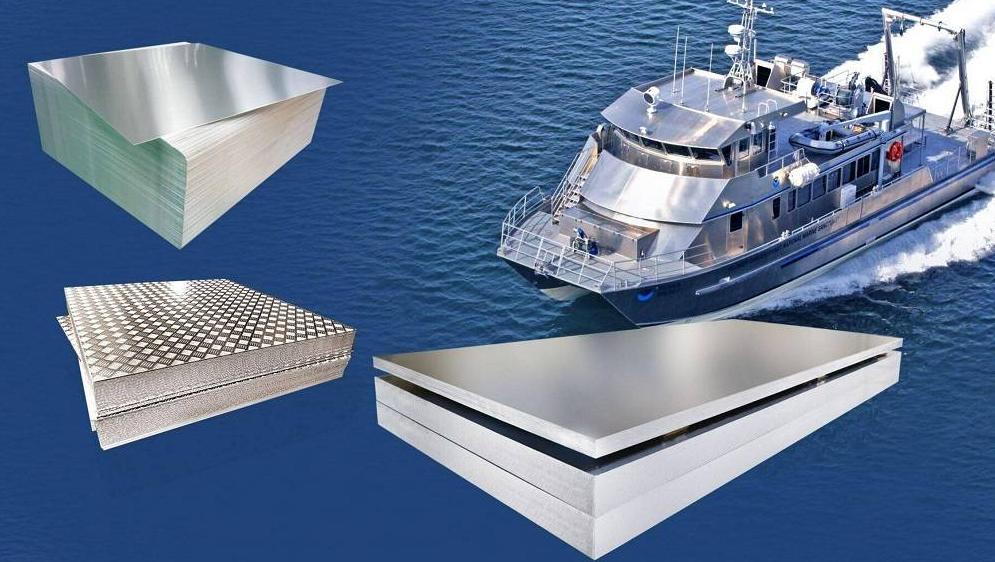
Specialized materials made to endure severe marine conditions are known as marine aluminum alloys. Because of their exceptional resistance to saltwater corrosion, high strength-to-weight ratio, and ease of fabrication, these alloys are frequently used in shipbuilding, offshore structures, and marine equipment.
The 5xxx series of aluminum, which is mostly alloyed with magnesium, is usually the aluminum that is used in marine applications. Magnesium greatly increases their strength and-more importantly-their ability to withstand pitting and crevice corrosion, which are frequent problems in maritime settings. Marine aluminum alloys create a protective oxide layer that prevents additional corrosion, in contrast to some other metals that can rust or deteriorate quickly in saltwater. In addition to being resistant to corrosion, marine aluminum alloys are lightweight, which makes them an energy-efficient material for building structures and vessels.
Differences of 5052 vs. 5083 vs. 5086 Aluminium
Although the three alloys (5052, 5083, and 5086) are all members of the 5xxx series of aluminum alloys and have exceptional corrosion resistance, their mechanical characteristics, chemical makeup, and, thus, suitability for different marine applications, vary. The main distinction is the quantity of magnesium and other trace elements in each alloy, which has a direct impact on its formability, strength, and weldability.
Core Properties Comparison
| Characteristic | 5052 Aluminum | 5083 Aluminum | 5086 Aluminum |
| Main Alloying | Mg (2.2-2.8%), Cr (0.1-0.35%) | Mg (4.0-4.9%), Mn (0.4-1.0%) | Mg (3.5-4.5%), Mn (0.2-0.7%) |
| Tensile Strength | 210-260 MPa | 300 MPa | 240 MPa |
| Yield Strength | 130 MPa | 145 MPa | 95 MPa |
| Elongation | 23% | 23% | 12% |
| Salt Spray Resistance | 5,000 hrs (no perforation) | 8,000 hrs (no perforation) | 6,000 hrs (no perforation) |
| Weldability | 0.85 (TIG) | 0.95 (MIG) | 0.90 (Laser) |
| Cold Workability | Good (Min bend R=1.5t) | Moderate (Min bend R=2.0t) | Excellent (Min bend R=1.2t) |
| Cost Index | 1.0 (Baseline) | 1.5-1.8 | 1.2-1.3 |
Important Distinctions
1. Hierarchy of Strengths
5083 is perfect for hull structures because it uses the Mg/Mn synergy to achieve a tensile strength of 300MPa.
5052 is appropriate for curved surfaces because it strikes a balance between strength and formability (2.8% Mg + Cr).
Compared to 5083, 5086 optimizes magnesium (3.5–4.5%) for superior cold-forming.
2. Mechanisms of Corrosion
The Mg-Mn oxide layer of 5083 exhibits self-healing characteristics (a corrosion rate of 0.002 mm/yr according to ISO 9227).
Although 5052 depends on Cr-enhanced passivation, tropical marine environments call for coatings.
5086 reduces micro-galvanic corrosion in ballast tanks by controlling the Si content (≤0.4%).
3. Performance of Welding
The base metal strength of 5083 with ER5183 filler is 95% (HAZ grain size 10-15μm).
ER4043 filler with rigorous heat input control (8–12 kJ/cm) is needed for 5052.
5086 is an excellent laser welder (6m/min speed for 6mm plate).
4. Uses in the Sea
5052: Porthole frames, fuel lines (ASTM B241), and superstructures (30% weight reduction).
5083: LNG tanks (impact toughness ≥27J at -165°C), primary hulls (DNV GL certified).
5086: Cold-formed ship gangways, desalination units (20000 ppm Cl⁻ resistance).
Choosing the Right Alloy for Your Project
A thorough assessment of the particular requirements of your project is necessary to choose the best marine aluminum alloy. Take into account the following elements when making your choice:
Strength Requirements: Of the three, 5083 offers the highest strength if your project involves high structural loads or the possibility of significant stress. 5052 is appropriate for applications requiring less strength, while 5086 offers a good balance for applications requiring moderate strength.
Corrosion Resistance: In marine environments, all three alloys provide exceptional corrosion resistance. However, because of its slightly higher magnesium content, 5083 is frequently chosen if your project calls for extremely harsh conditions or extended exposure to saltwater.
Weldability: When using standard welding methods like MIG and TIG, all three alloys show good weldability. However, depending on the alloy being used, particular welding techniques and filler alloys should be selected.
Formability: 5052 typically offers the best formability if your design calls for intricate shapes or extensive forming, followed by 5086. Because of its higher strength, 5083 is the least formable.
Cost: Because of its higher magnesium content and superior strength, 5052 is usually the most economical, followed by 5086. 5083 is usually the most costly.
| Aluminium sheet/Aluminium plate | |||||
| Aluminium Alloy | Thickness (mm) |
Width (mm) |
Length (mm) |
Temper | |
| A1050,A1060,A1070,A1100 | 0.1-500 | 100-4000 | 20-8000 | O,H12,H14,H16,H18,H22,H24,H26 | |
| A3003,A3004,A3105 | 0.1-200 | 100-4000 | 20-8000 | O,H12,H14,H16,H18,H22,H24,H26 | |
| A5052,A5005,A5083,A5754 | 0.1-200 | 100-4000 | 20-8000 | O,H12,H14,H34,H32,H36,H111,H112 | |
| A6061,A6082,A6063 | 0.1-200 | 100-4000 | 20-8000 | T4,T6,T651 | |
| A8011 | 0.1-200 | 100-4000 | 20-8000 | O,H12,H14,H16,H18,H22,H24,H26 | |
| Material process | CC AND DC | ||||
| Customerize size | Size can be produced as per clients requirement | ||||
| Surface | Mill finish ,Color coated(PVDF& PE),Stucco Embossed ,Bright Polish,Anodizing | ||||
| Mirror,Brush,Perforated,Tread plate ,Corrugated etc | |||||
| Quality Standard | ASTM B209,EN573-1 | ||||
| Payment Terms | TT OR LC OR DP at sight | ||||
| Delivery time | Within 25 days after receipt the lc or deposit | ||||
| Material Quality | Tension levelled ,flat ,Free of defects like oil stain,Roll Marks,Waves,Dents | ||||
| scratches etc ,A+++ quality, production process passed sgs and bv inspection | |||||
| Application | Construction ,Building,Decoration ,Curtain Wall ,Roofing,Mould,Lighting, | ||||
| curtain wall, ship building,Aircraft,Oil Tank ,Truck Body etc | |||||
| Packing | Standard export worthy wooden pallets and standard packing is about 2 tons/pallet |
||||
| Pallet weight also can be as per client's requirement | |||||


