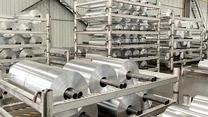
5052 aluminium tread plate is a rolled, anti-slip sheet produced from an aluminium-magnesium alloy with a raised pattern rolled into one or both faces. It is selected for walkways, platforms and vehicle floors where a durable, corrosion-resistant and low-maintenance surface is required. This guide summarises the available patterns, the specification range and the fabrication points that matter in service.
What Is 5052 Aluminum Tread Checker Plate?
The base material is alloy 5052, a non-heat-treatable Al-Mg alloy containing 2.2 to 2.8 percent magnesium. The pattern is rolled into the plate during rolling rather than welded or bonded, so the bars are integral with the sheet and cannot delaminate. The result is a lightweight panel combining moderate strength, high corrosion resistance and a slip-resistant walking surface.
Pattern Types Available
Five-bar pattern: the most common design, with five parallel bars per repeat; the pattern is directional and gives strong forward grip.
Diamond or pointer pattern: a single raised dash arranged in a diamond layout; lower profile and often chosen for decorative or light-duty surfaces.
Two-bar pattern: a simplified bar layout used for lighter duty flooring and lining panels.
Three-bar pattern: an intermediate design that offers a denser pattern with finer appearance.
Specification Range
| Item | Range |
|---|---|
| Alloy | 5052 |
| Temper | O, H22, H32, H114 |
| Thickness | 1.1 mm - 10.0 mm |
| Width | 600 mm - 1500 mm |
| Length | up to 11000 mm for sheet |
| Coil inner diameter | 508 mm |
| Pattern height | about 0.6 mm on lighter gauges, 0.8 mm and above on heavier gauges |
| Surface | mill finish, mirror finish, matte finish |
| Standard sizes | 1250 x 2500 mm, 1500 x 3000 mm, other sizes to order |
Corrosion and Mechanical Performance
The magnesium addition gives 5052 natural resistance to fresh water, seawater, salt spray and most industrial atmospheres, and the alloy performs well in the temperature range typical of vehicle floors, marine decks and process platforms. Because the pattern is rolled, the drainage paths between bars help shed water and reduce standing moisture. Load-bearing capacity depends on plate thickness, support spacing and bar height, so the walking surface should be calculated as a plate in bending rather than judged from the pattern alone.
Typical Applications
Ship decks, engine room floors and gangways where seawater exposure is continuous.
Truck and trailer floors, carriage linings and container interiors.
Work platforms, stair treads, foot pedals and access covers in plants.
Industrial flooring in food, chemical and packaging facilities requiring washable anti-slip surfaces.
Fabrication and Installation Notes
Forming: 5052 tread plate bends readily in O and H32 temper; bend radius should be generous enough to avoid pattern cracking at the bar edges.
Welding: use 5356 or 5554 filler wire. No post-weld heat treatment is required because the alloy is not heat-treatable.
Cutting: the pattern can be sheared on the flat side or cut by plasma or waterjet when openings are required.
Fixings: isolate aluminium from steel supports with an insulating barrier to prevent galvanic corrosion.
Surface protection: mill finish is normally sufficient; anodised or coated finishes extend appearance life in exposed architectural work.
Frequently Asked Questions
Q: Is 5052 tread plate suitable for outdoor decks?
Yes. The alloy resists salt spray and atmospheric corrosion, and the pattern provides grip on wet surfaces, which makes it suitable for marine decks and outdoor walkways.
Q: What does the H114 temper mean for tread plate?
H114 denotes a patterned product produced by rolling with a controlled strain-hardened condition. It is dimensionally stable and is one of the most common tempers supplied for tread plate.
Q: How much does the pattern increase slip resistance?
The raised bars create a mechanical grip that performs well when wet or lightly contaminated. Friction performance is normally verified by ramp friction testing rather than assumed from the pattern geometry.
Q: Can tread plate be bent over a tight radius?
Yes, but the radius must respect the plate thickness and temper. Annealed O temper tolerates the tightest radii, while H32 and H114 need a larger radius to avoid cracking at the bar roots.
Q: What is the maximum sheet length available?
Sheets are produced up to about 11000 mm in length and coils with a 508 mm inner diameter, with width normally between 600 mm and 1500 mm depending on the pattern.
Q: Does the pattern reduce the load capacity of the sheet?
The patterned surface does not weaken the base sheet, but the effective load capacity depends on the base thickness rather than the pattern height, so capacity should be calculated from the base gauge.