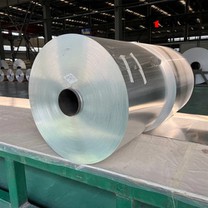
Why Aluminum-Plastic Panels Rely on 3004 Aluminum Foil
Aluminum-plastic composite panels, usually shortened to ACP, bond two thin aluminum skins to a polyethylene or mineral-filled core. Those skins are rolled from 3004 aluminum foil and are then coated, laminated and cut to size. 3004 is an aluminum-manganese alloy with magnesium as its second alloying element. It cannot be strengthened by heat treatment, so it gains strength only from cold rolling and is softened again by annealing. That behavior gives the alloy high plasticity, excellent formability, reliable weldability and corrosion resistance close to that of the 1xxx series, together with clearly higher strength than commercially pure aluminum.
Alloy Composition of 3004 Foil
The composition below follows the internationally recognized 3004 designation. Every heat is verified before rolling, and the finished coil is released only when the chemical analysis matches the order specification.
| Element | Content |
|---|---|
| Aluminum, Al | Balance |
| Manganese, Mn | 1.0 - 1.5 % |
| Magnesium, Mg | 0.8 - 1.3 % |
| Iron, Fe | ≤ 0.70 % |
| Silicon, Si | ≤ 0.30 % |
| Copper, Cu | ≤ 0.25 % |
| Zinc, Zn | ≤ 0.25 % |
| Other elements, each | ≤ 0.05 % |
| Other elements, total | ≤ 0.15 % |
Key Advantages for Composite Panel Skins
Good shape and flatness - the foil keeps a stable, even profile after light gauge rolling, so laminating lines run without waves or edge ripple.
Smooth, clean surface - low surface roughness gives a uniform base for chromate conversion coating and paint, and helps the adhesive wet out evenly against the core.
Very few pinholes - controlled melt cleanliness and roll conditions limit pinholes and inclusions, which matters for exterior facades exposed to driving rain.
Corrosion resistance - the dense natural oxide film protects the panel skin in outdoor, urban and coastal atmospheres.
Strength at thin gauges - higher strength than 1xxx foil allows thinner skins without losing stiffness or impact resistance.
Typical Specifications of 3004 Foil for ACP
| Parameter | Typical range |
|---|---|
| Alloy | 3004 |
| Temper | O, H14, H16, H18, H22, H24 |
| Thickness | 0.06 mm - 0.50 mm |
| Width | 100 mm - 1,600 mm |
| Coil inner diameter | 76 mm, 150 mm, 405 mm, 505 mm |
| Surface | mill finish, chromate conversion coating, coating base stock |
| Product standards | ASTM B209, EN 485-2, GB/T 3880.2 |
Production, Quality Control and Service Performance
Production starts with DC casting or continuous casting into slab, followed by hot rolling, several cold rolling passes, intermediate annealing and finish rolling to the ordered gauge. Slitting and edge trimming come next, then surface inspection and packing on seaworthy wooden pallets. Each coil is released only after checks of chemical composition, thickness profile, width tolerance, surface quality, pinhole density and mechanical properties. Thickness is measured continuously on the line, and samples are taken from the head, middle and tail of every coil so that the customer receives a uniform product from start to finish.
Where the foil ends up. In a completed ACP the foil works both as a decorative substrate and as a structural skin. Panels are used on building exterior walls and curtain walls, for renovating old facades, for interior wall and ceiling decoration, for advertising signs and display stands, and in clean-room and dust-control projects. Because a composite panel is made from a metal and a non-metal component, it keeps the useful properties of both: the rigidity, weather resistance and formability of aluminum, and the low weight, thermal insulation and impact damping of the polymer core. The 3004 skin carries the aluminum side of that partnership.
Frequently Asked Questions
Q: What thickness of 3004 foil is normally used for composite panel skins?
Skin thickness usually falls between 0.06 mm and 0.50 mm. Interior panels commonly use 0.10 mm to 0.21 mm, while exterior curtain wall panels are often built with 0.30 mm, 0.40 mm or 0.50 mm skins for better stiffness and wind load performance.
Q: Which temper should be ordered for ACP skins?
O, H14, H16, H18, H22 and H24 tempers are all supplied. H14 and H24 are the most common because they balance strength with the formability needed for bending, folding and roll forming of finished panels.
Q: How does 3004 compare with 3003 for composite panels?
Both are aluminum-manganese alloys with good corrosion resistance. 3004 also contains magnesium, which raises strength, so a thinner skin can deliver the same panel stiffness. 3003 remains a valid choice where lower strength is acceptable.
Q: Can the foil be supplied ready for coating?
Yes. Coils can be delivered with a mill finish, with a chromate conversion coating, or as coating base stock suitable for the polyester and fluorocarbon paint systems used on exterior panels.
Q: Why are pinholes controlled so strictly?
Pinholes create paths for moisture through a thin skin and can lead to blistering or corrosion along the bond line. Clean melt practice, filtration and careful roll gap control keep pinhole counts low.
Q: What width tolerances are achievable?
Slit coils are normally held within plus or minus 0.5 mm for widths up to 800 mm and within plus or minus 1.0 mm above that, with edge burr kept to a minimum so that laminating equipment runs without interruption.