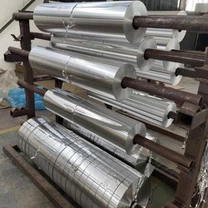
3003 H18 and EN AW-3003 aluminum are not directly comparable because they refer to different aspects of aluminum classification. 3003 H18 specifies both the alloy grade (3003) and the temper condition (H18) under ASTM standards. EN AW-3003 refers strictly to the alloy chemistry under European standards and does not indicate the hardness or temper. To make a fair and technically accurate comparison, you must compare 3003 H18 with EN AW-3003 H18.
When procurement managers source materials across international borders, confusion over naming conventions frequently causes supply chain disruptions. Receiving a technical drawing from Europe that specifies "EN AW-3003" while your North American supplier quotes "3003 H18" can lead to hesitation. Are they the same material? Can you substitute one for the other without causing a product failure?
This technical guide clarifies the fundamental difference between ASTM temper designations and European alloy standards. We will compare their chemical compositions and mechanical properties and highlight a real-world case study to show why specifying the temper is critical when buying aluminum internationally.
ASTM vs EN Designations
The root of the confusion lies in how different regulatory bodies structure their material designations.
What is 3003 H18 Aluminum?
This designation operates primarily under the American Society for Testing and Materials (ASTM), specifically ASTM B209 for sheet and plate.
3003 refers to the alloy chemistry (an Aluminum-Manganese alloy).
H18 refers to the temper. It explicitly states that the metal has been fully strain-hardened (cold-worked) to its maximum commercial hardness.
Therefore, "3003 H18" gives a manufacturer complete information about both what the metal is made of and how strong it is.
What is EN AW-3003 Aluminum?
This designation operates under the European Norm (EN) system.
EN AW stands for "European Norm Aluminum Wrought."
3003 refers to the exact same Aluminum-Manganese alloy chemistry as the ASTM standard.
However, it stops there. The designation "EN AW-3003" does not contain a temper. It tells you nothing about the material's yield strength, tensile strength, or hardness. It could be fully annealed and extremely soft, or it could be fully hard.

The Correct Way to Compare 3003 H18 Aluminum Coil
Because EN AW-3003 lacks a temper, comparing "3003 H18 vs. EN AW-3003" is like comparing a fully baked cake to a bag of flour. They are related, but not in the same state.
The correct, apples-to-apples comparison is:
ASTM 3003 H18 vs EN AW-3003 H18
Once you unify the temper (H18), you can accurately compare the material properties under the different international standards to verify if they are equivalent.
| Standard System | Regulatory Region | Equivalent Grade Designation |
| ASTM | United States / North America | 3003 H18 |
| EN | European Union | EN AW-3003 H18 |
| JIS | Japan | A3003 H18 |
| ISO | International | AlMn1Cu (H18) |
Chemical Composition Comparison
If a European technical drawing mandates EN AW-3003, will an ASTM 3003 material meet the chemical limit requirements? The table below confirms the strict alignment between the two major standards.
| Element | ASTM 3003 Limit (%) | EN AW-3003 Limit (%) | Conclusion |
| Manganese (Mn) | 1.0 – 1.5 | 1.0 – 1.5 | Identical core alloying element. |
| Copper (Cu) | 0.05 – 0.20 | 0.05 – 0.20 | Identical limits. |
| Iron (Fe) | 0.7 Max | 0.7 Max | Identical impurity control. |
| Silicon (Si) | 0.6 Max | 0.6 Max | Identical impurity control. |
| Zinc (Zn) | 0.10 Max | 0.10 Max | Identical impurity control. |
| Aluminum (Al) | Balance | Balance | Identical base metal. |
Data Analysis: The chemical composition limits are virtually identical. An EN AW-3003 aluminum sheet will react to atmospheric exposure, chemical contact, and welding heat exactly like an ASTM 3003 aluminum sheet.
Mechanical Properties Comparison of EN AW-3003 H18 Aluminum Sheet
The real test of global equivalency is mechanical performance. Assuming both materials are processed at the rolling mill to the H18 temper, do they behave the same way under structural load?
| Mechanical Property | ASTM 3003 H18 | EN AW-3003 H18 (Typical) |
| Tensile Strength (Rm) | 140 – 180 MPa | 140 – 180 MPa |
| Yield Strength (Rp0.2) | 120 – 150 MPa | 120 – 150 MPa |
| Hardness (Brinell, HB) | ~ 40 – 55 HB | ~ 40 – 55 HB |
| Elongation (A50mm) | ~ 1% – 4% | ~ 1% – 4% |
Data Analysis: The performance differences are statistically insignificant. The H18 physical state dictates the strength, not the regional standard prefix. Both materials will provide high surface hardness and rigidity, making them entirely equivalent for engineering and fabrication purposes.
Are you trying to convert a European Bill of Materials (BOM) into ASTM standards for local sourcing? A simple prefix error can cause an entire batch of material to be rejected by quality control. Contact our engineering team today for a free technical drawing review and certified material equivalent verification to ensure strict compliance with your project specifications.
What Does the H18 Temper Actually Mean?
To fully grasp why omitting the temper is dangerous, you must understand what H18 physically does to the EN AW-3003 base alloy.
The H18 designation means the aluminum has been completely strain-hardened. At the rolling mill, the aluminum is cold-rolled continuously to its maximum commercial reduction thickness without any heat treatment (annealing) to soften it. This mechanical process severely compresses the metal's internal grain structure.
This results in the highest possible yield strength and surface hardness for the 3003 alloy. However, this maximum strength comes with a major manufacturing limitation: almost zero ductility. 3003 H18 cannot be bent, folded, or deep-drawn without cracking. It must be used for flat, rigid applications.
Common Misconceptions in Global Aluminum Sourcing
To avoid similar supply chain disasters, procurement teams must abandon the following common myths.
| Common Myth | The Engineering Fact |
| EN AW-3003 is the same as 3003 H18. | False. EN AW-3003 only defines the chemistry. It could be H18, but it could also be H14 (half-hard) or O (fully soft). You must specify the temper. |
| European standards perform differently than ASTM. | False. When the temper (e.g., H18) is matched, EN AW-3003 H18 and ASTM 3003 H18 are metallurgically and mechanically equivalent. |
| I can ignore the temper if I just need "standard" metal. | False. There is no "standard" temper. Ignoring the temper means the supplier will guess, usually resulting in material that is too brittle to bend or too soft to hold a load. |
Industrial Applications for 3003 H18 Aluminum Plate and Foil
Whether purchased under ASTM or EN standards, the H18 temper of 3003 is strictly utilized in applications requiring high rigidity in thin gauges where no complex forming or deep drawing is required.
| Industry Sector | Typical Application | Why 3003 H18 is Required |
| Packaging | Bottle caps, ROPP closures, vial seals | High yield strength prevents crushing during the automated capping process. |
| Building Materials | Corrugated roofing sheets | High rigidity resists wind deflection and hail impacts on flat surfaces. |
| Insulation | Industrial pipe jacketing | Thin wraps that must maintain their protective shape against weather. |
| Electronics | Nameplates and dials | Flat stamped components requiring high surface hardness to prevent scratching. |
Procurement Advice: ASTM B209 vs EN 485 Tolerances
While the chemistry and mechanical properties match, procurement managers must be aware of documentation and tolerance differences when buying across borders.
Dimensional Tolerances: ASTM B209 (USA) and EN 485 (Europe) specify slightly different allowable variances for sheet thickness and flatness. Always verify that the supplier's cutting tolerances meet your specific factory machinery limits.
Certification Requirements: European projects often require compliance with EN 10204 3.1 for material traceability. American projects may rely strictly on standard ASTM Mill Test Certificates (MTC). Ensure your supplier can provide the documentation formatted to your local regulatory needs.

Your Certified Global Supplier for Dual-Standard Aluminum
Navigating international material designations should not delay your production schedule. You require a supply chain partner with deep metallurgical expertise who can seamlessly match regional specifications with physical inventory.
We operate as a high-capacity industrial aluminum supplier, providing materials that comply strictly with both ASTM B209 and EN 485 standards. Whether your engineering team specifies 3003 H18 aluminum sheet or EN AW-3003 H18 aluminum coil, we possess the massive inventory and precision manufacturing capabilities to fulfill your exact requirements.
Every shipment is accompanied by comprehensive Mill Test Certificates (including EN 10204 3.1) guaranteeing strict compliance with the requested international standard. We provide extensive custom processing, including precision coil slitting and cut-to-length sheet services, packaged securely for global export.
Ready to bridge the gap in your international supply chain and eliminate specification errors? We maintain a heavy stock of 3003 aluminum certified to both ASTM and EN standards, ready for immediate global shipment. Send us your required dimensions, tempers, and target destination today. Our dedicated export sales engineers will review your requirements and provide a transparent, factory-direct quotation within 24 hours. Contact us now to secure your material supply.