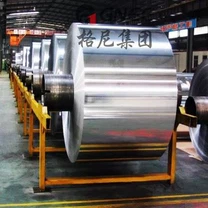
Aluminum 1100 is a commercially pure aluminum alloy with exceptional corrosion resistance and strong thermal conductivity.
Aluminum 1100 is a significant type of aluminum that has been widely employed in many industries due to its high purity, outstanding processing performance, broad variety of uses, and recyclability.
It is commonly used in applications requiring good formability and weldability, such as the fabrication of cooking utensils, heat exchangers, and chemical equipment. Aluminum 1100 is also widely utilized in the building industry for roofing, siding, and architectural purposes.
This alloy has high electrical conductivity and is commonly used in electrical and electronic components. It has lower strength than other aluminum alloys; however, it can be increased by cold working.
Overall, Aluminum 1100 is a flexible and widely utilized aluminum alloy that finds use in a variety of industries.
Aluminum 1100 and 6061 are two popular grades of aluminum alloy, each with unique qualities and applications.
Aluminum 1100 is a commercially pure aluminum alloy with a high aluminum content (at least 99.00%). It has great corrosion resistance, strong thermal and electrical conductivity, and outstanding formability.
Because of its softness and low strength, it is often utilized in applications requiring corrosion resistance, including as chemical and food processing equipment, refrigeration, and heat exchangers. It is also often employed in architectural and decorative settings.
Aluminum 6061 is an alloy made up of aluminium, magnesium, and silicon. It has outstanding mechanical qualities, such as high strength, machinability, and weldability. It also has good corrosion resistance, however not as much as aluminum 1100.
Aluminum 6061 is commonly utilized in structural applications, including aircraft, automotive parts, bicycle frames, and marine equipment.
Aluminum 6061 is also employed in the production of electronic components and heat sinks.
To summarize, aluminum 1100 is chosen primarily for its corrosion resistance and formability, whereas aluminum 6061 is chosen for its high strength and machinability. The decision between the two will be driven by the application's specific requirements.
The use of 1100 aluminium plates
Due to their outstanding corrosion resistance and exquisite surface quality, 1100 aluminum plates are frequently used as decorative and structural elements in the construction of exterior walls, roofs, doors, and windows.
Electronic industry: Because of its high electrical conductivity, 1100 aluminum plate is frequently utilized in the production of electronic components such as circuit boards and connections.
Packaging industry: Because of its excellent barrier capabilities and attractive look, 1100 aluminum plate is frequently used to make a variety of packaging containers and materials, including food packaging, pharmaceutical packaging, and more.
Automobile industry: 1100 aluminum plates may be used to make automobile parts such as hoods, doors, and so on, which improves the lightweight level of automobiles and has the effect of energy conservation and emission reduction.
Aerospace field: Because of its high purity and strength, 1100 aluminum plate is frequently used in aerospace manufacturing, such as airplanes.
6061 aluminum plate is a popular aluminum alloy material. It is mostly composed of aluminum (Al) and magnesium (Mg), with trace amounts of silicon (Si) and other elements.
This type of aluminium plate has medium strength, moderate plasticity and processing capabilities, and excellent corrosion resistance. It is commonly utilized in construction, transportation, equipment, electronics, and other industries.

The primary features of 6061 aluminum plate are:
Good processing performance: cutting, stamping, bending, and other processing operations are simple, and the product may be made in a variety of shapes and sizes.
Good corrosion resistance: It may be utilized in the natural environment and atmosphere without rusting or corrosion.
Excellent welding performance: It is easily welded, with high welding strength and plasticity.
Good ornamental properties: The surface is smooth and elegant, making it suitable for use as a decorative material.
| (Chemical Composition Limit Of 6061 Aluminum Alloys) | |||||||||||
| Alloy | Si | Fe | Cu | Mn | Mg | Cr | Zn | Ti | Others | Al | |
| 6061 | 0.4-0.8 | 0.7 | 0.15-0.4 | 0.15 | 0.8-1.20 | 0.04-0.35 | 0.25 | 0.15 | 0.05 | 0.15 | balance |
The major alloying constituents of 6061 aluminum alloy are magnesium and silicon, which have medium strength, strong corrosion resistance, weldability, and an excellent oxidation effect.
The 6-series alloy is mostly composed of magnesium-aluminum 6061-T651. It is a heat-treated and pre-stretched aluminum alloy product of superior quality.
Magnesium-aluminum 6061 has outstanding processing properties, including exceptional corrosion resistance, high toughness, and no deformation during processing. It has outstanding properties such as facile coloring film and a good oxidation effect.
6061-T651 is mostly utilized in industrial structural elements that require high strength and corrosion resistance, such as trucks, tower structures, ships, trams, and railway cars.