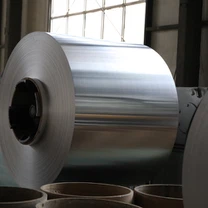
Definition and Positioning of 1050 Coil
1050 pure aluminium coil is a wrought, commercially pure aluminium product in coil form. The word pure is a commercial term, not an absolute: the standard guarantees a minimum aluminium content of 99.5%, with iron limited to 0.40% and silicon to 0.25%, and the remaining elements held to residual levels. Because the alloy contains no deliberate hardening additions, it cannot be strengthened by heat treatment and relies entirely on cold work for any increase in strength.
The coil format suits continuous processes: slitting, levelling, roll forming, stamping, deep drawing and coil coating. It is supplied with a defined inner diameter, coil weight and width so that it can be loaded directly onto a customer decoiler.
Chemical Composition of 1050 Aluminium
The table below states the limits that apply to 1050 under GB/T 3190 and EN 573-3. Composition is quoted in mass percent of the total, with aluminium reported as the minimum remainder.
| Element | Limit (mass %) |
|---|---|
| Aluminium (Al) | 99.50 minimum |
| Iron (Fe) | 0.40 maximum |
| Silicon (Si) | 0.25 maximum |
| Copper (Cu) | 0.05 maximum |
| Manganese (Mn) | 0.05 maximum |
| Magnesium (Mg) | 0.05 maximum |
| Zinc (Zn) | 0.05 maximum |
| Titanium (Ti) | 0.03 maximum |
Elements such as carbon, phosphorus, sulphur, nickel and chromium are not specified constituents of wrought aluminium alloys and have no place in a 1050 composition table; any table that lists them is describing a steel grade, not aluminium, and should not be used for purchasing or inspection.
Temper Range and Mechanical Behaviour
| Temper | Condition | Effect |
|---|---|---|
| O | Annealed | Maximum elongation and formability, minimum strength |
| H12 / H14 | Quarter hard | Useful combination of strength and ductility |
| H16 | Half hard | Stiffer coil for panels and profiles |
| H18 | Full hard | Maximum strength from cold work, limited ductility |
| H22 / H24 | Partially annealed | Strength of H1x tempers with better forming behaviour |
The general rule is that each step of cold reduction raises tensile strength and lowers elongation. Choosing a temper is therefore a trade between the stiffness required in the finished part and the deformation the coil must survive during forming. Where a part needs to be drawn deeply and then remain rigid, an H2x temper is usually a better starting point than an H1x temper of equal strength.
Physical and Functional Properties
Density: approximately 2.705 g/cm3.
Melting range: approximately 646 to 657 Celsius.
Electrical conductivity: about 61% IACS in the annealed condition, which is why the grade appears in busbars, cable sheathing and transformer components.
Thermal conductivity: about 231 W/(m.K) at room temperature, supporting heat exchangers, reflectors and cookware.
Reflectivity: high for both visible light and infrared radiation when the surface is polished or bright rolled.
Corrosion resistance: strong in rural, urban and many industrial atmospheres because of the natural oxide film; attacked by strong alkalis and by wet chlorides.
Solderability and brazability: good, since the thin oxide can be displaced by appropriate flux.
Processing the Coil
Deep drawing and spinning
O temper coil is the standard input for deep drawn and spun parts. Uniform elongation governs how deep a cup can be produced in a single draw, and a low-earing structure keeps the drawn rim level so that trimming scrap stays low.
Roll forming and bending
H14, H16 and H24 tempers are used for profiled and bent parts, with the bend radius set by the temper rather than by the gauge alone. Tight radii in hard tempers cause cracking on the outside of the bend.
Stamping and blanking
The alloy blanks and punches cleanly with sharp tooling. Because it is soft, it tends to build up on cutting edges unless tool geometry and lubrication are correct, and small burrs must be controlled if the blank will be anodised.
Joining
Gas tungsten arc and gas metal arc welding both work well, with 4043 or 1100 filler. Resistance welding is used on thin gauges. Note that welding anneals the heat-affected zone and removes any strength gained by cold work.
Surface finishing
1050 takes chemical brightening, anodising and polishing exceptionally well, which makes it a preferred substrate for reflectors, nameplates and decorative trim.
Applications
Roofing, gutters, flashings and general building sheet.
PS plate and lithographic substrates requiring a uniform, fine-grained surface.
Cable sheathing, busbars and electrical components.
Reflectors, lighting components and decorative trim.
Deep drawn holloware, cookware and packaging components.
Heat exchanger fins and thermal transfer parts.
Common Misconceptions
Pure aluminium coil cannot be strengthened. It cannot be strengthened by heat treatment, but cold work raises its strength substantially.
1050 is the same as 1060. 1060 guarantees 99.6% aluminium against 99.5% for 1050, and has tighter limits on residual elements.
Higher conductivity means better for every electrical part. Conductivity is high, but the low mechanical strength limits its use where the conductor must resist mechanical load.
Aluminium coil needs no special storage. Condensation between laps causes white rust, so coils should be stored dry, under cover and off the ground.
FAQ
Q: What does pure mean in 1050 pure aluminium coil?
It means a guaranteed minimum aluminium content of 99.5%, with the remaining 0.5% consisting of controlled iron, silicon and residual elements.
Q: What tempers are available for 1050 coil?
O, H12, H14, H16, H18, H22, H24 and H26 are standard, and other tempers can be produced to order.
Q: Is 1050 aluminium heat treatable?
No. It is a non-heat-treatable alloy and gains strength only through cold working.
Q: What is the electrical conductivity of 1050 aluminium?
About 61% IACS in the annealed condition, which is high for aluminium and makes the grade suitable for conductor and shielding applications.
Q: Why is 1050 used for reflectors?
Because it polishes to a high, uniform reflectivity and can be anodised or brightened without the alloying elements that would dull the surface.
Q: How should 1050 coil be stored before processing?
Horizontally on a dry support indoors, protected from condensation and from contact with steel or copper, with older stock consumed first.