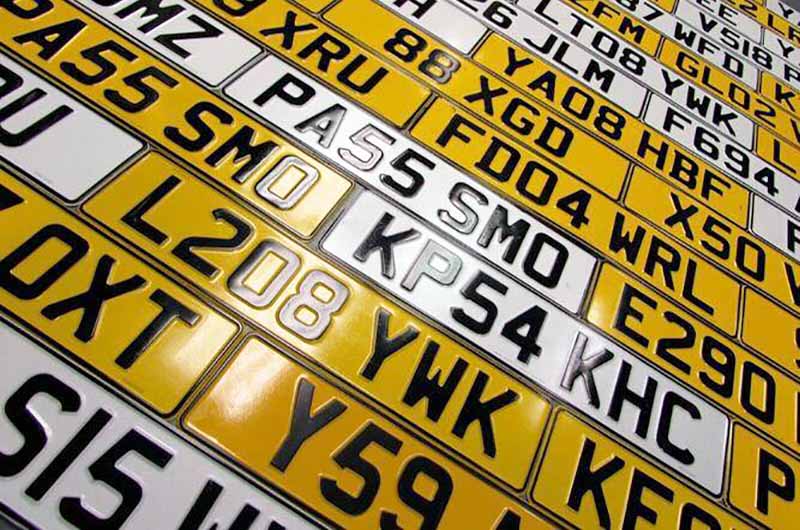
With the continuous growth of automobile ownership and the improvement of the market economy, various sectors of the automobile industry have developed rapidly. This trend has driven a steady increase in the demand for automobile license plates, especially those made from 1050 aluminum plates.
1050 aluminum plates are widely used in license plate manufacturing due to their stable properties and fixed height. As the market demand for automobiles and related products continues to rise, the demand for this material also grows.
The most important feature of using 1050 H12 aluminum plate for license plates is its durability and corrosion resistance. Aluminum panels, especially those made from alloys like 1050 H12, offer excellent service life even in harsh weather conditions. They are also lightweight, which makes them easy to handle during installation and reduces the load on the vehicle.
1050 H12 Aluminum Plate as License Plate Material
1. Is 1050 H12 Aluminum Plate Durable Enough for License Plates?
License plates are exposed to various environmental factors like rain, snow, and sunlight. Customers need the material to withstand these conditions without deteriorating quickly.
2. Does the 1050 H12 Aluminum Plate Comply with Regulatory Standards as a License Plate Material?
The reflectivity and visibility of the 1050 H12 aluminum plate meet the required standards, and the specific size requirements are customized to customer needs.
3. Can 1050 H12 Aluminum Plate for License Plates Be Customized?
Yes, it can be customized according to customer specifications such as size, shape, color, or design. 1050 H12 aluminum sheets can be easily customized through processes like printing, embossing, or coating.
4. Is It Cost-Effective to Use 1050 H12 Aluminum Plate for License Plates?
The prices are affordable, and there is a good balance of cost and quality, ensuring customer satisfaction.

Reasons for Choosing 1050 H12 Aluminum Plate as License Plate Material:
Corrosion Resistance: Aluminum, especially in alloys like 1050, offers excellent corrosion resistance, which is crucial for license plates exposed to various weather conditions.
Lightweight: Aluminum is much lighter than steel, making it ideal for license plates. This reduces the vehicle's weight and improves fuel efficiency.
Formability: The H12 temper indicates the aluminum is strain-hardened and partially annealed, making it relatively soft and easy to form. This is essential for stamping or embossing license plate numbers and letters.
Cost-Effectiveness: 1050 aluminum is one of the most affordable alloys, making it a cost-effective choice for large-scale license plate production.
Reflectivity: Aluminum can be polished to a high gloss, which is useful for making reflective license plates that enhance visibility in low-light conditions.
Recyclability: Aluminum is highly recyclable, making it an environmentally friendly choice for license plate materials.
Overall, 1050 H12 aluminum plate offers a balanced set of properties, making it an ideal material for license plates.
Specifications of 1050 H12 Aluminum Plate for License Plates:
Thickness: 0.1–500mm
Width: 20–2650mm
Length: 500–16000mm
Material Status: F, O, H12, H14, H16, H18, H19, H22, H24, H26, H28, H111, H112, H114
Application Fields: PS board base, signs, lamps, battery soft connections, etc.
Performance Characteristics: This material boasts mature processing technology, excellent formability, high corrosion resistance, good electrical and thermal conductivity, long service life, low cost, and high recycling value.
License Plate Material: 1050 H12 Aluminum Plate Coil
Processing Technology for License Plate Material 1050 H12 Aluminum Plate Coil:
Uncoiling: Unwind the raw aluminum coil to prepare it for the next processing stage.
Feeding: Feed the aluminum coils into processing machines for further steps.
Tensioning: Tension the aluminum coil to prevent slack or wrinkles during processing.
Degreasing: Remove oil stains and impurities from the surface to facilitate the next steps.
Rinsing: Clean the aluminum coil with water to remove contaminants.
Polishing: Polish the surface for a smooth finish and increased gloss.
Oxidation: Oxidize the aluminum coil to create an oxide film, enhancing corrosion resistance and appearance.
Conductivity: Apply a conductive layer to improve the aluminum's conductivity.
Sealing: Seal the aluminum coil to improve corrosion resistance and surface hardness.
Drying: Dry the treated aluminum to remove moisture.
Cutting: Cut the coil to the required customer size.
Straightening: Straighten the aluminum to ensure flatness and proper shape.
Coiling: Recoil the processed aluminum for storage or transportation.
These steps ensure that the 1050 H12 aluminum coils meet customer specifications with excellent quality and performance.
GNEE Aluminum's High-Quality License Plate Materials
GNEE Aluminum offers high-quality 1050 pure aluminum sheets for vehicle license plates, ensuring precise thickness and consistent quality. The thickness of our license plate materials is typically over 1.0 mm and is available in both roll and sheet forms. The 1050 aluminum plates are processed using deep drawing techniques to maintain consistent thickness, ensuring excellent quality. After oxidation treatment, the material's corrosion resistance, wear resistance, and aesthetic qualities are further enhanced.
Compared to natural aluminum oxide, the processed oxide film offers clear advantages in terms of durability and performance.